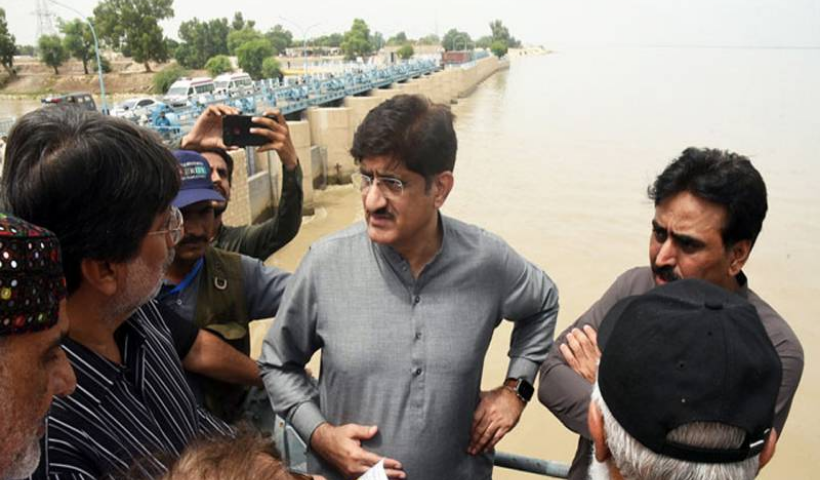
Sukkur, September 14, 2025: Sindh Chief Minister Syed Murad Ali Shah on Sunday said the provincial government is fully prepared to manage the ongoing flood situation, with the protection of barrages declared its top priority.
Speaking to the media during his visit to Guddu Barrage, the chief minister said Pakistan People’s Party (PPP) Chairman Bilawal Bhutto Zardari had already inspected both Guddu and Sukkur barrages to review arrangements. He thanked Prime Minister Shahbaz Sharif for declaring agricultural and climate emergencies through the federal cabinet, adding that swift financial assistance to affected families must be ensured via the Benazir Income Support Programme.
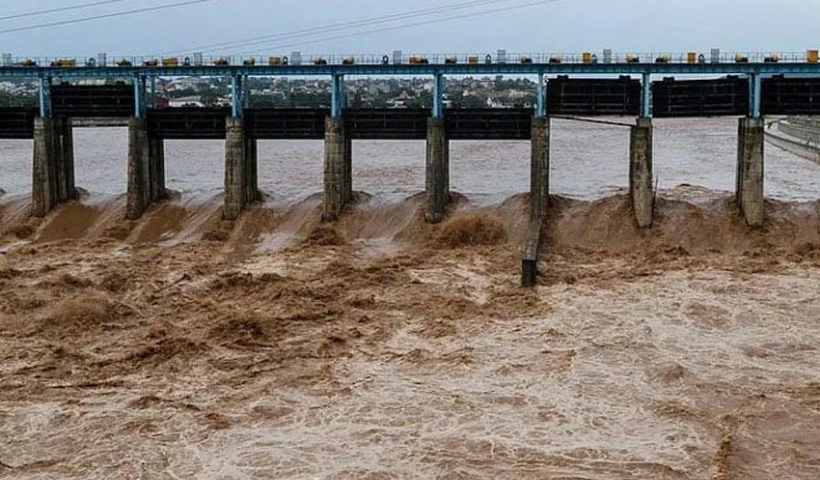
Shah reported that inflows at Guddu Barrage had reached 627,908 cusecs — a high-level flood against its designed capacity of 1.1 million cusecs — with projections of 650,000–700,000 cusecs likely to pass through Sukkur Barrage in the coming days. He said embankments between Guddu and Sukkur had been reinforced and that around 30,000 people had been shifted to safer areas in Kashmore district. Medical facilities in Kashmore and Ghotki remain operational, while no displaced families are currently staying in camps, he added.
Briefings given to the chief minister by Irrigation Minister Jam Khan Shoro and Irrigation Secretary Zarif Khehro identified Tori Bund and K.K. Bund as vulnerable points, with emergency flood-fighting work ongoing at the 18th mile of K.K. Bund. Shah directed that surveillance at weak spots be further strengthened, flood staff remain on duty round the clock, and district administrations expedite relief efforts in coordination with local communities.
He said machinery, lanchas, and equipment have been deployed across embankments, with the Sindh Barrages Improvement Project (SBIP) underway with World Bank support. The SBIP includes replacement of gates, gearing systems, and restoration of river training works to improve flood resilience.
“The people of Sindh are facing recurring disasters due to climate change,” Shah said. “We must act collectively and urgently to protect lives and livelihoods.” He assured the public that their safety would be ensured at all costs, praising the resilience of farmers and laborers in confronting the crisis.
According to the National Disaster Management Authority (NDMA), Guddu Barrage is under a high-flood situation, while Sukkur Barrage is witnessing medium-to-high flows. Kotri Barrage downstream also remains under close watch. Authorities have evacuated more than 100,000 people from vulnerable katcha (riverine) areas, with Pakistan Army personnel deployed for embankment reinforcement and medical support.
Since late June, Pakistan has recorded over 930 deaths and damage to more than 8,200 homes due to heavy monsoon rains and flash floods, according to UN and ReliefWeb updates. Sindh is among the worst-hit provinces, with humanitarian agencies warning that up to 1.6 million people could be exposed to floodwaters in coming days if river flows rise further. More than 1,600 villages remain at risk of partial inundation.
The United Nations has released $5 million in emergency assistance for Pakistan’s flood response, while cautioning that additional heavy rains could worsen the crisis.