United Nations, September 25, 2025: Prime Minister Shehbaz Sharif on Thursday urged the global community to fulfil its commitments on climate finance, warning that debt-driven funding cannot address the catastrophic impacts of climate change faced by vulnerable countries like Pakistan.
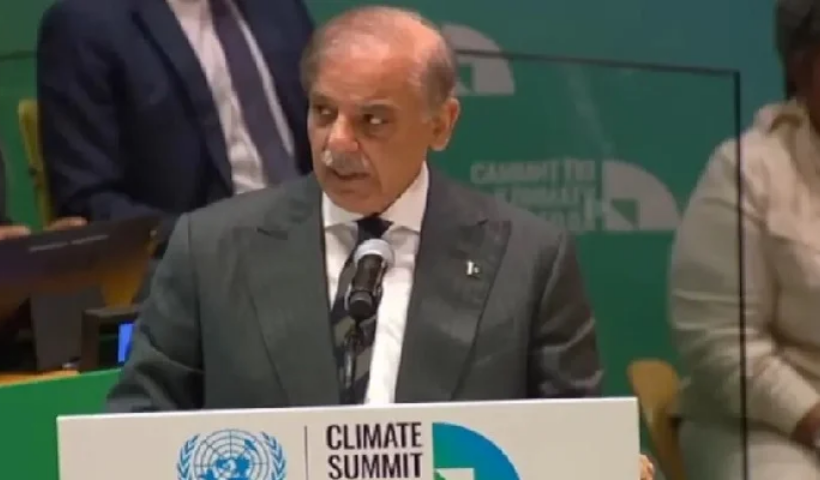
“Loans over loans, adding to loans is not a solution,” the prime minister said while addressing the Special Climate Event convened by UN Secretary-General António Guterres and the President of Brazil, host of COP30. The session provided member states an opportunity to present new Nationally Determined Contributions (NDCs) with 2035 targets.
Sharif reminded delegates that Pakistan was still grappling with the aftermath of the 2022 floods, which caused more than $30 billion in losses and displaced millions. “This year, intense monsoon rains, cloudbursts, flash floods and devastating urban flooding have impacted more than five million people, destroyed 4,100 villages, and claimed over 1,000 precious lives,” he said.
Despite contributing minimally to global greenhouse gas emissions, the prime minister stressed, “We bear impacts far beyond our share.” He reaffirmed Pakistan’s commitment to climate goals, noting that the country had already achieved its unconditional target of reducing emissions by 15% by 2030, with renewables now providing over 32% of the national power mix and solar energy growing sevenfold since 2021.
Sharif outlined further plans, including raising the share of renewables and hydropower to 62% by 2035, expanding nuclear capacity by 1,200 megawatts by 2030, shifting 30% of transport to clean mobility, installing 3,000 charging stations nationwide, scaling up climate-smart agriculture, securing water resources, and advancing the plantation of one billion trees.
However, he cautioned that Pakistan’s national adaptation plan remains severely constrained by inadequate international climate finance.
Earlier, UN Secretary-General António Guterres told the gathering it was still possible to limit global temperature rise to 1.5°C by the end of the century. He said clean energy was not only driving jobs, growth and sustainable development, but also generating the fastest and cheapest electricity while shielding economies from fossil fuel volatility.
“The bottom line: clean is competitive, and climate action is imperative,” Guterres said. He urged countries to bring forward ambitious new 2035 plans, stressing that COP30 in Brazil must deliver a credible global response plan.
The UN chief also called for mobilising $1.3 trillion annually in climate finance by 2035, as agreed at COP29 in Baku, with clear funding sources, accessible mechanisms, and accountability measures. He underlined that developing countries, least responsible for the crisis, were suffering the most and called for effective debt relief and innovative financing tools such as debt swaps and disaster pause clauses.