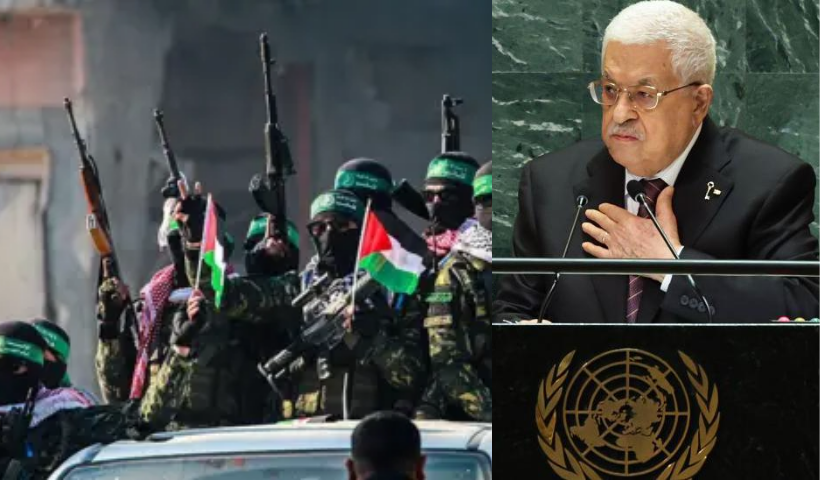
United Nations, September 26, 2025: The future of Gaza dominated discussions at the United Nations General Assembly (UNGA) on Thursday, as Palestinian Authority (PA) President Mahmoud Abbas accused Israel of pursuing a “war of genocide” while calling for the disarmament of Hamas.
Abbas, who was permitted to address the Assembly remotely after member states voted 145-5 to bypass U.S. visa restrictions on more than 80 Palestinian delegates, declared that Hamas would have no role in governing Gaza after the war — a stance aligned with Israel and Washington. The PA currently administers parts of the West Bank but does not control Gaza.
Hamas swiftly rejected the remarks, insisting that “the resistance’s weapons cannot be touched as long as the occupation remains on our land.”
Turning to Israel’s settlement policy, Abbas condemned Prime Minister Benjamin Netanyahu’s vision of a “greater Israel,” warning that the planned E1 settlement project would split the West Bank in two, isolate occupied Jerusalem, and dismantle prospects for a two-state solution “in blatant violation of international law and Security Council resolutions.”
In a major development, Saudi Arabia announced a $90 million pledge to the PA as part of a new regional funding alliance, with Arab states signaling stronger support for Abbas’ administration as the legitimate authority in both Gaza and the West Bank. Diplomats noted that the move reflects growing momentum at the UN, where more than 150 countries now recognise Palestinian statehood.
Alongside the Palestinian interventions, Turkish President Recep Tayyip Erdoğan said after talks with U.S. President Donald Trump that they had reached an “understanding” on advancing a ceasefire and lasting peace. Erdoğan reiterated his stance that Hamas is a resistance movement and accused Israel of genocide in Gaza. Washington also unveiled a strategic nuclear energy partnership with Turkey and announced an agreement to reopen Iraq’s Kurdish oil pipeline to Ankara.
Meanwhile, European positions shifted significantly. Italian Prime Minister Giorgia Meloni — previously one of Israel’s strongest backers in the EU — joined calls for sanctions against Tel Aviv, citing the UN Commission of Inquiry’s finding that Israel is committing genocide in Gaza. Meloni urged coordinated European action, signaling an unprecedented hardening of the EU’s stance.
The move comes as Israel’s far-right ministers push for West Bank annexation in response to rising global recognition of Palestine — a step the United States has explicitly warned against.
All eyes are now on Netanyahu, who is due to address the UNGA on Friday amid intensifying calls for sanctions, deepening isolation over settlement policies, and international momentum for Palestinian statehood. He is expected to strongly oppose the two-state solution while facing pressure from Washington to avoid further escalation.