Islamabad, October 17, 2025: Pakistan and Afghanistan are engaged in constructive dialogue aimed at peacefully resolving recent border tensions, the Foreign Office (FO) said on Friday.
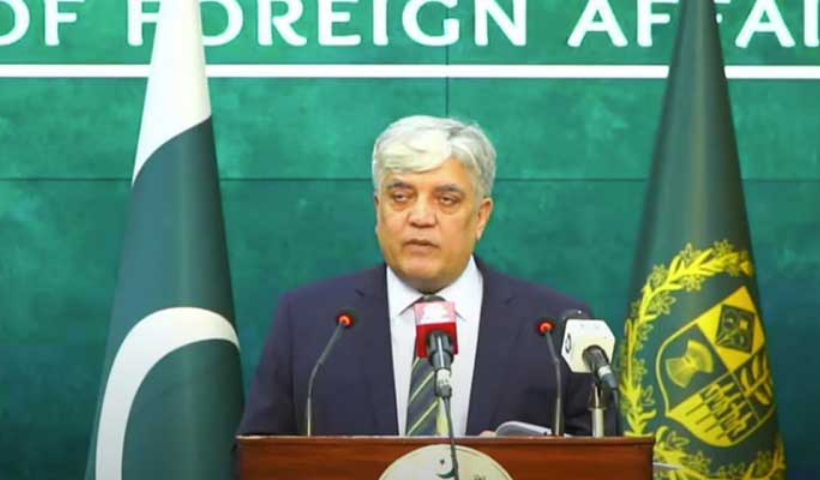
Addressing the weekly media briefing, FO spokesperson Shafqat Ali Khan said Pakistan had repeatedly informed Kabul about the presence of Fitna al-Khawarij—a term referring to terrorist elements—operating from within Afghanistan.
He expressed concern over the Taliban’s “provocative attacks” along the border between October 11 and 15, which Pakistan repelled “in self-defence.”
“Our retaliatory action was directed against terrorist elements, not civilians,” the spokesperson emphasised, adding that a 48-hour ceasefire was enforced from 6pm on October 15 at the Taliban’s request.
Khan said both countries were in active communication to prevent further escalation. “Pakistan expects the Taliban government to take concrete action against terrorist groups and ensure that Afghan soil is not used for terrorism,” he said.
He reaffirmed that Pakistan respects Afghanistan’s sovereignty and seeks dialogue and cooperation to address shared security challenges.
“The recent contacts between the two countries reflect mutual trust and understanding,” he added, commending Saudi Arabia’s diplomatic efforts to promote regional stability.
When asked about ceasefire violations, the spokesperson referred reporters to the Inter-Services Public Relations (ISPR) for operational details, clarifying that the truce was arranged through direct bilateral channels and initiated by the Taliban.
Rejecting Kabul’s claim that Pakistan had requested the ceasefire, he termed it “incorrect.”
Khan also clarified that Pakistan’s policy toward Afghanistan remains unchanged, though “the articulation of its position has evolved slightly.”
The FO spokesperson reaffirmed that Pakistan’s policy is based on diplomacy, stability, and peaceful coexistence. He noted that Pakistan has hosted over four million Afghan refugees for more than four decades and will continue to regulate the presence of foreigners in accordance with international norms and domestic laws.
“Pakistan wishes to see a peaceful, stable, and prosperous Afghanistan,” he said, expressing hope that Afghans would one day live under a representative and inclusive government.
Khan voiced Pakistan’s strong reservations over the recent joint India-Afghanistan statement, calling its references to Jammu and Kashmir a “clear violation” of UN resolutions and international law.
He also rejected remarks by the Afghan acting foreign minister, who had claimed that terrorism was Pakistan’s internal issue. “We have already shared detailed information on terrorist groups operating from Afghan territory,” Khan said.
“Afghanistan cannot absolve itself of the responsibility to prevent its soil from being used for terrorism. Peace and stability are shared responsibilities,” he asserted.
The spokesperson further accused India of supporting terrorist networks active in Pakistan and Afghanistan, saying New Delhi’s “destabilising role” undermines regional peace.
“India has no right to level accusations against others,” he said. “Its claims about respecting Afghanistan’s sovereignty contradict its actions.”
He added that the international community is “well aware” of India’s involvement in sponsoring militant groups across the region.
Khan underscored that non-interference in the internal affairs of sovereign states remains a cornerstone of Pakistan’s foreign policy.
“Pakistan does not require external advice or intervention in its domestic matters,” he said, adding that engagement with the Taliban government in Kabul continues.
“Diplomatic relations do not mean Pakistan cannot interact with other Afghan stakeholders,” he clarified, reiterating that the Afghan people alone have the right to determine their political direction.
Responding to reports of violence and desecration in Afghan territory, the FO spokesperson termed them “inhumane and unacceptable,” urging Afghan authorities to hold perpetrators accountable.
He said Pakistan’s security forces conduct “targeted and intelligence-based operations” in border areas to protect citizens.
“Pakistan will continue to defend its people against groups like the Fitna al-Khawarij and the TTP,” he stressed, adding that any speculation about future operations would be “inappropriate.”
Khan confirmed that trade activities along the border remain suspended due to heightened tensions and exchange of fire in recent days.
Concluding his remarks, he stated that the Pakistan-Afghanistan border situation is a bilateral matter, which Pakistan is “fully capable of managing and resolving on its own.”