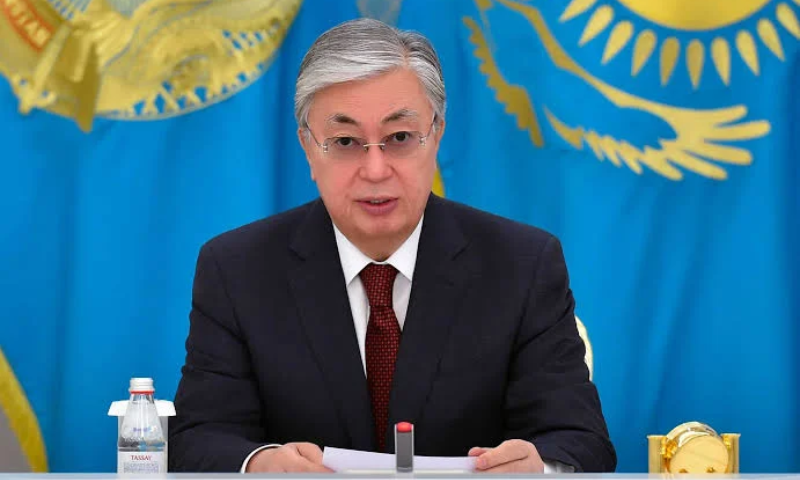
Astana, January 5,2026: President of Kazakhstan Kassym-Jomart Tokayev has said that 2026 will be a decisive year for the country’s modernization, as Kazakhstan enters a new phase marked by irreversible reforms, economic resilience and accelerated digital transformation.
Outlining the key outcomes of 2025 and priorities for the year ahead, President Tokayev said Kazakhstan’s economy grew by more than six percent last year, with gross domestic product surpassing $300 billion and per capita GDP exceeding $15,000. While welcoming these achievements, he cautioned against complacency.
“There are grounds for satisfaction, but I constantly urge all civil servants not to relax. We must work hard and move forward, especially since many unresolved issues remain,” he said.
Among the key challenges, the president identified inflation as a persistent issue that continues to erode household incomes, stressing that both the government and regional authorities must strengthen the country’s socio-economic framework.
Tokayev said Kazakhstan has taken a major step forward on the path of modernization and has become a more developed and stable state, with society increasingly recognizing the importance of large-scale reforms for the well-being of future generations.
Addressing concerns over the proposed new Tax Code, the president described tax reform as a structural reset rather than a short-term fiscal measure. He noted that similar reforms are underway globally and recalled that earlier proposals to raise value-added tax to 20 percent were reduced on his directive.
“The new Tax Code is intended to shift the emphasis from control to partnership, where the state, business and citizens fulfill their obligations in good faith,” Tokayev said, adding that taxes should be seen as an instrument of fair redistribution rather than a burden. He emphasized that public trust, tax literacy and civic responsibility are essential for an effective fiscal system and for curbing corruption.
Highlighting digitalization and artificial intelligence as matters of national survival, Tokayev said Kazakhstan must keep pace with rapid global technological change. He pointed to the growth of Astana Hub, which now hosts around 2,000 companies, and noted that IT exports reached approximately $1 billion in 2025. He also cited initiatives such as CryptoCity, the development of Alatau City and expanded state data systems.
Tokayev said the government has already laid the institutional groundwork through the establishment of the Ministry of Artificial Intelligence and Digital Development, adoption of the Law on Artificial Intelligence, and the launch of national supercomputers Alem.Cloud and Al-Farabium.
“With the emergence of artificial intelligence, a watershed has formed between countries that move into the future and those that remain in the past. This year will be decisive,” he said.
The president also underscored the strategic importance of nuclear energy, calling the construction of nuclear power plants both a correction of historical imbalance and a matter of national prestige. He said nuclear development would help train a new generation of technical professionals and support Kazakhstan’s transition to a new technological model.
Tokayev further highlighted rising global demand for rare earth metals as a major opportunity for Kazakhstan, noting expanding cooperation with the United States, China, Russia, Japan, South Korea and the European Union.
On asset recovery and anti-corruption efforts, the president said investigations linked to the January 2022 events were conducted transparently and in cooperation with civil society. He rejected claims that asset recovery efforts had slowed, citing the recovery of more than 1.3 trillion tenge (about $2.7 billion), with over 1 trillion tenge transferred to the state budget to fund social and infrastructure projects.
“Restoring social justice through the recovery of illegally acquired assets is a principled position of the state,” Tokayev said, reiterating that the fight against corruption remains a top priority.
The remarks were published in Turkistan, one of Kazakhstan’s most influential newspapers, which has been in circulation for over three decades and is known for its coverage of national developments and Turkic-related themes.