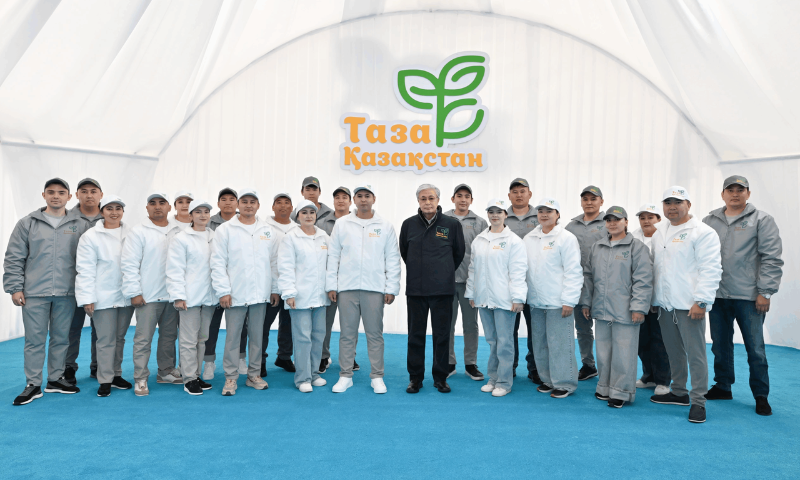
Astana, January 15, 2026: Launched at the initiative of President Kassym-Jomart Tokayev, the large-scale national environmental campaign Taza Kazakhstan has evolved into one of the country’s most significant social movements, uniting millions of citizens around the shared goals of environmental protection, civic responsibility, and sustainable development.
According to the Prime Minister’s press service, more than 10.4 million people across Kazakhstan have participated in the initiative since its launch. Citizens, businesses, educational institutions, and government bodies have actively taken part in clean-up drives, tree plantation campaigns, and environmental awareness activities, reflecting the growing integration of ecological responsibility into public life.
The movement is closely aligned with the priorities outlined in the President’s 2024 state-of-the-nation address. In October 2024, the government approved the Taza Kazakhstan Concept for the Development of Environmental Culture for 2024–2029, a strategic framework that defines state priorities for promoting ecological values and outlines concrete measures to support sustainable development.
Minister of Ecology and Natural Resources Yerlan Nyssanbayev said the concept focuses on building environmental awareness, encouraging responsible lifestyles, strengthening ecological education, and ensuring broad public awareness of environmental challenges. A comprehensive action plan includes landscaping initiatives, eco-volunteer programs, environmental competitions, and region-specific projects tailored to local needs.
Since the beginning of this year alone, more than 767 environmental events have been organized nationwide. These include campaigns such as Taza kasip – taza aimak (Clean production for a clean region), Kieli meken (protection of natural and sacred sites), Taza olke (general territory cleaning), and Moldir bulak (preservation of springs and reservoirs). The initiatives have mobilized hundreds of thousands of participants and strengthened cooperation among government institutions, businesses, students, and volunteers.
Official figures show that since the launch of Taza Kazakhstan, over 1.6 million tons of waste have been collected and 859,000 hectares of land cleaned, with approximately 586,000 volunteers contributing to these efforts.
Waste management remains a key pillar of the campaign. Kazakhstan generates more than 4.5 million tons of municipal waste annually, while the recycling rate stood at 25.8 percent in 2024. To improve recycling, eco-boxes and reverse vending machines have been installed in major cities including Astana, Almaty, Aktobe, and Ust-Kamenogorsk, encouraging citizens to return plastic and aluminum in exchange for bonuses.
A pilot project has also been launched in schools to promote waste segregation. By the end of August, more than 1,000 eco-boxes for separate waste collection are expected to be installed in 129 schools in Astana and Zhezkazgan. Nyssanbayev said such initiatives not only reduce landfill pressure but also instill environmental responsibility in younger generations.
Reforestation and land restoration are also central to the initiative. More than 1.3 billion seedlings have been planted nationwide, including 48.7 million saxaul trees on the dried bed of the Aral Sea. A new forest nursery in Kazalinsk, with an annual capacity of three million seedlings, has been launched, while additional projects are underway to rehabilitate degraded lands.
Digital tools are being used to enhance transparency and public participation. Since 2024, citizens have been able to report local environmental issues through the @TazaQazBot Telegram bot. Since the beginning of this year, the platform has received 16,500 complaints, with over 15,000 successfully resolved—most related to waste removal, street cleaning, and landscaping.
Minister Nyssanbayev said the Taza Kazakhstan initiative demonstrates how strong state support combined with active civic engagement can deliver measurable results. He added that the campaign is not only about cleaning public spaces, but about shaping new social ethics and fostering a nationwide culture of environmental responsibility.