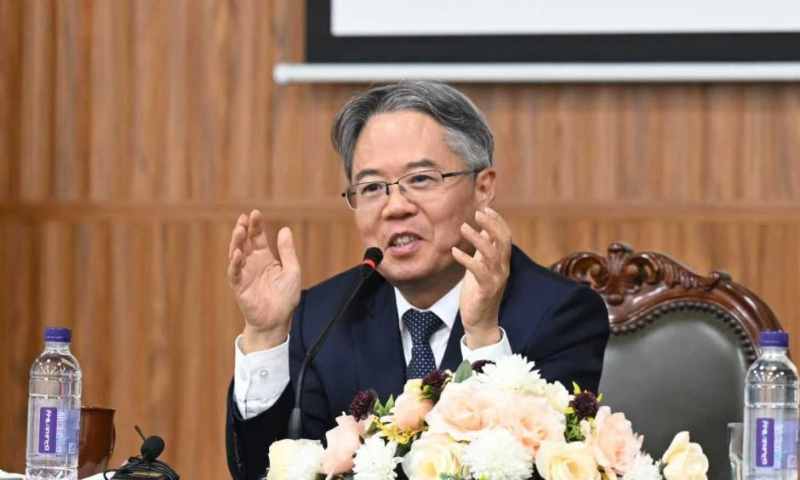
Islamabad, February 4, 2026: The Chinese Embassy in Pakistan, in collaboration with the National University of Sciences and Technology (NUST), on Wednesday organized a seminar titled “SCO and the Global Governance Initiative,” featuring a keynote address by Chinese Ambassador to Pakistan Jiang Zaidong.
Addressing academics, students, and diplomats at NUST, Ambassador Jiang said it was a pleasure to return to the university for the third time, describing the visit as “coming home.” He thanked Rector Lt Gen (R) Javed Mahmood Bukhari (represented by Rector Latif) for the invitation and appreciated Professor Ashfaque and his team for organizing the seminar. Extending greetings ahead of the Chinese Spring Festival, the ambassador wished participants an auspicious Year of the Horse marked by happiness, good health, and success.
Highlighting the evolving global situation, Ambassador Jiang said the international landscape is undergoing profound transformation amid turbulence and growing global challenges. He noted that the seminar provided a timely opportunity to reflect on the outcomes of the Shanghai Cooperation Organization (SCO) Tianjin Summit held last September and assess their relevance in the current context.
The ambassador emphasized that addressing global uncertainty requires adherence to the “Shanghai Spirit,” which is based on mutual trust, mutual benefit, equality, consultation, respect for diverse civilizations, and common development. He said that in the face of hegemony, protectionism, and zero-sum politics, division and confrontation offer no solutions.
Over the past 24 years, he noted, the SCO has forged a successful path as a new type of international organization by promoting dialogue, sovereign equality, openness, and mutually beneficial cooperation, while opposing coercion and power politics.
Ambassador Jiang said the current global governance system suffers from insufficient representation, weakened authority, and limited effectiveness. He highlighted President Xi Jinping’s Global Governance Initiative, which advocates sovereign equality, adherence to international law, multilateralism, a people-centered approach, and practical action.
He explained that the initiative, together with the Global Development Initiative, Global Security Initiative, and Global Civilization Initiative, forms an integrated framework aimed at promoting development-driven prosperity, security-based stability, civilizational mutual trust, and governance-based justice.
Calling the SCO the largest regional organization representing nearly half of the world’s population, Ambassador Jiang said it reflects the collective rise of the Global South. He stressed that China and Pakistan, as all-weather strategic cooperative partners and key SCO members, play a crucial role in promoting regional peace, stability, and multilateralism.
He outlined three priority areas for China-Pakistan cooperation within the SCO framework. These include strengthening bilateral trust and people-centered development through enhanced exchanges and livelihood projects; advancing multilateral cooperation in security, economic integration, digital economy, and artificial intelligence; and jointly safeguarding the interests of developing countries in global governance, climate action, and emerging technologies.
Reaffirming China’s commitment to working closely with Pakistan, Ambassador Jiang said both countries would continue to uphold the UN-centered international system, oppose fascism and militarism, support free trade, and promote an equal and orderly multipolar world.
Concluding his address, the ambassador urged participants to draw inspiration from the “Shanghai Spirit” and take the Global Governance Initiative as a roadmap for building a community with a shared future for humanity. He wished the seminar success and expressed hope for lasting prosperity and the continuation of the ironclad China-Pakistan friendship.