Dhaka, February 12, 2026: Early results from Bangladesh’s pivotal national election show the Bangladesh Nationalist Party (BNP) ahead of rival Jamaat-i-Islami, as tens of millions of voters cast ballots in a landmark vote following the 2024 Gen Z-led uprising that toppled long-time premier Sheikh Hasina.
With counting starting at 4:30pm local time, BNP was leading in 50 seats while Jamaat held 18, according to local news outlets. Bangladesh’s 300-seat parliament requires 151 seats for a majority. BNP chief and prime ministerial candidate Tarique Rahman reportedly won one of two constituencies he contested, although official results are yet to be confirmed. Party supporters celebrated outside the BNP headquarters in Dhaka, according to visuals shared on the party’s Facebook page.
The election marks the first nationwide vote since the youth-led uprisings that shook the country in 2024. Analysts note that a clear outcome is critical for stability in the 175-million-strong nation, whose economy, particularly the garment sector, suffered disruptions amid months of anti-Hasina protests. Voter turnout is expected to exceed 60 per cent, surpassing the 42 per cent recorded in the 2024 election.
Awami League leader Sheikh Hasina, currently in self-imposed exile in India, criticized the election as a “carefully planned farce” and demanded its cancellation, calling for the restoration of voting rights through a free and inclusive process under a neutral caretaker government. Her party is banned from participating in the vote, opening the door for greater Chinese influence in Dhaka as ties with New Delhi weaken.
Alongside the election, voters also participated in a referendum on constitutional reforms aimed at establishing a neutral interim government during elections, restructuring parliament into a bicameral legislature, increasing women’s representation, strengthening judicial independence, and introducing a two-term limit for the prime minister.
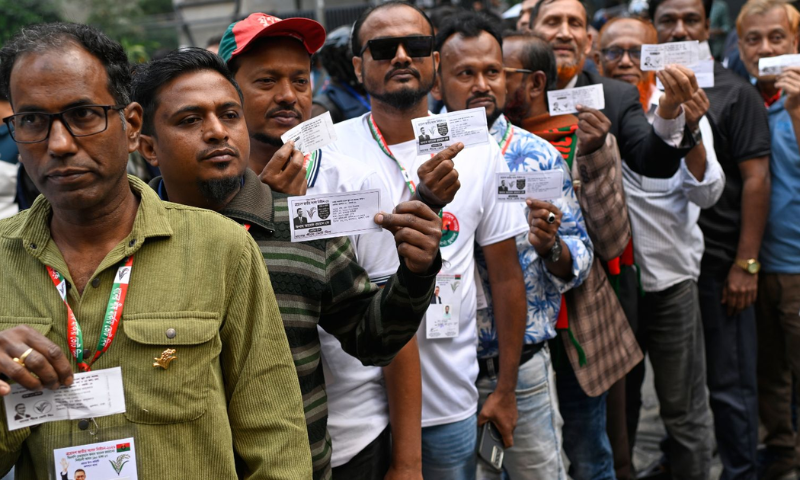
The vote proceeded amid heavy security, with nearly 958,000 personnel from the police, army, and paramilitary forces deployed nationwide. Despite concerns over unrest, no major incidents of violence were reported. Many voters described the atmosphere as festive, with long lines and heightened enthusiasm compared to previous elections.
President Asif Ali Zardari extended his best wishes to the people of Bangladesh on social media, emphasizing hopes for a peaceful process that strengthens democracy and stability.
This election, widely seen as a defining moment for Bangladesh’s post-Hasina political landscape, could reshape the nation’s governance and regional alignments in the months ahead.