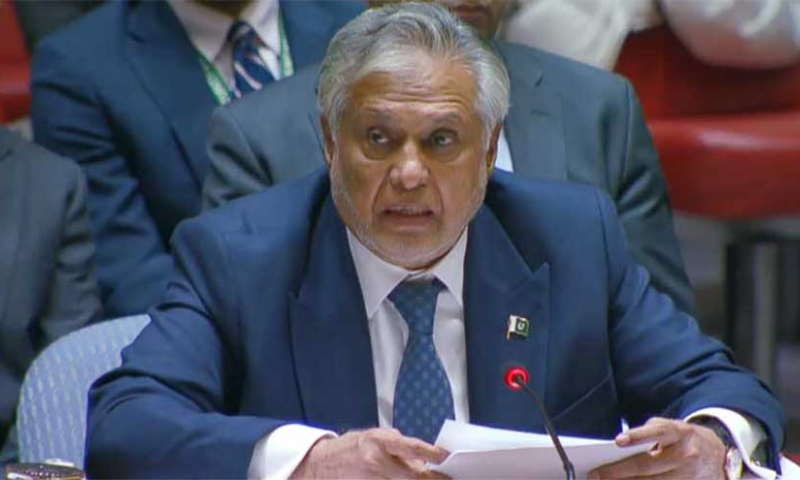
New York/Islamabad, February 19,2026: Deputy Prime Minister and Foreign Minister Senator Mohammad Ishaq Dar on Wednesday participated in a high-level briefing of the United Nations Security Council on Palestine in New York. The meeting was chaired by the United Kingdom Foreign Secretary in her capacity as President of the Security Council.
In his remarks, Senator Dar strongly condemned Israel’s continued ceasefire violations, illegal settlement expansion, and attempts to alter the status of the Occupied Palestinian Territory. He particularly criticized recent measures to expand control over the West Bank, including the designation of Palestinian land as “state land,” and called for the immediate halt and reversal of such actions.
The Deputy Prime Minister emphasized the urgent need for a permanent ceasefire in Gaza, full implementation of Security Council Resolution 2803, scaled-up humanitarian assistance, and the early commencement of Gaza’s recovery and reconstruction.
He noted that, in pursuit of these objectives, Pakistan had joined the Board of Peace (BoP) as part of the Group of Eight Arab and Islamic countries, in line with Resolution 2803.
Expressing hope that the BoP framework would yield concrete progress, Senator Dar said it should lead to a permanent ceasefire, enhanced humanitarian aid, reconstruction of Gaza, and the realization of the Palestinian people’s right to self-determination through a credible and time-bound political process consistent with international legitimacy and relevant UN resolutions.
He reiterated Pakistan’s longstanding support for the establishment of an independent, sovereign, and contiguous State of Palestine based on pre-1967 borders, with Al-Quds Al-Sharif as its capital.
The Deputy Prime Minister also reaffirmed Pakistan’s readiness to contribute to all diplomatic initiatives aimed at resolving the conflict, including President Trump’s Peace Plan, the Board of Peace, the High-Level Conference on the Peaceful Settlement of the Question of Palestine, and the Global Alliance for the Two-State Solution. He stressed that these efforts must be mutually reinforcing to achieve a just, lasting, and comprehensive peace in the Middle East.