Wuhan, May 8, 2026: A new wave of “tech tourism” is rapidly transforming China’s travel landscape, with visitors increasingly opting for immersive experiences centered on robotics, artificial intelligence, smart factories and futuristic urban infrastructure instead of conventional sightseeing.
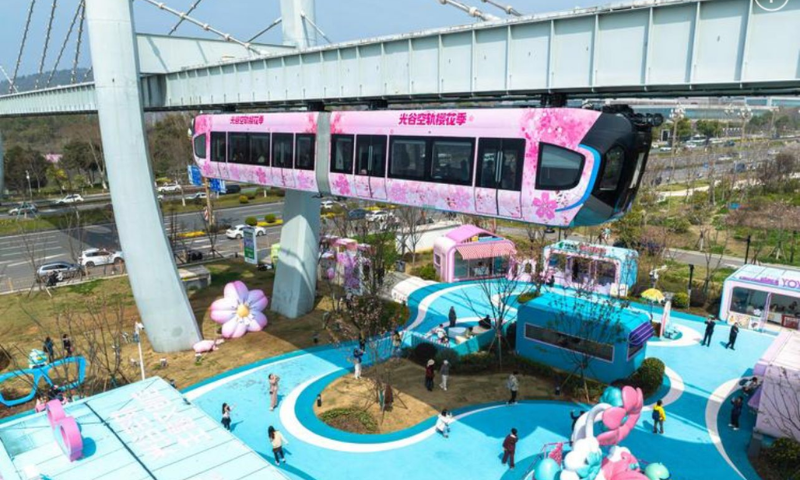
In the central Chinese city of Wuhan, travelers are flocking to ride the Optics Valley Photon — China’s first operational suspended monorail line — which has become one of the city’s most popular attractions since its launch in 2023.
Gliding above Wuhan’s sprawling innovation hubs and green corridors, the 10.5-kilometer rail route passes through the city’s renowned East Lake High-tech Development Zone, also known as the “Optics Valley of China.”
“Seeing the city from above on the suspended train feels like stepping into the future,” said Chen Zhi, a tourist from Nanjing, who visited Wuhan during China’s five-day May Day holiday. “The whole experience is incredibly high-tech.”
Unlike his previous visits, which focused on landmarks such as the Yellow Crane Tower and East Lake, Chen said this trip offered a glimpse into China’s technological future.
According to Zhou Xinlin of Wuhan Optics Valley Tourism Development Investment Co., the suspended monorail acts “like a necklace linking science museums, industrial sites and ecological attractions” across the innovation district.
Since the beginning of 2026, Optics Valley authorities have introduced several themed tourism routes featuring “super factories,” AI applications, low-altitude aviation technology, humanoid robots and laser innovation.
The growing popularity of these attractions has been striking. On the first day of the May Day holiday alone, suspended rail and tech-tourism sites in Optics Valley recorded more than 13,000 visits — a five percent increase compared to last year.
The trend is spreading well beyond Wuhan.
In Guangzhou, the newly launched Haixinsha Omni-Space Intelligent Experience Center has emerged as a major destination for tourists and student groups eager to experience advanced technologies firsthand.
During the May Day holiday, the center attracted over 10,000 visitors — roughly 220 percent higher than on regular days.
Among them was 14-year-old Zhang Sinuo from Huizhou, who visited the center with her parents.
“I’m very interested in technology and hope to work in the tech industry in the future,” she said. “Here, I can see different kinds of robots and aircraft.”
Across China, factories, laboratories and research centers that were once closed to the public are increasingly being converted into tourism destinations as authorities and companies seek to combine industrial innovation with consumer tourism.
At Xiaomi’s smart appliance factory in Wuhan, visitors observed robots operating assembly lines with minimal human intervention, rapidly assembling and testing products before completed air conditioners rolled off the production line every few seconds.
“I had only seen smart factories online before,” said visitor Zhang Xinyu. “Seeing it in person is shocking. It almost feels like magic.”
Similarly, Chinese electric vehicle manufacturer XPeng has opened AI-themed manufacturing tours, giving visitors access to its headquarters and smart manufacturing bases in Guangzhou and Zhaoqing to explore AI-powered vehicles, robotics and flying-car technologies.
Other Chinese cities are also embracing the trend.
In Qingdao, marine science museums, undersea tunnel exhibits and deep-sea exploration bases have been integrated into tourism routes combining industrial heritage with ocean technology education.
Meanwhile, Beijing is actively promoting industrial tourism by encouraging the transformation of factory floors, industrial parks and heritage sites into visitor attractions. Authorities aim to attract 20 million industrial tourism visits annually and generate 3 billion yuan (approximately 438 million U.S. dollars) in revenue by 2027.
During the recent May Day holiday, Beijing recorded 18.83 million tourist visits, while tourism revenue rose 6.6 percent to 22.36 billion yuan. Among more than 2,000 tourism and cultural activities launched during the holiday, science-focused educational tours emerged as one of the most sought-after attractions.
Industry experts believe the sector still has enormous growth potential.
According to a report by Zero Power Intelligence Group, industrial tourism currently contributes only less than five percent of China’s total tourism output, compared to 10–15 percent globally. However, the sector is projected to expand at an average annual growth rate of 18 percent over the next five years, with market value expected to surpass 300 billion yuan by 2030.
“The rapid rise of tech tourism reflects China’s broader industrial transformation and upgrading consumer demand,” said Deng Aimin, a tourism and culture expert at Jiangxi University of Finance and Economics.
“In the past, sightseeing alone was enough for many travelers. Now people want deeper, interactive and immersive experiences,” Deng said. “Tech tourism combines education and entertainment, making it especially appealing to young people and families.”
Courtesy: Xinhua News Agency