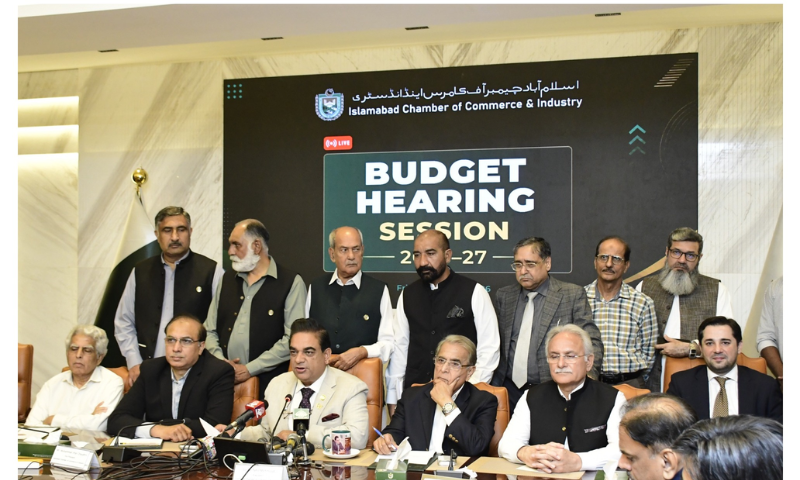
Islamabad, June 12,2026: President Islamabad Chamber of Commerce and Industry (ICCI), Sardar Tahir Mahmood, has welcomed several business-friendly measures announced in the Federal Budget 2026-27, while emphasizing the need for deeper structural reforms, tax rationalization, and a clearer roadmap for achieving sustainable economic growth.
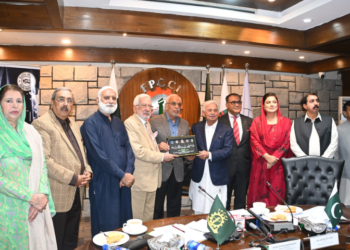
Commenting on the budget during a hugely attended press conference here at the Chamber House alongside Chairman ICCI Founder Group Tariq Sadiq, Senior Vice President Tahir Ayub and Vice President Irfan Chaudhry he congratulated the government on maintaining macroeconomic stability under challenging circumstances and appreciated the inclusion of a number of recommendations submitted by the Islamabad Chamber of Commerce and Industry.
“The government deserves recognition for steering the economy towards stability. However, the next phase must focus on stimulating investment, enhancing productivity, and creating conditions for sustained economic growth,” he remarked.
Sardar Tahir Mahmood particularly welcomed the decision to reduce withholding taxes in the real estate sector by up to 50 percent, describing it as a significant step towards reviving investment and restoring confidence in one of the country’s key economic sectors. He also praised the abolition of the one percent Capital Value Tax (CVT) on foreign wealth, stating that the measure would encourage investment and improve Pakistan’s attractiveness for overseas Pakistanis and investors.
The ICCI President appreciated the government’s commitment to expanding the digital economy through 2029, noting that Islamabad has become a major hub for IT professionals, technology startups, and freelancers. He said that strengthening the digital economy would create new employment opportunities, boost exports, and enhance Pakistan’s competitiveness in global markets.
He further welcomed the withdrawal of Super Tax for businesses earning up to Rs. 500 million, terming it a positive development that would provide much-needed relief to the corporate sector and encourage business expansion.
Referring to the proposed simplified tax scheme for small traders, Sardar Tahir Mahmood said the initiative could help broaden the tax base and improve documentation of the economy. However, he maintained that taxes imposed on exporters should be eliminated altogether to strengthen Pakistan’s export competitiveness and support foreign exchange earnings.
The ICCI President also lauded the Federal Board of Revenue’s efforts to digitize tax administration and modernize compliance procedures. He stressed that minimizing direct interaction between taxpayers and tax officials would enhance transparency, reduce discretionary powers, and improve ease of doing business.
While appreciating the positive measures, he expressed concern over several areas where the budget fell short of business community expectations. He noted that no relief had been provided in tax rates applicable to Associations of Persons (AOPs), despite repeated demands from stakeholders.
He also observed that the budget lacked a comprehensive policy framework for agriculture, a sector that contributes significantly to employment, food security, and economic stability. “Agriculture requires targeted reforms and a clear growth strategy if Pakistan is to achieve long-term economic resilience,” he said.
Questioning the ambitious revenue targets set for the coming fiscal year, Sardar Tahir Mahmood pointed out that many economic objectives of the previous year remained unmet, yet the government had increased the revenue collection target by approximately 14 percent. He emphasized that achieving a tax collection target exceeding Rs. 15 trillion would require a transparent and credible implementation strategy.
“The transition from economic stabilization to sustainable growth cannot be achieved through higher taxation alone. It requires tax rationalization, expansion of the tax base, investment-friendly policies, and meaningful reforms that reduce the cost of doing business,” he stated.
He further urged the government to revisit taxation policies related to electric vehicles to encourage the adoption of clean energy technologies and support Pakistan’s environmental sustainability goals.
Calling for major improvements in the business environment, the ICCI President reiterated the Chamber’s longstanding demand for the gradual elimination of the withholding tax regime, arguing that it has complicated tax compliance and increased the cost of doing business.
Sardar Tahir Mahmood expressed hope that the government would continue engaging closely with the business community and incorporate private-sector input in future policy decisions to promote investment, industrial growth, exports, entrepreneurship, and job creation.
“The business community stands ready to partner with the government in achieving higher growth, greater competitiveness, and a stronger economy. With the right reforms and policy consistency, Pakistan can unlock its immense economic potential,” he concluded.
On this occasion former Presidents Zubair Ahmed Malik, Khalid Javaid, Mohammad Ejaz Abbasi, Zafar Bakhtawari, Zahid Maqbool, Mian Akram Farid, Mian Shaukat Masood, Mohammad Ahmed, Executive Members, Convener ICCI Standing Committee on FBR Mian Ramazan, Markets Presidents, ICCI members were present in large number.