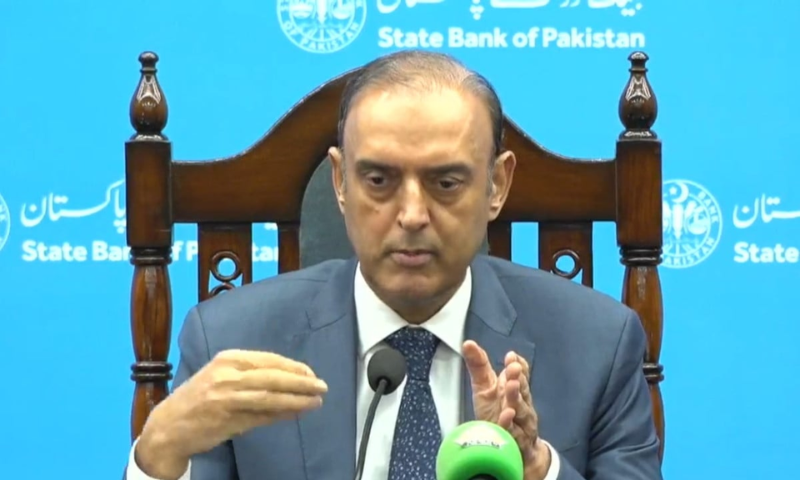
Islamabad, July 27, 2026: The State Bank of Pakistan (SBP) on Monday left its key policy interest rate unchanged at 11.5 per cent, citing inflationary pressures, external sector uncertainties and geopolitical risks stemming from the Middle East despite projecting an improvement in the country’s economic outlook.
The decision was announced by SBP Governor Jameel Ahmed following a meeting of the Monetary Policy Committee (MPC), which also released its latest assessment of inflation, economic growth and the external sector.
Addressing a press conference, the governor said the committee had decided to maintain the benchmark interest rate at 11.5pc after reviewing the country’s evolving macroeconomic conditions.
He noted that inflation had remained within the government’s target range during the first half of the fiscal year, averaging 5.5pc between July and February, but accelerated following the Middle East conflict.
“Inflation rose to 11.7pc in May and eased slightly to 11.1pc in June,” Ahmed said, expressing optimism that price pressures would begin to decline over the next one to two months if regional tensions do not escalate further.
The central bank expects inflation to return close to the upper limit of its target range of 5-7pc by the end of the current fiscal year, although the governor cautioned that geopolitical developments continue to pose significant risks. He added that higher food prices, particularly wheat, had also contributed to recent inflationary pressures.
On the external sector, the SBP projected the current account deficit to remain between 0 and 1pc of GDP, while acknowledging that the outlook depends on regional stability.
The governor said the central bank aims to raise Pakistan’s foreign exchange reserves to $20.2 billion by December 2026, after exceeding its June target by ending the previous fiscal year with $18.4bn in reserves against the targeted $18bn.
He also projected workers’ remittances to increase from $41.6bn in the previous fiscal year to $44bn during the current year.
Ahmed acknowledged that exports had remained under pressure but said government support measures were expected to improve export performance in the coming months. He also highlighted stronger inflows under the Roshan Digital Account initiative, which have averaged around $300 million per month over the past four to five months.
Discussing Pakistan’s external debt obligations, the governor said total public external debt servicing for the year was estimated at $21.5bn, including $17bn in principal repayments and $3.5bn in interest payments. He explained that a substantial portion of the principal repayments is expected to be rolled over, reducing actual repayment obligations to approximately $7bn.
Ahmed said Pakistan had also reduced reliance on short-term commercial borrowing by replacing it with longer-term multilateral financing and eurobond issuances, lowering debt repayment requirements by around $4bn.
He added that the country’s external public debt has remained broadly stable, with total foreign public sector debt close to $100bn, while the federal government’s external debt has remained around $82bn since 2022.
The governor further said the SBP had reduced its forward foreign exchange liabilities from $5bn to $900 million, expressing hope that these obligations could be converted into assets by the end of the year.
On economic growth, Ahmed said the Pakistan Bureau of Statistics had estimated GDP growth at 3.7pc for the previous fiscal year, although the revised figure could be slightly higher and remain within the SBP’s projected range.
He said economic activity had slowed during the final quarter because of the Middle East conflict after averaging around 4pc during the first three quarters of the fiscal year.
For the current fiscal year, the central bank expects Pakistan’s economy to expand between 3.5pc and 4.5pc, with the governor expressing confidence that growth would remain within that range.
The MPC’s decision was widely anticipated by financial markets. Surveys conducted by brokerage firms showed that more than 90 per cent of market participants expected the central bank to maintain the policy rate despite calls from the business community for further monetary easing to stimulate investment and economic activity.
The SBP last reduced the policy rate by 50 basis points to 10.5pc in December 2025 before raising it by 100 basis points to 11.5pc in April 2026, where it has remained since.