Islamabad, July 16,2026: Pakistan on Thursday urged the United States and Iran to end hostilities and return to dialogue, saying the Pakistan-mediated Islamabad Memorandum of Understanding (MoU) aimed at ending the conflict was facing challenges but remained a viable framework for peace.
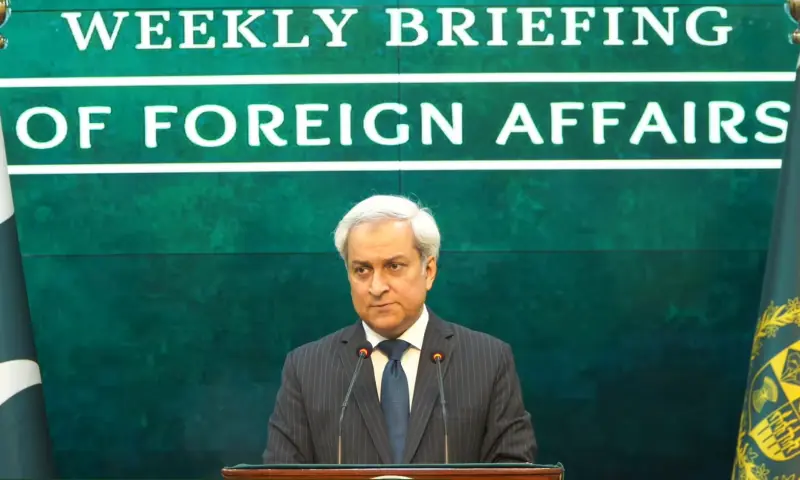
Addressing the Foreign Office’s weekly media briefing, spokesperson Tahir Andrabi said the implementation of the Islamabad MoU, signed between Washington and Tehran last month, had encountered difficulties amid renewed fighting.
“Pakistan will continue to encourage all sides to end violence and resume technical-level talks in accordance with the Islamabad MoU and the joint statement issued by Pakistan and Qatar following the direct talks in Switzerland on June 20,” Andrabi said.
He expressed hope that all parties would remain committed to dialogue and diplomacy to resolve their outstanding issues peacefully.
The remarks came as fighting between the United States and Iran intensified, with reports of US strikes on Iranian coastal defence and missile facilities and Iranian retaliatory attacks on American military installations in neighbouring Gulf states.
“As hostilities have continued over the past week, Pakistan reiterates its call on all parties to exercise maximum restraint and refrain from any actions that would further undermine peace and stability,” Andrabi said.
He stressed that sustained engagement remained the only path to achieving lasting peace, stability and progress.
“Pakistan firmly believes that there is no alternative to sustained engagement, dialogue and diplomacy,” he said, adding that all conflicts are ultimately resolved through negotiations.
The spokesperson described the Islamabad MoU as an enduring framework for promoting peace, mutual respect and shared prosperity despite the current setbacks.
Concern over Strait of Hormuz
The Foreign Office also voiced concern over the deteriorating security situation in the Strait of Hormuz, emphasising the need to ensure the safety, security and freedom of maritime navigation through one of the world’s most vital energy corridors.
Andrabi warned that disruptions in the waterway were adversely affecting many countries, particularly those in the Global South, by threatening global energy supplies, trade and food security.
“Pakistan recognises the urgent need to address the impact of the current situation on global energy supplies and other economic commodities,” he said, expressing hope for an early normalisation of maritime traffic.
The Strait of Hormuz has remained at the centre of the conflict after Iran announced its closure and the United States responded with naval measures, disrupting shipping through a route that previously carried around one-fifth of global oil and gas supplies. The crisis has pushed international oil prices sharply higher, increasing inflationary pressures worldwide, including in Pakistan.
Pakistan’s diplomatic efforts
Highlighting Islamabad’s diplomatic engagement, Andrabi said Pakistan had remained actively involved with regional and international stakeholders in support of de-escalation and a peaceful resolution of the conflict.
He referred to Prime Minister Shehbaz Sharif’s recent telephone conversations with the Amir of Qatar and Iranian President Masoud Pezeshkian, during which the importance of dialogue and preserving the gains achieved through diplomacy was emphasised.
The spokesperson also highlighted Deputy Prime Minister and Foreign Minister Ishaq Dar’s recent contacts with his Saudi and Iranian counterparts as part of Pakistan’s continued efforts to promote regional peace.
The Islamabad MoU, signed on June 18 under Pakistan’s mediation, sought to end the conflict and reopen the Strait of Hormuz through a 60-day negotiation process. However, renewed fighting since July 8 and US President Donald Trump’s recent declaration that the ceasefire was “over” have cast uncertainty over its future.
UK grooming gang case
Responding to questions regarding convicted child grooming gang ringleader Shabbir Ahmed, Andrabi said the matter was entirely an internal issue of the United Kingdom and had no connection with Pakistan.
He noted that Ahmed, who was convicted by a British court in 2012 for multiple child sexual offences, had spent his entire adult life in the UK and that any decisions regarding his legal status or release fell solely within the jurisdiction of British authorities.
“The individual concerned is a British national who spent his entire adult life in the UK and was duly convicted by a British court for reprehensible offences committed on British soil,” Andrabi said.
He stressed that Pakistan could not be associated with decisions relating to Ahmed’s release or treatment under British law.
Condemning child sexual abuse in the strongest terms, Andrabi said perpetrators of such crimes must be thoroughly investigated, prosecuted and punished irrespective of race, ethnicity or religion.
“His heinous crimes demand serious introspection rather than a quest to search for extraneous causes,” the spokesperson added.