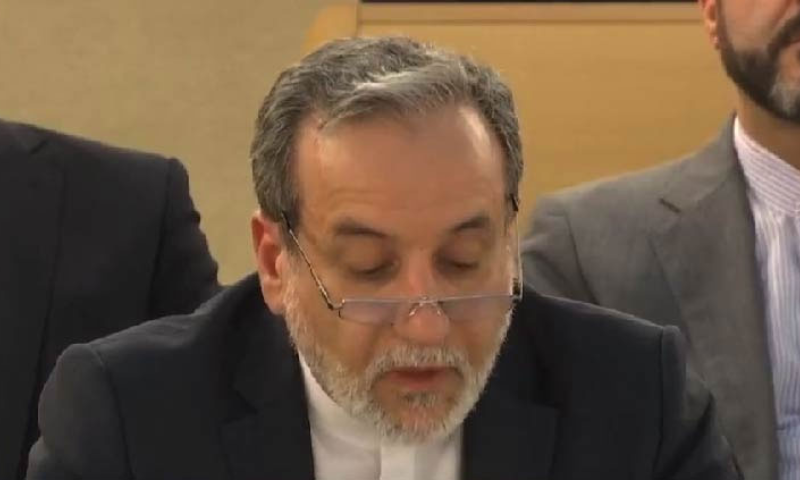
Geneva/Tehran, June 20, 2025: Iranian Foreign Minister Abbas Araqchi on Friday accused Israel of launching attacks on Iranian territory during sensitive negotiations over Tehran’s nuclear program, declaring that talks cannot proceed while Iran is under fire.
Speaking at the UN Human Rights Council in Geneva, Araqchi condemned what he described as an “unjustified war imposed on the Iranian people,” claiming Israeli forces targeted residential neighborhoods and hospitals in Tehran.
“While our representatives were engaged in nuclear discussions, our people were being bombarded. This is nothing short of barbarity,” Araqchi told delegates. “Iran will defend its territorial integrity and sovereignty with full force.”
As diplomatic efforts intensified in Geneva, Israel continued its air campaign against Iranian targets. The Israeli military said Friday it had conducted overnight strikes on dozens of sites, including missile production facilities and a nuclear research center in Tehran, which it claims is linked to Iran’s alleged nuclear weapons development.
In response, Iran launched another wave of missile attacks early Friday, with projectiles reportedly hitting residential and industrial zones in Beersheba, southern Israel. Both countries insist they are only targeting military infrastructure, but mounting civilian casualties and infrastructure damage have escalated tensions sharply.
Araqchi made clear that Iran would not entertain nuclear negotiations while Israeli airstrikes continued and warned the United States against expecting engagement under such conditions.
“There will be no talks with the United States while Israeli aggression persists,” he said, directly challenging European efforts to restore a diplomatic track. European Union foreign policy chief Josep Borrell and the foreign ministers of France, Germany, and the UK were scheduled to meet Araqchi later on Friday in Geneva in an attempt to salvage talks.
Two diplomats told reporters that the U.S. remains open to direct dialogue with Tehran, though expectations for any breakthrough remain low amid the ongoing conflict.
The latest round of violence began on June 12 when Israel launched Operation Rising Lion, targeting Iran’s nuclear and missile infrastructure. Israel claimed it acted to prevent Iran from acquiring nuclear weapons—an accusation Tehran denies, maintaining its nuclear program is strictly for peaceful purposes.
Mounting human toll
According to the U.S.-based Human Rights Activists News Agency, Israeli airstrikes have killed at least 639 people in Iran, including top military officials and nuclear scientists. Iran has also suffered major infrastructure losses in and around Tehran.
Iranian media reported a drone strike on an apartment block in central Tehran Friday morning, while Israel claims at least two dozen civilians have been killed by Iranian missile fire.
The conflict has raised fears of a regional escalation, particularly as both sides accuse one another of targeting civilian areas, including hospitals and schools.
The White House has said President Donald Trump will decide “within the next two weeks” whether to involve the U.S. militarily. Spokesperson Karoline Leavitt said any decision would depend on whether diplomatic avenues with Iran remain viable.
Trump’s special envoy, Steve Witkoff, has reportedly held multiple backchannel conversations with Araqchi since the start of hostilities. However, Tehran’s stance has hardened following the Israeli strikes.
Meanwhile, Hezbollah, the Lebanon-based armed group, formally declared its support for Iran. Secretary-General Naim Qassem said in a statement that “Hezbollah and the Islamic Resistance are not neutral in the face of American-Israeli aggression” and pledged to stand alongside Iran’s leadership and people.
“We will act as we see appropriate in confronting this brutal aggression,” he warned, raising concerns that the conflict could widen.
In a post on X (formerly Twitter), Iran’s Supreme Leader Ayatollah Ali Khamenei called on the Iranian people to remain resolute.
“Do not lose heart. The enemy is waiting for your despair to strike harder,” Khamenei said. Expressing confidence in eventual victory, he described the Iranian people’s resistance as a divine struggle backed by “truth and justice.”
Military analysts have warned that while most Israeli strikes have targeted missile and research facilities, any attack on Iran’s Bushehr nuclear power plant could pose catastrophic risks. Israel has reiterated that it seeks to dismantle Iran’s nuclear capabilities but wants to avoid a regional nuclear disaster.
As the Geneva talks proceed in a climate of deep mistrust and open warfare, the prospects for diplomacy appear slim. Observers warn that without a ceasefire, the path back to dialogue—and stability—will be difficult to achieve.