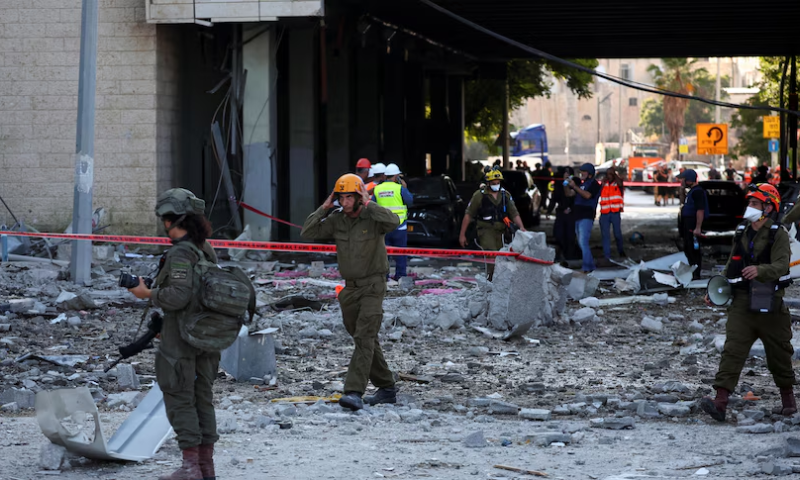
Jerusalem/Istanbul/Washington, June 21, 2025: Israel announced on Saturday that it had killed a senior Iranian military commander amid an intensifying aerial conflict between the two countries, now entering its second week. Meanwhile, Iran declared it would not return to nuclear negotiations while under continued military threat.
Israeli Defense Minister Israel Katz confirmed the killing of Saeed Izadi, a veteran commander of the Quds Force’s Palestine Corps, in a targeted airstrike on an apartment building in Qom, central Iran. Katz hailed the operation as a “major achievement for Israeli intelligence and the Air Force,” accusing Izadi of financing and arming Hamas ahead of its October 7, 2023, assault that ignited the war in Gaza.
Iran’s Islamic Revolutionary Guard Corps (IRGC) acknowledged the deaths of five personnel in separate strikes on Khorramabad but made no mention of Izadi, who is sanctioned by both the U.S. and the UK.
Earlier Iranian reports said that a 16-year-old was killed and two others injured in the Qom strike. Iranian state media, citing the health ministry, reported that at least 430 people have been killed and over 3,500 injured in Israeli attacks since June 13. The U.S.-based Human Rights Activists News Agency claims the death toll in Iran has reached 639, including senior military officials and nuclear scientists.
In response, Iran has launched multiple missile barrages into Israel. Local Israeli authorities report that 24 civilians have been killed in the worst conflict between the two nations in decades. One Iranian missile struck a hospital in Beersheba, southern Israel, while the Israeli military claims its strikes have focused strictly on military targets, though it admitted the possibility of collateral damage.
Iran’s Health Minister Mohammadreza Zafarqandi accused Israel of targeting three hospitals, killing two medical workers and a child, and hitting six ambulances. Meanwhile, Nour News named 15 Iranian air defense personnel reportedly killed during the conflict.
Adding to tensions, Israel claimed to have eliminated a second Quds Force commander, Benham Shariyari, in an overnight airstrike. Ali Shamkhani, a senior adviser to Iran’s Supreme Leader, also survived a targeted attack. “It was my fate to stay with a wounded body, so I stay to continue to be the reason for the enemy’s hostility,” he said through state media.
The Israeli military on Saturday morning warned of incoming Iranian missile attacks, triggering sirens across central Israel and the occupied West Bank. Interceptions lit up the sky over Tel Aviv, with no immediate casualties reported.
Amid the violence, Iran reiterated its stance against nuclear talks under fire. Speaking in Istanbul at a meeting of the Organisation of Islamic Cooperation (OIC), Iranian Foreign Minister Abbas Araqchi said, “It is obvious that I can’t go to negotiations with the U.S. when our people are under bombardment supported by the U.S.”
Araqchi met European officials in Geneva on Friday to explore a diplomatic pathway, though little progress was reported. President Donald Trump, speaking the same day, warned that Iran may be weeks away from acquiring a nuclear weapon, stating, “We can’t let that happen.” He said he would decide within two weeks whether to involve the U.S. militarily, hoping “people come to their senses” before then.
Iran’s Fars News Agency reported that Israeli forces targeted the Isfahan nuclear facility — one of the country’s largest — though officials said there was no leakage of hazardous materials. Israel said it carried out broad attacks on missile storage and launch sites.
At the OIC summit, Turkish President Recep Tayyip Erdoğan accused Israel of sabotaging planned nuclear talks and seeking to avoid diplomacy. Turkey, Russia, and China have all called for immediate de-escalation.
Trump expressed skepticism about a ceasefire, stating, “Iran doesn’t want to speak to Europe. They want to speak to us,” and indicated he was unlikely to pressure Israel to ease strikes because it was “winning.”
Israel has vowed to continue its military campaign until Iran’s nuclear and missile capabilities — which it views as existential threats — are dismantled. A senior Iranian official told Reuters that Tehran was willing to discuss limits on uranium enrichment but would not accept a complete ban, particularly while under Israeli attack.