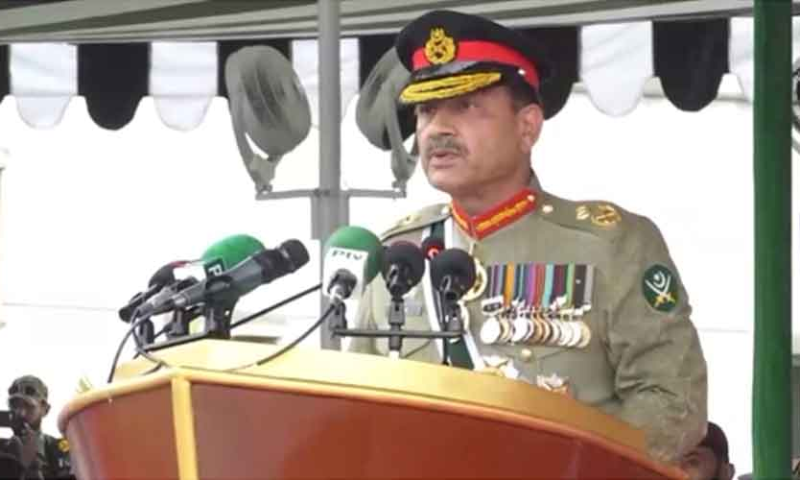
Karachi, June 28, 2025: Field Marshal Syed Asim Munir issued a stern warning to India on Saturday, stating that any future violation of Pakistan’s sovereignty would be met with decisive retaliation. His remarks came during a keynote address at the commissioning parade of the 123rd Midshipmen and 31st Short Service Commission Course at the Pakistan Naval Academy.
Addressing newly commissioned naval officers and cadets from allied nations — including Turkey, Bahrain, Iraq, Palestine, and Djibouti — the Chief of Army Staff highlighted regional threats, evolving maritime strategy, and the need for Pakistan to maintain strategic readiness in a rapidly changing security environment.
“Pakistan is now seen as a net regional stabilizer,” Munir said, cautioning that any misjudgment of the country’s resolve would be a “dangerous miscalculation.”
In one of his strongest statements to date, Munir lambasted India’s “arrogant and aggressive posture,” accusing New Delhi of manipulating militarism and nationalism for domestic political gains. He cited two past Indian actions — conducted under the pretext of counterterrorism — that he said endangered regional stability. Pakistan’s measured but firm responses, he claimed, had helped avert wider conflict.
Emphasizing the growing importance of maritime strength, Field Marshal Munir called for bolstering Pakistan’s naval capabilities amid heightened tensions in the Indian Ocean. He described naval readiness as critical to safeguarding national trade routes, energy supplies, and broader strategic interests.
“The nature of maritime conflict is evolving fast,” he noted, urging officers to prepare for complex and shifting challenges in modern warfare.
Reaffirming Pakistan’s longstanding stance on Kashmir, Munir supported the region’s right to self-determination, and rejected India’s narrative of branding the freedom movement as terrorism. He said durable peace in South Asia depends on a just resolution of the Kashmir dispute.
Field Marshal Munir also invoked Quranic references, echoing themes of resilience, justice, and divine guidance, often present in Pakistan’s military rhetoric. His speech comes as the country transitions from a counterinsurgency focus to strategic modernization, with the Navy playing a central role in future defense planning.
The commissioning ceremony showcased the discipline, professionalism, and international cooperation embodied in Pakistan’s new generation of naval officers. It also reinforced the military’s commitment to defending the nation’s sovereignty amid emerging regional and global threats.