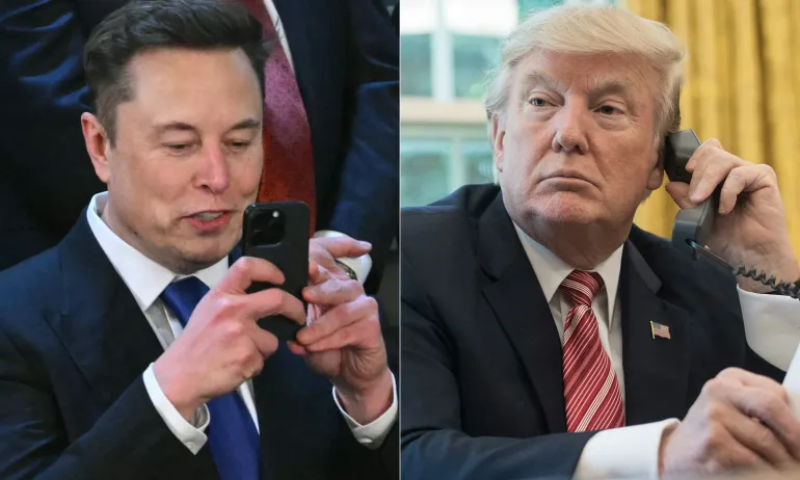
Washington, July 1, 2025: U.S. President Donald Trump reignited his feud with tech billionaire Elon Musk on Tuesday, accusing him of benefiting from record-breaking government subsidies, amid a deepening row over Trump’s signature spending legislation.
“Elon may get more subsidy than any human being in history, by far,” Trump wrote on social media. “And without subsidies, Elon would probably have to close up shop and head back home to South Africa.”
The attack comes after Musk, who recently stepped down as head of Trump’s Department of Government Efficiency (DOGE), renewed his fierce criticism of the president’s proposed spending bill — dubbed the “One Big Beautiful Bill.” The $4.5 trillion package seeks to extend Trump-era tax cuts and bolster border security but has drawn controversy for provisions that would eliminate healthcare coverage for millions and increase national debt by over $3 trillion.
Musk, the world’s richest person, accused Republicans of betraying fiscal conservatism. “All I’m asking is that we don’t bankrupt America,” he posted on social media. “What’s the point of a debt ceiling if we keep raising it?”
Trump retaliated by suggesting that DOGE investigate Musk’s companies, particularly SpaceX and Tesla. “No more rocket launches, satellites, or electric car production, and our country would save a FORTUNE,” he said. “Perhaps DOGE should take a good, hard look at this? BIG MONEY TO BE SAVED!!!”
The public fallout between the two high-profile figures comes at a politically sensitive time. With the 2026 midterms approaching, divisions within the Republican Party are intensifying. Many conservatives have expressed concern over the fiscal implications of the bill, even as Trump frames it as central to his presidential legacy.
Musk, for his part, has floated the idea of launching a new political movement. “VOX POPULI, VOX DEI — 80% voted for a new party,” he claimed online, referring to a recent social media poll he conducted.
The clash underscores growing tensions between traditional conservatives and populist factions over the future of the Republican Party — and the direction of U.S. economic policy.