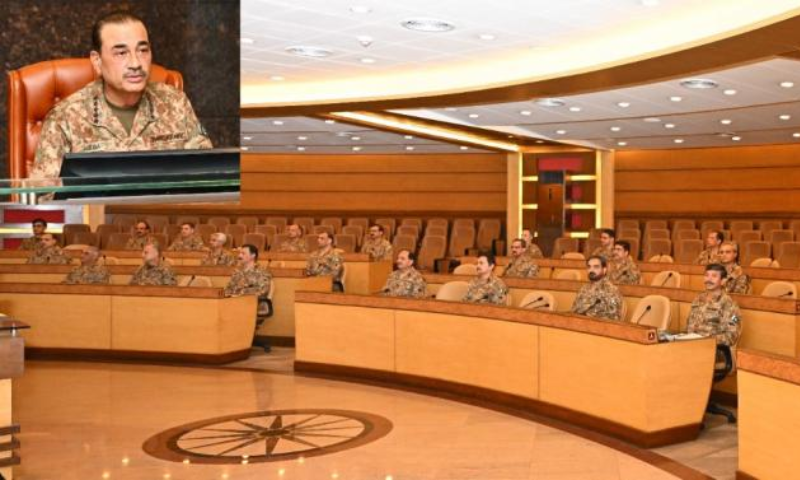
Rawalpindi, July 10, 2025: The Pakistan Army’s top leadership has reaffirmed its unwavering commitment to taking comprehensive action against Indian-backed and sponsored proxy networks operating against Pakistan, according to a statement issued by the Inter-Services Public Relations (ISPR) on Thursday.
The 271st Corps Commanders’ Conference (CCC) was held at the General Headquarters (GHQ) in Rawalpindi under the chairmanship of Field Marshal Syed Asim Munir, Chief of Army Staff (COAS).
The forum noted that India has intensified hostile activities following its recent defeat in the brief but intense military conflict with Pakistan. The two countries went to war in May after New Delhi accused Islamabad of orchestrating a deadly attack on tourists in Pahalgam, located in Indian Illegally Occupied Jammu and Kashmir (IIOJK). Pakistan has strongly denied the allegation.
The conflict ended within 90 hours due to what the government described as Pakistan’s “decisive response.” However, officials say India has since increased terrorist activities within Pakistan through its network of proxies.
The conference began with prayers (Fateha) for the martyrs of recent terrorist attacks allegedly carried out by Indian-sponsored elements. The forum vowed that the sacrifices of these personnel would not go in vain.
“Taking stock of recent successes against terrorist proxies, the forum resolved that the blood of our Shuhada will not go to waste and the safety and security of the people of Pakistan remains the top-most priority for the Armed Forces,” the ISPR said.
Participants noted that following its failure in direct military engagement, India is now resorting to proxy warfare through outfits identified as Fitna al-Khawarij and Fitna al-Hindustan, in an effort to destabilize Pakistan.
Responding to what were described as “baseless insinuations” by the Indian Army aimed at masking its military defeat, the COAS said the region is becoming increasingly disillusioned with India’s hegemonic ambitions and Hindutva-driven extremism.
“Invoking third parties in what is unmistakably a bilateral military confrontation reflects a disingenuous attempt at bloc politics aimed at falsely projecting India’s self-assigned role as a net security provider,” Field Marshal Munir remarked.
The COAS also shared details of Pakistan’s recent diplomatic outreach, including visits to Iran, Türkiye, Azerbaijan, Saudi Arabia, and the UAE, during which he accompanied Prime Minister Shehbaz Sharif. He also highlighted his own “historic and unique” visit to the United States, where he met with top-tier U.S. leadership to present Pakistan’s strategic perspective on regional and international developments.
According to the ISPR, the army leadership carried out a holistic review of the prevailing internal and external security landscape, including recent developments in the Middle East and Iran. The forum expressed concern over the growing trend of using force as a primary foreign policy tool, underscoring the need for self-reliance, national cohesion, and strategic preparedness.
The conference was also briefed on the Pakistan Army’s efforts to adapt rapidly to the evolving threat spectrum and the changing nature of warfare. The COAS lauded the leadership of the Pakistan Navy and Pakistan Air Force for enhancing tri-services operational synergy.
In his concluding remarks, Field Marshal Munir expressed full confidence in the Pakistan Army’s operational readiness and its ability to meet any threat across the full spectrum of conflict.