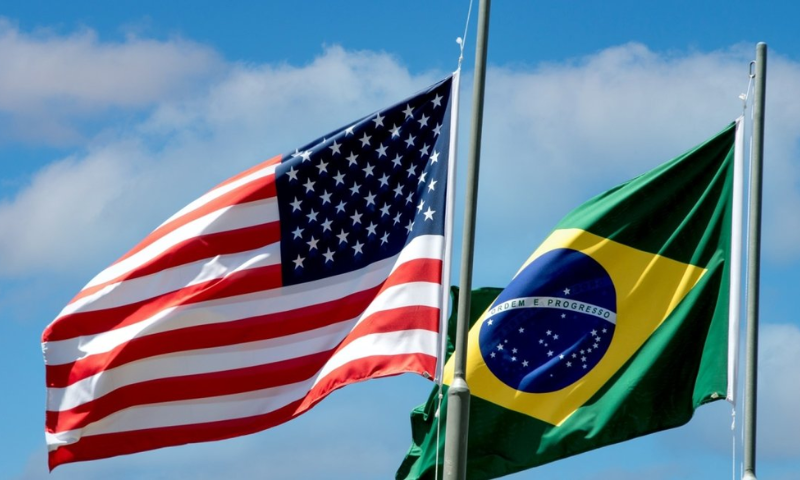
Washington/Brasília, July 10, 2025: U.S. President Donald Trump has announced a sweeping 50% tariff on all imports from Brazil, intensifying tensions with Brazilian President Luiz Inácio Lula da Silva following a public feud over democratic norms and former President Jair Bolsonaro.
The announcement, made via Trump’s social media platform Social Truth, marks a significant escalation in trade measures. It comes just days after a verbal spat in which Lula labeled Trump an “unwanted emperor,” rejecting what he described as U.S. attempts to strong-arm sovereign nations.
Trump’s letter accused Brazil of “insidious attacks on Free Elections and the fundamental Free Speech Rights of Americans,” citing its treatment of Bolsonaro, who is currently on trial for allegedly plotting to overturn Lula’s 2022 election win.
“These tariffs are due in part to Brazil’s egregious political persecution and anti-democratic censorship,” Trump wrote.
President Lula condemned the move and warned of reciprocal action.
“Any unilateral tariff increases will be addressed in accordance with the Brazilian Law of Economic Reciprocity,” Lula posted on X.
The Brazilian real slid more than 2% against the dollar, while stocks of major exporters like Embraer and Petrobras declined sharply in U.S. markets. Analysts warned of further volatility as investors digest the implications of the trade standoff between the Western Hemisphere’s two largest democracies.
Brazil’s top leadership, including Lula, Vice President Geraldo Alckmin, and Finance Minister Fernando Haddad, were summoned to an emergency meeting in Brasília late Wednesday to assess the economic and diplomatic fallout.
The United States is Brazil’s second-largest trading partner, and the new tariffs—up from a 10% rate imposed in April—are scheduled to take effect August 1. Trump’s directive states the 50% tariff will apply across all goods, separate from existing sector-specific duties.
Tensions between Washington and Brasília have been building for months, particularly around the Bolsonaro trial and Brazil’s stricter regulations on social media. Bolsonaro’s allies and Trump have both criticized Brazil’s Supreme Court for ordering the removal of right-wing content from digital platforms.
In a statement echoing Trump’s rhetoric, the U.S. Embassy in Brasília said:
“The political persecution of Jair Bolsonaro, his family, and his supporters is shameful and disrespectful of Brazil’s democratic traditions.”
Trump further instructed U.S. Trade Representative James Greer to open an investigation into what he called Brazil’s “unfair trade practices,” including digital trade barriers and judicial censorship impacting American firms.
The tariff hike is expected to have significant consequences for American consumers. Brazil is the world’s largest producer of several key commodities—coffee, orange juice, sugar, beef, and ethanol.
Brazil supplies about one-third of all coffee consumed in the United States and more than half of the country’s orange juice imports. Industry leaders are warning of ripple effects on food prices.
“This measure impacts not only Brazil, but the entire U.S. juice industry that relies on Brazilian supply chains,” said Ibiapaba Netto, Executive Director of CitrusBR, Brazil’s orange juice industry association.
The tariff move follows Trump’s threat earlier this week to impose a 10% tariff on all BRICS nations, which he labeled “anti-American” during the group’s summit in Rio de Janeiro. Lula responded forcefully at the time, saying, “The world has changed. We don’t want an emperor. We are sovereign nations.”
With the new levies and diplomatic strains escalating, analysts expect both political and economic aftershocks in the weeks ahead as Brazil and the U.S. brace for a potentially prolonged trade standoff.