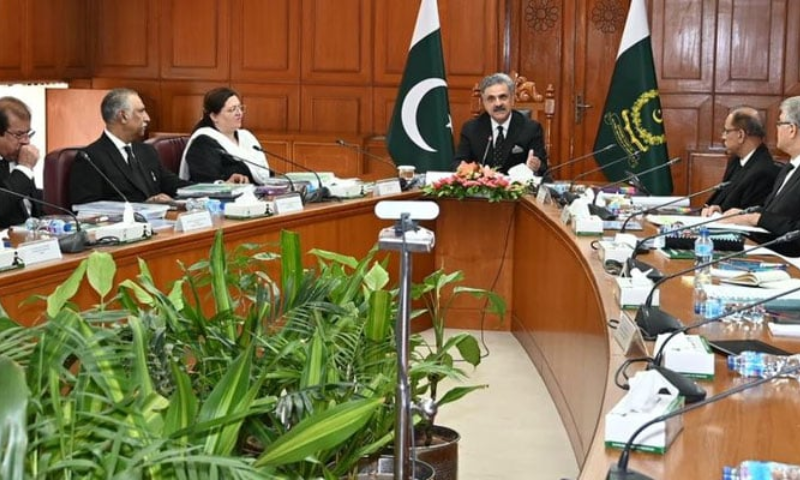
Islamabad, July 11, 2025: In a major development, the National Judicial (Policy Making) Committee (NJPMC) on Friday constituted a dedicated committee to craft an institutional response to the issue of enforced disappearances. The move was made during the NJPMC’s 53rd meeting held at the Supreme Court, chaired by Chief Justice of Pakistan Yahya Afridi.
According to an official statement from the apex court, the meeting was attended by chief justices of all high courts and the Additional Attorney General for Pakistan. The committee unanimously resolved that the judiciary would not compromise on its constitutional duty to protect fundamental rights.
The newly constituted committee on enforced disappearances will also consider executive concerns conveyed through the office of the Attorney General for Pakistan.
The NJPMC also directed all high courts to establish structured mechanisms for reporting and addressing external influence or interference in judicial proceedings, ensuring such complaints are resolved within a defined timeframe.
In a bid to modernise and streamline the judicial system, the NJPMC approved several key initiatives including establishment of a Commercial Litigation Corridor with specialised courts and benches to expedite business-related cases, launch of a Double-Docket Court Regime to be piloted in select districts for efficient case disposal, creation of a court-annexed mediation regime, aimed at promoting alternative dispute resolution and approval of Model Criminal Trial Courts and plans for district-level family courts and mediation centres.
To ensure consistency and performance across the judiciary, a separate committee headed by Justice (retd) Rehmat Hussain Jafferi was formed to recommend:
- Key performance indicators (KPIs) for judges,
- Standardised judicial training, and
- Addressing service disparities across different courts.
Additionally, the NJPMC approved the development of a Professional Excellence Index for the induction of lawyers, and directed all high courts to submit their proposals within 30 days.
The committee also deliberated on the ethical use of generative AI in judicial functions, assigning the National Judicial Automation Committee to finalise a charter of ethical use.
It endorsed Standard Operating Procedures (SOPs) for the video-link appearance of undertrial prisoners and police witnesses, and A proposal by the IGP Punjab on police reforms, including training of officers at judicial academies.
Responding to a request from the Additional Attorney General, the NJPMC decided that constitutional petitions involving tax and financial matters would now be heard by division benches, replacing the current practice of single-bench hearings.
The committee also praised recent initiatives by the Lahore High Court, including the establishment of female bar rooms, daycare centres, and health insurance for judges and their families — encouraging other high courts to replicate these steps in coordination with provincial governments.
It further agreed that the NJPMC Secretariat would pursue prior consultation with presiding officers before transferring ministerial staff from administrative courts and tribunals to the federal government.
The NJPMC reaffirmed its commitment to ensuring a transparent, efficient, and constitutionally grounded judicial system, equipped to meet emerging challenges and uphold the rule of law across Pakistan.