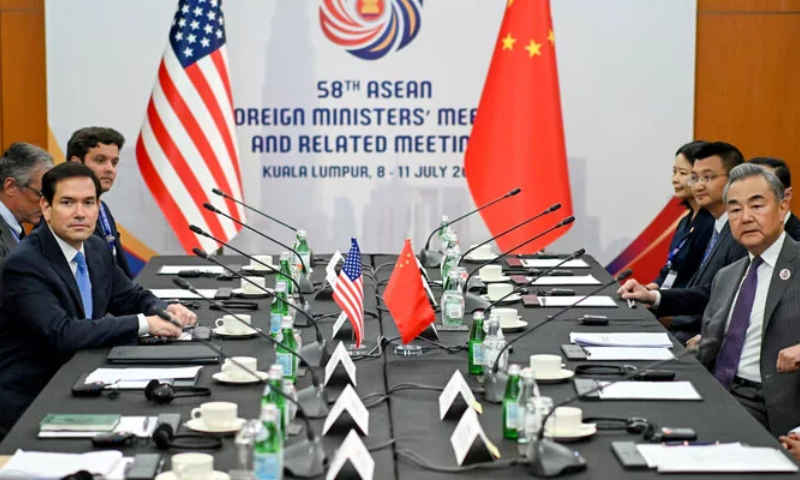
Kuala Lumpur, July 11, 2025: U.S. Secretary of State Marco Rubio held his first in-person meeting with Chinese Foreign Minister Wang Yi on Friday, amid escalating trade tensions and geopolitical rivalries between Washington and Beijing. The meeting, which took place on the sidelines of the East Asia Summit and ASEAN Regional Forum in Kuala Lumpur, came as both powers seek to assert their influence across the Indo-Pacific.
Rubio’s visit marks his first official trip to Asia since taking office earlier this year and reflects Washington’s renewed push to re-engage with Southeast Asia amid shifting global dynamics.
The high-level dialogue occurred against the backdrop of the Biden administration’s latest tariff measures, including steep import duties on several Asian countries. The newly announced U.S. tariffs include 25% on goods from Japan, South Korea, and Malaysia, 32% for Indonesia, 36% for Thailand and Cambodia, and 40% for Myanmar and Laos. These measures have triggered alarm across the region and criticism from China.
China, which faces the harshest duties—with tariffs surpassing 100% on key exports—has until August 12 to strike a deal with Washington before the tariffs take full effect. Beijing has strongly condemned the move, calling it a return to unilateralism and economic coercion.
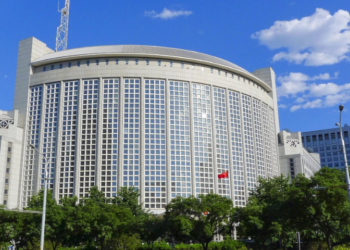
Foreign Minister Wang, in meetings with regional leaders, lashed out at the U.S. for what he termed “typical unilateral bullying.” Speaking to Malaysia’s foreign minister, he said the American tariffs threaten the global supply chain and erode the principles of free trade. Wang also warned Cambodia’s leadership that the levies were an attempt to stifle Southeast Asia’s right to development.
“We believe that Southeast Asian countries have the ability to cope with complex situations, adhere to principled positions, and safeguard their own interests,” Wang asserted, according to a Chinese foreign ministry readout.
While neither Rubio nor Wang made public remarks before or after their meeting—which lasted about an hour—Rubio had earlier pledged to raise Washington’s concerns over China’s support for Russia in the Ukraine conflict. He claimed Beijing was aiding Moscow “as much as they can without getting caught.”
Rubio also met with foreign ministers from Japan, South Korea, Indonesia, Thailand, and Cambodia, reaffirming U.S. commitment to its trilateral partnerships and the Indo-Pacific strategy. According to the U.S. State Department, talks focused on critical technologies, regional security, and resilient supply chains.
In a joint communique released Friday, ASEAN foreign ministers voiced alarm over the rising tide of global trade tensions, warning that unilateral tariffs are counterproductive and risk deepening global economic fragmentation. Without directly naming the United States, the ministers called for a fair, transparent, and rules-based multilateral trading system and emphasized the need to diversify economic ties.
Meanwhile, Philippine officials confirmed that President Ferdinand Marcos Jr. will travel to Washington later this month to meet President Donald Trump, with the tariff issue expected to feature prominently in discussions.
As both the U.S. and China intensify their diplomatic outreach in Southeast Asia, analysts warn that the region is likely to remain a key battleground for influence, especially amid mounting concerns about trade disruption and geopolitical rivalry.