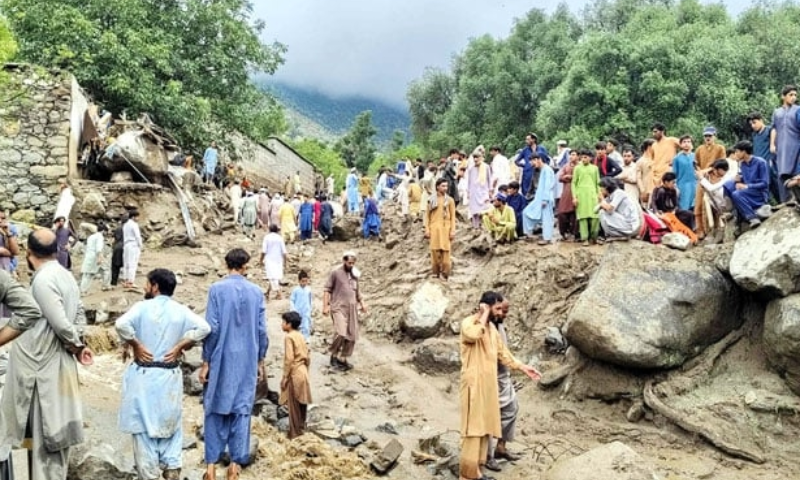
Khyber Pakhtunkhwa, GB, and AJK among worst-hit; Army, rescue teams intensify relief efforts
Islamabad, August 15, 2025: Northern Pakistan is reeling from one of the deadliest monsoon spells in recent years, as torrential rains, cloudbursts, landslides, and flash floods have caused unprecedented devastation in Khyber Pakhtunkhwa (KP), Gilgit-Baltistan (GB), and Azad Jammu and Kashmir (AJK). Official figures suggest that more than 280 people have lost their lives in the past 24 hours alone, while the cumulative toll since late June has climbed past 556.
The deluge has destroyed homes, swept away bridges, stranded thousands of tourists, and triggered large-scale evacuations. The Pakistan Army, provincial authorities, and emergency services are conducting round-the-clock rescue and relief operations in some of the country’s most rugged and inaccessible terrain.
Khyber Pakhtunkhwa: epicenter of the disaster
KP has suffered the heaviest losses, with the Provincial Disaster Management Authority (PDMA) confirming over 189 deaths in a single day across Battagram, Bajaur, Mansehra, Swat, Buner, Torghar, and Shangla. In Buner alone, a devastating cloudburst flattened over a dozen villages, killing at least 157 residents and injuring dozens more.
Battagram saw another lethal cloudburst late last night, washing away entire households and livestock. At least 45 houses have been partially or completely destroyed across the province, along with schools and basic infrastructure. The provincial government has declared Buner, Bajaur, Mansehra, and Battagram calamity-hit districts and deployed helicopters for airlifting stranded people, delivering food, and medical supplies.
Gilgit-Baltistan: valleys swept away
In GB, flash floods have swept through multiple valleys, killing at least five people. In Chilas, residents described surviving by clinging to trees as floodwaters from the Ochar stream surged through. Orchards, water channels, and bridges have been destroyed, and the Naltar power station has been rendered inoperative, plunging the region into darkness.
Authorities in Hunza have issued evacuation orders for areas near Hassanabad after the Shisper glacier showed signs of rapid melting, intensifying fears of a glacial lake outburst flood.
Azad Jammu and Kashmir: bridges and roads washed away
AJK’s Neelum Valley has been hit hard, with flash floods destroying six bridges—three over the Neelum stream and three over the Lawat stream—cutting off entire communities. At least nine people have died in separate incidents, including an entire family of six in Muzaffarabad.
Landslides have blocked the Kohala–Rawalpindi highway and several link roads along the Neelum Highway, leaving over 500 tourists stranded at Ratti Gali base camp. Although officials say the tourists are safe, food and communication shortages are worsening. Electricity and phone services remain disrupted in upper areas.
National disaster response and relief
The Pakistan Army has deployed troops to Swat, Bajaur, and Mansehra, using helicopters for evacuations and supply drops. In KP’s Siran Valley, more than 1,300 tourists have been rescued. Relief camps are being set up for displaced families, though access remains a major challenge due to damaged roads and ongoing heavy rains, forecast to last until August 21.
The National Disaster Management Authority (NDMA) has reported 325 deaths nationwide since June 26, including 142 children, and warned that climate change has intensified the severity of this year’s monsoon. Meteorologists note that rainfall from late June to late July was 10–15% heavier than usual, increasing the likelihood of destructive cloudbursts.
Regional impact beyond borders
The disaster has also struck across the Line of Control. In Indian-administered Kashmir’s Kishtwar district, a cloudburst triggered flash floods that killed at least 60 people, with more than 200 missing, many of them pilgrims heading to a remote shrine.
Government appeals and climate warning
Prime Minister Shehbaz Sharif has expressed deep grief over the mounting death toll, announcing compensation for victims’ families and urging immediate international assistance. Experts have drawn parallels to the catastrophic 2022 floods, which killed over 1,700 people and caused $40 billion in damages, warning that without robust adaptation measures, such disasters could become an annual reality.