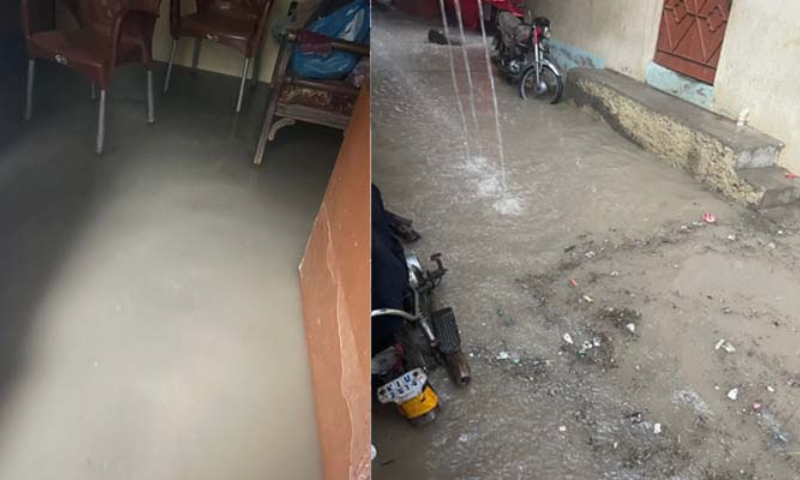
Karachi, August 19, 2025: Heavy monsoon rains lashed Karachi on Tuesday, plunging the country’s largest metropolis into chaos as several feet of floodwater submerged major roads, paralyzed traffic, disrupted power supply, and forced businesses to shut down.
The downpour, which continued intermittently throughout the day, inundated entire neighborhoods, leaving thousands stranded on waterlogged streets. Authorities urged residents to stay indoors, warning against unnecessary travel as rescue teams struggled to reach low-lying areas.
Several parts of the city — including Malir, Gulshan-e-Hadeed, Korangi Crossing, Liaquatabad, Baldia Town, Rafah-e-Aam, and Shah Faisal Colony — reported severe flooding, with rainwater entering homes and shops. In Malir and North Karachi, floodwaters rose up to four feet, forcing residents to abandon vehicles and wade through waist-deep water.
Traffic ground to a halt on major arteries, including Sharea Faisal, University Road, and II Chundrigar Road, where vehicles stalled on submerged stretches. Long tailbacks were reported at Nagan Chowrangi, Hub River Road, and Miran Naka, stranding commuters for hours.
Flooding also swamped low-lying neighborhoods in Surjani Town, North Nazimabad’s Shadman Town, and District Malir, where rescue workers continued to evacuate residents late into the evening.
Rescue officials confirmed five deaths from rain-related incidents. Four people were killed and two injured when the wall of a house collapsed in Gulistan-e-Jauhar Block 12, while another child died in Orangi following a similar collapse.
Meanwhile, reports of homes, shops, and boundary walls collapsing were received from multiple areas as heavy rain battered already fragile structures.
According to the Pakistan Meteorological Department (PMD), the highest rainfall was recorded at Karachi Airport (125mm), followed by Gulistan-e-Jauhar (122mm), Gulshan-e-Hadeed (75mm), University Road (59mm), Keamari (30mm), Saadi Town (24mm), Korangi (14.6mm), Orangi (12.2mm), Nazimabad (29mm), Sharea Faisal (17mm), Gulshan-e-Maymar (11mm), and airport surroundings (13mm).
The downpour also disrupted flight operations at Jinnah International Airport, where at least eight flights were cancelled and 20 others delayed. Several inbound flights were diverted to alternate airports.
Flights from Jeddah, Sharjah, Abu Dhabi, Colombo, Medina, Peshawar, and Toronto were delayed by one to five hours, sources at the airport confirmed.
Sindh Chief Minister Murad Ali Shah ordered the immediate implementation of a Rain Emergency Plan, directing local authorities to drain water from inundated areas on priority. He also urged law enforcement and rescue officials to ensure citizen safety.
A Rain Emergency Cell was established at the Governor’s House under directives from Governor Kamran Tessori, while Karachi Mayor Murtaza Wahab confirmed the city had received over 100mm of rainfall.
“People have the right to criticise, but facts should also be known. It rained continuously for two hours and continues even now. We are all on the streets, monitoring the situation,” Wahab told reporters, adding that the Tipu Sultan nullah had become difficult to clear.
He warned that flooding worsens whenever rainfall exceeds 40mm, urging citizens to stay home until water recedes.
The PMD forecast widespread rain, wind, and thunderstorms across Sindh, including Karachi, from August 19–22, with heavy to very heavy downpours expected in Tharparkar, Umerkot, Mirpurkhas, Hyderabad, Thatta, Badin, Sajawal, Sanghar, Jamshoro, and Shaheed Benazirabad, as well as scattered areas of Sukkur, Larkana, Khairpur, and Jacobabad.
Meteorologists warned of further urban flooding in Karachi and other low-lying areas of Sindh.
The rains also disrupted electricity supply in several neighborhoods. K-Electric (KE) confirmed that out of its 2,100 feeders, over 1,770 remained operational, while supply was suspended in flood-prone and low-lying areas as a precaution.
KE spokesperson said the utility’s field teams had been fully mobilised to restore power in affected areas, though many residents continued to complain of prolonged blackouts.