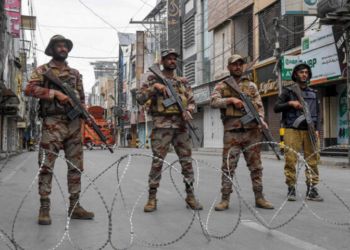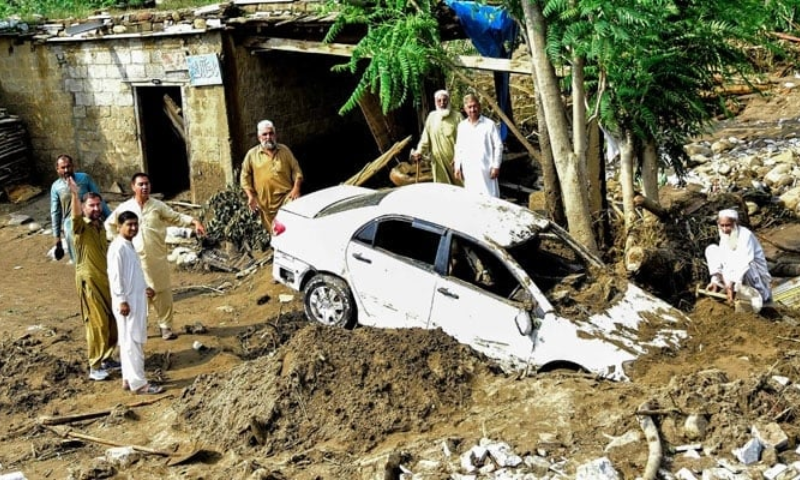
Islamabad/Peshawar, August 19, 2025: Rescue and relief operations gained momentum on Tuesday in flood-ravaged districts of Khyber Pakhtunkhwa (KP), where Pakistan Army engineers and urban search teams are working around the clock to reopen blocked roads, clear landslides, and reach stranded residents after days of torrential rains and cloudbursts wreaked havoc across the province.
According to the Army Engineers Corps, key progress was made overnight in Buner district, one of the worst-hit areas. The Pir Baba bypass was reopened for all kinds of traffic, while debris blocking the Pir Baba bazaar was cleared to facilitate local movement. The road to Gokand village has also been restored at three points affected by landslides, and the Aluch–Poran road has been reopened with the help of heavy machinery.
Urban Search and Rescue teams, backed by heavy equipment, continued operations in Bishoni and Qadir Nagar, where five bodies were recovered from a stream. Military officials vowed to sustain rescue operations until full access and rehabilitation are achieved across the affected districts.
Rising death toll and widespread destruction
The Provincial Disaster Management Authority (PDMA) reported that flash floods triggered by intense rainfall and cloudbursts have killed at least 341 people in KP since Friday, with Buner alone accounting for more than 200 fatalities. Narrow streets and rugged terrain have hampered the movement of heavy machinery, slowing rescue efforts in many villages.
Nationwide, the National Disaster Management Authority (NDMA) said the monsoon death toll since late June has risen to 660, with KP registering the highest casualties at 392. Other provinces recorded: Punjab 164, Gilgit-Baltistan 32, Sindh 29, Balochistan 20, Azad Jammu and Kashmir 15, and Islamabad 8.
Officials said Buner suffered an unprecedented cloudburst exceeding 150mm of rainfall within an hour on Friday morning, unleashing torrents that swept away homes, vehicles, and infrastructure.
Widespread destruction has also been reported in Peshawar, Mardan, Swabi, and Abbottabad. In Swabi, 11 people died on Monday when flash floods surged through residential areas, while across hilly districts, homes, shops, and belongings were washed away.
NDMA Chairman Lieutenant General Inam Haider Malik warned that more rain spells are expected between August 21 and September 10, cautioning that further cloudbursts “could intensify” the disaster.
Army and relief agencies step up operations
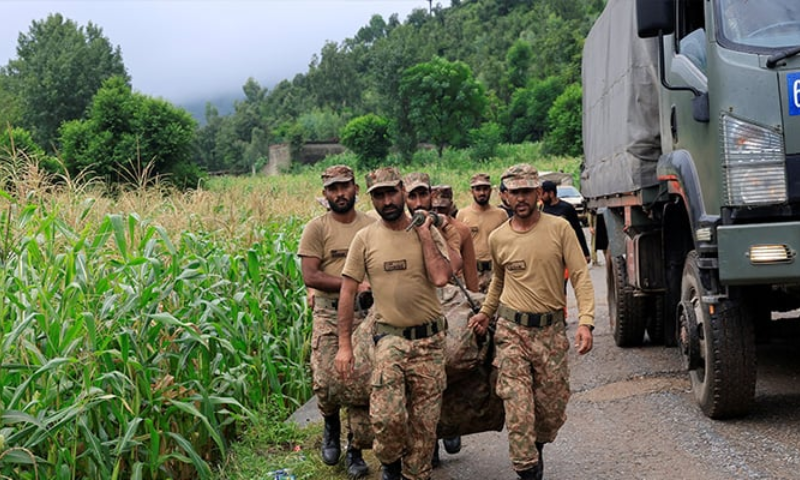
At a media briefing in Islamabad, DG ISPR Lieutenant General Ahmed Sharif Chaudhary confirmed that two engineer battalions have been deployed in KP and two in Gilgit-Baltistan to reopen roads and rebuild damaged infrastructure.
He said that medical camps have treated more than 6,000 injured people, with three military medical units stationed in Gilgit and KP. Additional medical teams have been dispatched from CMH Rawalpindi to reinforce field operations.
Medical units are fully functional in Buner and Shangla, while food supplies from army reserves are being distributed both by road and helicopter. On the directives of COAS Field Marshal Asim Munir, one day’s ration from army reserves has also been allocated for flood-affected families.
Lt Gen Chaudhary added that several temporary bridges have been constructed and multiple roads reopened, though 90 roads in KP remain destroyed and will take time to restore.
PMD warns of more heavy rains
The Pakistan Meteorological Department (PMD) has issued fresh alerts for widespread rain, wind, and thunderstorms across KP, Punjab, Sindh, Balochistan, Kashmir, Gilgit-Baltistan, and Islamabad. Heavy to very heavy rainfall is expected in several regions, heightening the risk of flash floods in streams and nullahs of KP, Kashmir, Gilgit-Baltistan, Potohar, Dera Ghazi Khan, Koh-e-Suleman, and northeastern Balochistan.
Urban flooding is feared in Rawalpindi/Islamabad, Peshawar, Nowshera, and southeastern Sindh, while landslides are likely in hilly regions including Murree, Galliyat, Kashmir, KP, and Gilgit-Baltistan.
In the past 24 hours, Rawalakot received 110mm of rain, Murree 88mm, Chakwal 84mm, Takht Bhai 80mm, and Peshawar Airport 54mm. Meanwhile, Dalbandin and Turbat remained the hottest at 43°C, followed by Nokundi at 42°C.
Educational institutions shut in KP
Amid safety concerns, the KP Higher Education Department has ordered the closure of all colleges and universities in the Counter Zone from August 19 to 25, directing institutions to shift academic activities online. Provincial Higher Education Minister Meena Khan Afridi said measures are being taken to protect students and staff and ensure continuity of education.
A damage assessment report revealed extensive destruction of educational infrastructure:
- Government Degree College Lalqila (Lower Dir) lost its 300-foot boundary wall.
- Government Degree College Wari (Upper Dir) suffered damage to its water supply and tube well.
- Chakisar College (Shangla) lost its 3,000-foot boundary wall.
- Government Girls Postgraduate College Saidu Sharif (Swat) and Government Degree College Shamozai (Swat) also reported wall collapses.
- At the University of Shangla, a 1,400-foot water pipeline was damaged.
- At the University of Swat (Charbagh campus), a 40-foot boundary wall and parts of its residential colony wall were destroyed.
Federal and provincial governments respond
KP Chief Minister Ali Amin Gandapur announced salary donations to aid victims: one month’s salary from the CM, half a month from cabinet members, seven days from provincial lawmakers, two days from Grade-17 and above officers, and one day from lower staff.
Prime Minister Shehbaz Sharif pledged the federal cabinet’s one-month salary to support victims, while Federal Climate Minister Musadik Malik assured that all blocked roads would be reopened within 24 hours in collaboration with provincial governments.
Climate change and Pakistan’s vulnerability
Experts warn that the scale of destruction reflects climate change–driven shifts in South Asia’s monsoon patterns. Chief Meteorologist Zaheer Babar noted that extreme rainfall events are increasing in frequency and intensity. He explained that torrential mountain downpours often turn into sudden flash floods downstream, overwhelming low-lying communities.
Babar added that poor urban planning, such as homes built along riverbanks, garbage dumping in waterways, and encroachments, amplify flood damage.
Pakistan, ranked among the world’s most climate-vulnerable countries, has faced repeated disasters. In 2022, catastrophic floods submerged one-third of the country, killing nearly 1,700 people, a tragedy that continues to underscore the urgent need for resilience and preparedness.