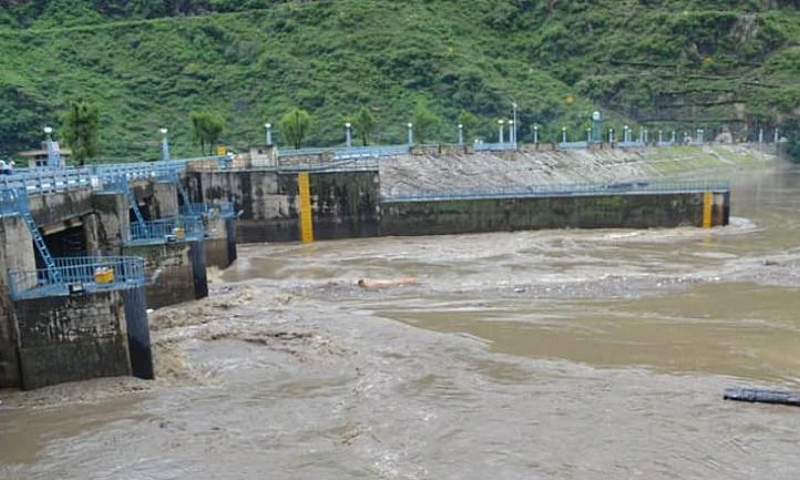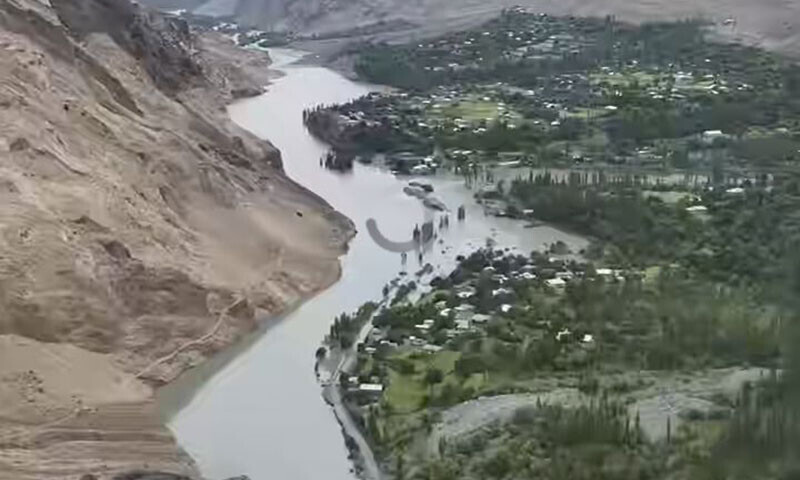
Gilgit, August 24, 2025: The Gilgit-Baltistan (GB) government on Sunday said that the lake formed after a glacial outburst in Ghizer district has receded to around 40 feet and currently poses no danger to nearby settlements.
The glacial lake outburst flood (GLOF) occurred early Friday morning in Talidas village of Gupis Valley, prompting the evacuation of at least 200 residents after a local shepherd raised the alarm. Authorities credited the early warning with saving hundreds of lives.
“Right now, there is no danger from the lake,” GB government spokesperson Faizullah Faraq said, noting that earlier fears of flooding downstream in Ghizer, Gilgit, and Diamer have eased.
The Human Rights Commission of Pakistan’s GB coordinator, Israruddin Israr, confirmed that over 3,000 people from 330 households were displaced, making it the second-largest displacement in the region since the 2010 Attabad disaster.
Displaced residents have been shifted to tent settlements, while relief operations are being supervised on-site by GB Chief Secretary Abrar Ahmed Mirza.
The federal government has also stepped in to honour the shepherds who raised the alarm. According to Faraq, three shepherds who “saved around 300 lives” have been invited by the Prime Minister’s Secretariat to Islamabad. GB Chief Minister Haji Gulbar Khan has also announced cash rewards for their bravery.
The GB Disaster Management Authority (GBDMA) said standard operating procedures (SOPs) had been devised by a technical team to safely release water from the artificial lake while protecting nearby populations and infrastructure.
Work is underway to restore the Gilgit–Shandur Road, with traffic expected to resume within 48 hours. The National Highway Authority (NHA) has deployed heavy machinery for permanent repairs, though progress depends on stabilisation of the mud-filled area.
Former GB chief minister Hafeezur Rehman criticised the federal government’s Rs10 billion GLOF-II early warning project, implemented by the UNDP, alleging mismanagement of funds. He argued that installing high-cost equipment in remote areas without electricity was ineffective, suggesting instead the provision of satellite phones as a cheaper and more reliable alternative.
Meanwhile, scattered rainfall across GB has renewed fears of further glacial outburst floods and landslides. The Pakistan Meteorological Department (PMD) has warned of increased risks in glaciated regions of GB and Khyber Pakhtunkhwa during the ongoing wet spell, which began on August 23.
Road connectivity has been badly hit, with Astore Valley Road, K2 Road in Shigar, and several routes in Hunza, Ghanche, and Ghizer blocked due to landslides. Drinking water systems, irrigation channels, and crops have also been severely impacted.
Local residents say fear now grips GB communities even during light rain. “People are living in constant uncertainty. GB has never seen such disasters before,” said Zulfiqar Ali, a Gilgit resident.