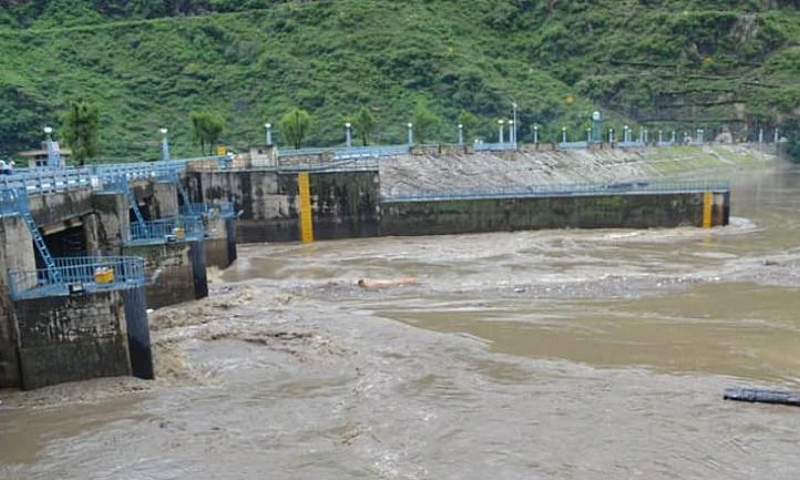
Islamabad, August 25, 2025: India on Monday contacted Pakistan for the second time in a day to warn of potential flooding, this time in the Sutlej River, after earlier issuing an alert regarding the Tawi River in Jammu, according to diplomatic sources cited by a private news channel.
Officials said the Indian High Commission in Islamabad reached out to Pakistan’s Ministry of Foreign Affairs (MoFA) to share details of possible flood conditions in the Sutlej. India has provided such information in the past during high-flow situations, the sources added.
The Foreign Office (FO), however, clarified that India had communicated both flood alerts through diplomatic channels rather than via the Permanent Indus Commission, as required under the Indus Waters Treaty (IWT). “India is obligated to fully comply with all provisions of the treaty,” the FO said, warning that New Delhi’s unilateral suspension of the IWT earlier this year constituted a “serious violation of international law” with potentially grave consequences for regional peace and stability.
India had first contacted Pakistan hours earlier, on Sunday morning (August 24), to share information about expected flooding in the Tawi River at Jammu. Based on the alert, Pakistani authorities issued warnings downstream.
Tensions over the water-sharing pact have escalated since April, when 26 people were killed in Pahalgam, Indian Illegally Occupied Jammu and Kashmir (IIOJK). India blamed Pakistan for orchestrating the militant attack—an allegation Islamabad denies. In its aftermath, New Delhi announced that it would hold the IWT “in abeyance.” The standoff escalated into the most intense military confrontation in decades in May, before the United States brokered a ceasefire.
Despite surviving three wars and decades of strained relations, the IWT now faces its most serious challenge. Reuters reported in May that India is considering projects that could reduce water flows into Pakistan from the eastern rivers, which Islamabad has warned would be treated as an “act of war.”
India maintains it will keep the treaty suspended until Pakistan “credibly and irrevocably” ends its alleged support for cross-border militancy.
Signed in 1960 under World Bank mediation, the IWT divides the waters of the Indus basin between the two nuclear-armed neighbours. India has rights over the three eastern rivers — Sutlej, Beas, and Ravi — while Pakistan controls most of the western rivers — Indus, Jhelum, and Chenab.
The treaty contains detailed mechanisms for cooperation and dispute resolution but provides no provision for unilateral suspension or termination.