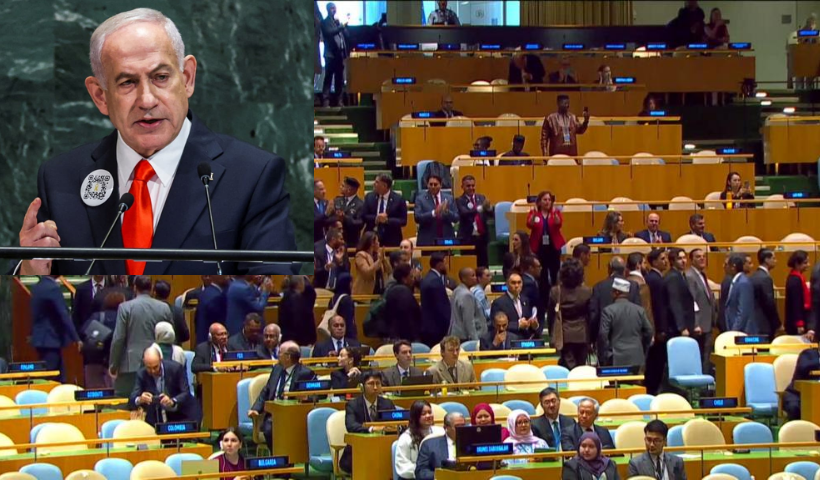
United Nations, September 26, 2025: Israeli Prime Minister Benjamin Netanyahu’s address to the United Nations General Assembly on Friday triggered a mass walkout by several delegations, even as cheers erupted from supporters invited to the hall.
Opening the day’s speeches, Netanyahu declared that Israel had “crushed the bulk” of Hamas’s “terror machine” and vowed to finish the job “as fast as possible.” He highlighted what he called a series of Israeli strategic victories over the past year, including strikes on Iran’s nuclear program and the assassination of Hezbollah leader Hassan Nasrallah in Lebanon.
But the address was delivered against a backdrop of renewed bloodshed in Gaza. The enclave’s civil defence agency, operating under Hamas authority, reported at least 22 deaths across the territory since dawn on Friday, including 11 in Gaza City. The Israeli military confirmed its air force had hit “over 140 targets,” including tunnel shafts and military infrastructure, as its ground offensive pressed deeper into Gaza City, displacing hundreds of thousands.
Scenes of devastation continued, with bombed-out facades, tangled electric wires, and families — including children — combing rubble for belongings.
Meanwhile, the UN on Friday released a long-awaited update to its database of companies linked to Israeli settlements in occupied Palestinian territories, listing 158 firms from 11 countries.
UN rights chief Volker Turk condemned Israel’s settlement policy as a “war crime” and urged businesses to ensure they are not complicit in human rights abuses. “This report underscores the due diligence responsibility of businesses working in contexts of conflict,” he said.
Well-known international companies such as Airbnb, Booking.com, Motorola Solutions and TripAdvisor remained on the list, while some, including Alstom and Opodo, were removed. The updated database, the first since 2023, added 68 new companies, mainly with direct ties to construction, real estate, mining and quarrying in West Bank settlements.
First published in 2020, the list was mandated by a UN Human Rights Council resolution to track firms profiting from activities in settlements deemed illegal under international law. The rights office stressed that the database is neither judicial nor exhaustive but aims to pressure companies into corrective action.
The timing of the release — coinciding with Netanyahu’s UN appearance — underscored the deepening scrutiny of Israel’s policies. As delegations filed out in protest and rights bodies renewed calls for accountability, Netanyahu now faces a dual challenge: pressing forward with Israel’s military campaign while navigating growing international isolation over settlements and civilian casualties.