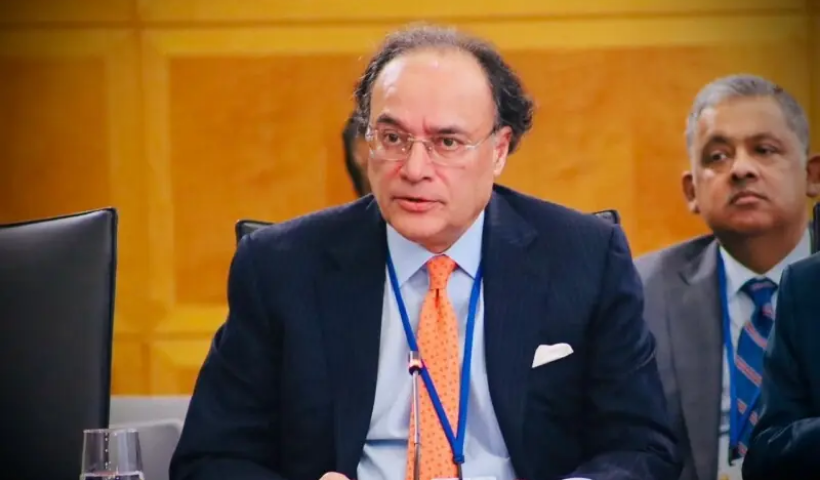
Islamabad, October 22, 2025: Finance Minister Muhammad Aurangzeb has expressed optimism that Pakistan could achieve close to 3.5 per cent gross domestic product (GDP) growth during the ongoing fiscal year, despite the economic impact of recent floods.
In an interview with CGTN America’s programme One on One, aired on Tuesday, the finance minister said climate change had become an “existential issue” for Pakistan.
“We are living it day in and day out,” Aurangzeb remarked, recalling the devastation caused by successive floods. “We grew at 3 per cent GDP last year. We had estimated a little over 4 per cent growth this year, but given the flood situation, this will shave off a certain percentage. Still, I am quite hopeful we can manage anything close to 3.5 per cent during this fiscal year.”
Discussing economic recovery efforts, Aurangzeb said the government had “consolidated gains on the macroeconomic stability front,” highlighting that inflation was now in single digits and the policy rate had been halved. “As a result, all global rating agencies — Fitch, S&P, and Moody’s — have upgraded us during the course of this year after a hiatus of nearly three years,” he added.
Referring to Pakistan’s ongoing engagement with the International Monetary Fund (IMF), the minister said a staff-level agreement reached earlier this month would allow Pakistan to access $1.2 billion following board approval. He noted that the Fund had shown “trust and confidence” in Pakistan’s economic management and commitment to structural reforms, particularly in taxation, energy, and public finance.
Aurangzeb acknowledged that privatisation had been a weak area in the past but noted progress with the sale of a small public-sector bank to a UAE investor. “WeFitch are also sanguine that Pakistan International Airlines (PIA) will be privatised before the end of this year,” he said.
The finance minister further revealed that Pakistan had returned to commercial borrowing markets after a gap of two and a half years, securing funding from Middle Eastern banks. “We are now looking forward to printing the inaugural Panda Bond before the year is out,” he added, noting that the government was refreshing its global medium-term note (GMTN) to explore further international bond issuances next year.
Speaking on Pakistan-China relations, Aurangzeb described the partnership as “ironclad” and said the China-Pakistan Economic Corridor (CPEC) had now entered its second phase. “Phase one was about infrastructure. Phase two is about monetisation — using special economic zones and facilitating private-to-private sector cooperation,” he explained.
He said Pakistan was now seeing “traction” in bilateral cooperation, with 24 joint venture agreements signed during Prime Minister Shehbaz Sharif’s recent visit to Beijing. “We have moved from MoUs to JVs, which shows real progress,” he added.
Aurangzeb said CPEC Phase II would focus on boosting trade, investment, and technology cooperation. “We are working on expanding our $19 billion-plus trade volume and upgrading our Free Trade Agreement. The focus areas for investment include minerals, mining, agriculture, artificial intelligence, and IT,” he said.
The minister also underscored the importance of developing Pakistan’s pharmaceutical and vaccine production capabilities in collaboration with Chinese firms. “The Covid-19 pandemic showed us how critical it is to have local vaccine manufacturing capacity. This is one of the key areas where we can work with Chinese enterprises,” he concluded.