By Qurat-ul-Ain Haider, Director, Media Coordination and Outreach, Benazir Income Support Programme (BISP)
In a country where almost 40 percent of children under five face the silent crisis of stunting, Benazir Nashonuma Programme has emerged as a story of hope and evidence-based impact. Operating under the Benazir Income Support Programme (BISP), Pakistan’s largest social protection initiative, it represents a defining moment in the nation’s fight against malnutrition — a model where science meets compassion and policy translates into human progress.
A midterm independent evaluation by the Aga Khan University’s Institute for Global Health and Development confirmed a national breakthrough: a 6.4 percent reduction in child stunting, a 5.6 percent decrease in low birth weight, and a 7–8 percent drop in babies born too small or too weak in target areas. Even more striking is the 20 percent reduction in stunting among six-month-old infants whose mothers joined the programme during early pregnancy and stayed through breastfeeding. Behind these figures are real lives, women, children, and families whose futures have quietly transformed.
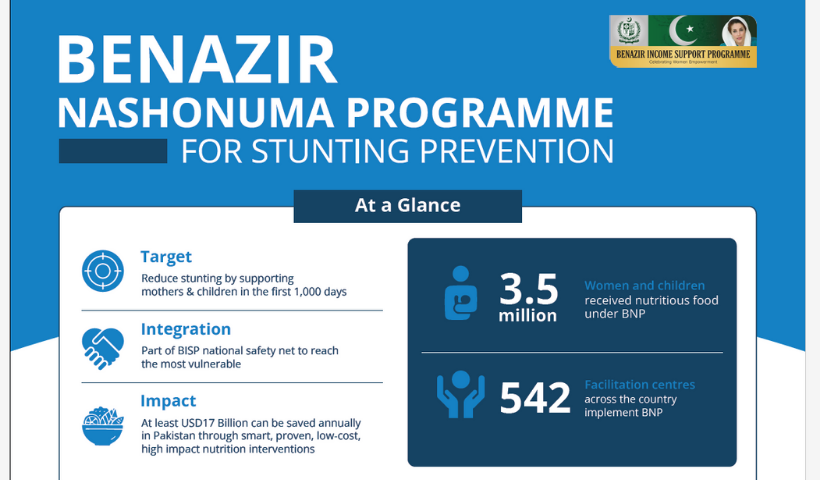
Launched in 2020, Nashonuma is rooted in a simple but transformative idea: investing in mothers is investing in a nation’s future. The programme focuses on the crucial first 1,000 days, from conception to a child’s second birthday, a window that determines lifelong growth and cognitive potential. Through 542 facilitation centers in 156 districts, it has reached over 3.5 million women and children. These centers provide antenatal and postnatal care, growth monitoring, immunization, and awareness sessions on nutrition and hygiene. Mothers also receive locally produced nutritious food supplements and conditional cash stipends to sustain healthy practices at home.
Step into a Nashonuma center in rural Sindh or Balochistan, and the transformation is visible. Mothers arrive not just for assistance but with a sense of ownership. Health workers use digital systems to track growth and progress, while nutrition counselors educate families about breastfeeding, complementary feeding, and hygiene. The atmosphere feels less like a clinic and more like a community of care.
International partners have played a central role in this effort. The World Health Organization (WHO), the World Food Programme (WFP), and UNICEF have all contributed technical, operational, and advocacy support, helping transform the government’s vision into measurable impact.
“WHO is thankful to BISP and its partners for this collaboration to protect and save lives,” said Dr. Dapeng Luo, WHO Representative in Pakistan. “The results are excellent, but even a single child lost to malnutrition is one too many. Each child has a story and a family with dreams for their future, and we must leave no one behind.”
UNICEF’s Representative, Pernille Ironside, described the programme as a partnership rooted in human rights, development, and resilience: “At the heart of our work with BISP is every child’s right to grow up healthy and strong. By engaging communities, empowering mothers and adolescent girls with knowledge and better nutrition, we are breaking the cycle of malnutrition and helping families build brighter futures.”
For Coco Ushiyama, Country Director of WFP Pakistan, Nashonuma represents “a model of government leadership and partnership in action.” She added, “A 20 percent reduction in stunting among infants at six months of age is an unprecedented achievement – for Pakistan and globally. When social protection and nutrition come together, the results are transformative. Investing in nutrition is one of the smartest investments a country can make for its future generations.”
Dr. Zulfiqar Bhutta of Aga Khan University called the findings “among the strongest globally.” He emphasized that investing in early nutrition “pays off for generations” and that Pakistan’s progress represents “a powerful return on investment for human capital.”
Yet beyond the data lies the human story the quiet, consistent transformation taking place in Pakistan’s most remote corners. In a small fishing village in Ormara, Balochistan, Rozina, a mother of four, arrived weak and malnourished at her nearest Nashonuma center. After months of counseling, care, and nutritious supplements, her strength returned. Her youngest daughter, Misra, was born healthy. “When I see my children now, I don’t see the shadows of sickness,” she says. “I see a future filled with hope.”
In the mountains of Khyber Pakhtunkhwa, Raham Bibi learned for the first time that the first 1,000 days determine a child’s lifelong health. Her youngest, Habiba, now thrives. “They respected me and taught me that my care matters,” she says softly. “That changed everything.”
Such stories of strength embody the essence of the Benazir Nashonuma Programme an initiative that restores dignity through empathy and delivers measurable results through science. As Senator Rubina Khalid, Chairperson BISP, explained, “The findings provide clear evidence that social protection, when linked with nutrition interventions, delivers meaningful results for vulnerable women and children. Pakistan’s success with Nashonuma proves that large-scale solutions to malnutrition are not only possible but effective. At BISP, we firmly believe that a healthy mother is the foundation of a healthy nation.”
The programme also aligns closely with Pakistan’s broader development agenda and the Sustainable Development Goals (SDGs): eradicating poverty, ending hunger, promoting health, and empowering women. It embodies the philosophy that social protection is not just about assistance; it is about opportunity, empowerment, and transformation.
Backed by the Bill & Melinda Gates Foundation and grounded in rigorous research, the Benazir Nashonuma model is now drawing international attention as a pioneering example of how conditional cash transfers can be effectively integrated with nutrition and health interventions. In a world struggling with rising food insecurity, climate pressures, and widening inequality, Pakistan’s approach stands as proof that well-designed national programmes can deliver both scale and substance.
The story is far from over. The final evaluation in 2026 will measure long-term outcomes, but the visible progress is already reshaping lives. For millions of mothers and children, Nashonuma has become more than a programme — it is a silent movement that is instilling care and confidence in mothers and families.
As one mother in Sindh said, “This programme didn’t just feed my child. It taught me how to care for my family.” Her words embody a transformation that no statistic can measure — a movement of mothers nurturing a healthier, more resilient Pakistan.
Bio: Qurat-ul-Ain Haider is Director Media Coordination and Outreach at BISP, a seasoned communication strategist and trainer. She is also a columnist whose writings explore international issues, social issues, social policy, developmental journalism, and public discourse in Pakistan.