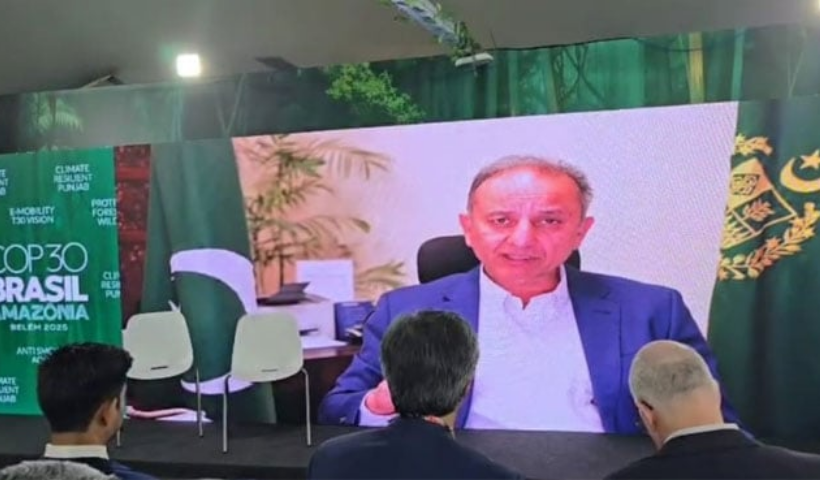
Islamabad, November 16,2025: Minister for Climate Change Dr Musadik Malik has called for accelerated global efforts to tackle climate-induced glacial melt in the Himalayas–Karakoram–Hindu Kush (HKH) region, warning that glaciers were disappearing at an “unprecedented rate” due to rising temperatures.
Speaking via video link at a COP30 side event titled “Cryosphere Adaptation & Disaster Risk Reduction”, the minister said Pakistan — home to nearly 13,000 glaciers — was already witnessing severe climate impacts, including glacial lake outburst floods (GLOFs), threatening millions of people who depend on the Indus River system.
His remarks come against the backdrop of a 2023 International Centre for Integrated Mountain Development (ICIMOD) report, which found Himalayan glaciers — a critical water source for almost two billion people — are melting faster than ever, increasing the risk of unpredictable and costly disasters.
Calling the HKH region the “white rooftops of the world” and the “primary lifeline of millions across South Asia”, Malik stressed the urgent need for coordinated regional and global action to protect the cryosphere.
The event, organised by Pakistan’s Ministry of Climate Change & Environmental Coordination in partnership with ICIMOD, was also attended by deputy ministers from Türkiye and Azerbaijan, the ICIMOD director-general, and senior representatives from Nepal, Bhutan, UNESCO, UNDP and the Asian Development Bank (ADB), according to a Press Information Department (PID) release on Saturday.
“Pakistan hosts 13,000 glaciers that feed the Indus River system and sustain our agricultural, ecological and economic foundations,” Malik said, adding that accelerated glacier melt was already resulting in major losses and damages.
A GLOF — a sudden release of water from a glacial lake — can trigger catastrophic downstream flooding, a threat Pakistan has increasingly faced over recent years.
Terming the issue one of “justice and rights”, the minister said that 70 per cent of global carbon emissions originate from just 10 countries, while these same nations receive 85pc of global green finance.
He urged historically high-emitting countries to contribute their fair share to adaptation and resilience efforts in vulnerable mountain regions, calling on the global community to place the cryosphere high on the COP30 agenda.
Malik also highlighted Pakistan’s “leadership” in climate action through its updated Nationally Determined Contributions (NDC 3.0).
According to ICIMOD, glaciers in the HKH region support around 240 million people living in the mountains and another 1.65 billion people in the downstream river basins. Current emissions trends could cause the glaciers to lose up to 80pc of their volume by 2100, the Nepal-based organisation warns.