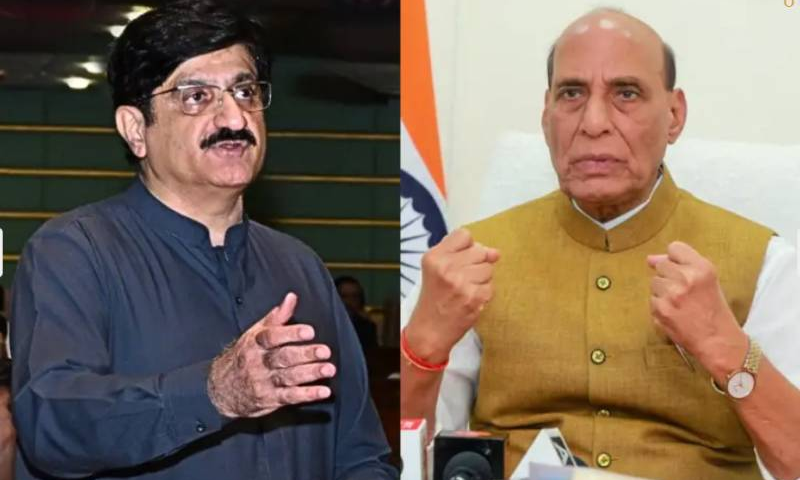
Karachi, November 27, 2025: The Sindh Assembly on Thursday unanimously passed a strongly worded resolution rejecting recent remarks by India’s defence minister regarding Sindh, denouncing them as inflammatory, revisionist and a deliberate distortion of history.
Moved by PPP lawmaker Mukesh Chawla, the resolution “unequivocally condemns” the comments as delusional and asserts that Sindh “is, and will forever remain, an inseparable part of Pakistan.” It calls on the federal government to pursue diplomatic and legal action at the international level.
The resolution further rejects what it describes as “revisionist and expansionist claims emanating from India,” accusing the Modi government of promoting extremist policies that threaten regional peace. It also warns that New Delhi is attempting to weaponise water resources, posing serious risks to environmental security.
Urging Islamabad to safeguard Pakistan’s Indus water rights, the document calls for holding India accountable for treaty violations and environmental harm. It also expresses solidarity with communities “within Pakistan and across India” who reject extremism and promote coexistence.
‘Sindh existed long before the pre-BC era,’ CM Murad says
Speaking on the floor of the House, Sindh Chief Minister Murad Ali Shah said the Indian defence minister had delivered a “highly condemnable” statement that ignored historical realities.
“The resolution we have presented narrates the entire history,” he said, noting that Sindh existed “long before the pre-BC era” and historically extended to Multan and Makran. “Our elders’ sacrifices created Pakistan. We are sitting here today because we helped build this country.”
In a pointed remark, CM Murad said the Indian minister “has never drunk the water of the Indus, which is why his mind is unsettled,” adding that “those who drink from the Indus cannot betray this land.” He claimed India’s “panic began after May’s conflict.”
Jamaat-e-Islami MPA Muhammad Farooq termed the Indian minister’s remarks an outcome of “frustration and isolation,” mocking India’s defence industry by saying: “At air shows, your planes fall from the sky.” He reminded the House that the Pakistan Resolution was first passed in the Sindh Assembly, adding: “India should worry about itself, not us.”
MQM-P MPA Abdul Waseem said India had “nothing left to do” except issue provocative statements. “Stop dreaming,” he said, warning that such rhetoric only escalated regional tensions. “We saw what happened to you in May,” he added, condemning the remarks “in the strongest terms.”
Education Minister Syed Sardar Shah dismissed the Indian defence minister’s understanding of history: “He knows nothing. Rajasthan and Amritsar were historically parts of Sindh — we could make that claim, not India.” He added that Kashmir too had historical alignment with Pakistan and accused India of “point-scoring to hide its failures and weak defence system.”
Minister Saeed Ghani said Pakistan’s armed forces and people had “always faced India with courage,” asserting: “India may have a larger army and economy, but it cannot match Pakistan in battle.” He said Prime Minister Narendra Modi lacked the courage to brief his own people on wartime matters, predicting that “India will break into several pieces.”
“Pakistan is one,” Ghani concluded. “Sindh is part of Pakistan and will always remain so.”
The debate followed Indian media reports quoting Defence Minister Rajnath Singh as claiming that Sindh, though not part of India today, remained part of India “civilisationally,” saying “borders can change … who knows, tomorrow Sindh may return to India again.” Singh also claimed many Sindhi Hindus of his generation had never accepted the province’s accession to Pakistan.