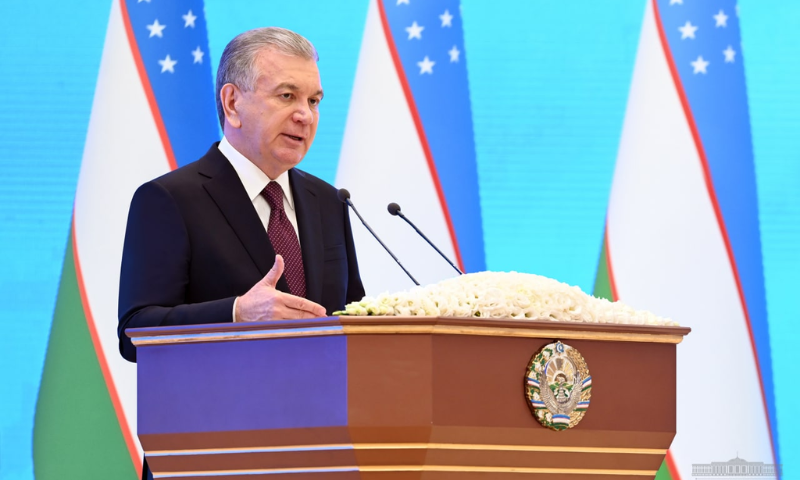
Tashkent, December 31,2025: President of Uzbekistan Shavkat Mirziyoyev has placed strong emphasis on socio-economic development, improving citizens’ well-being and enhancing the competitiveness of the national economy, according to Akramjon Ne’matov, First Deputy Director of the Institute for Strategic and Interregional Studies (ISRS) under the President of Uzbekistan.
In a commentary on the President’s address to the Oliy Majlis and the people of Uzbekistan, Ne’matov highlighted the key messages conveyed to both domestic and international audiences. He said the address clearly underscored that economic sustainability, development resilience and the quality of growth now define Uzbekistan’s opportunities at home and abroad.
Despite a challenging and fragmented global environment, Ne’matov noted that Uzbekistan’s economy continues to demonstrate stable growth. For the first time in the country’s history, GDP has surpassed $145 billion, a milestone that was considered highly ambitious just nine years ago. Exports increased by 23 percent to $33.4 billion despite global supply chain disruptions, while electricity production in 2025 reached 85 billion kilowatt-hours. Foreign exchange reserves exceeded $60 billion, and more than $43.1 billion in investments were attracted this year, raising the investment-to-GDP ratio to 31.9 percent and reflecting the country’s growing investment appeal.
The expert said that while maintaining high growth rates remains a top priority, a notable shift is underway from quantitative expansion to a technological and innovation-driven development model. This includes building a knowledge-based economy, modernising industry, advancing the digital economy, promoting scientific research and facilitating technology transfer. An innovative economy, he stressed, is essential for long-term competitiveness and reducing reliance on raw materials amid global uncertainty.
Another major priority highlighted in the address is the stimulation of domestic demand. Ne’matov explained that strengthening the domestic market—through higher household incomes, support for small and medium-sized enterprises and expanded access to financial instruments—is seen as a key driver of sustainable growth and a buffer against external economic shocks.
Special attention was also given to workforce development and labour market reform. According to the expert, the President outlined plans to modernise vocational education, develop new skills and create a flexible labour market aligned with the needs of a modern economy. Human capital, he noted, is recognised as the most critical resource of the 21st century.
Environmental sustainability also featured prominently in the address. Ne’matov said priorities include ensuring ecological balance, expanding “green” energy, improving energy and water efficiency and adapting to climate change. These measures are now regarded as central to national security and long-term sustainable development.
In addition, the President highlighted the importance of modern state governance and a fair judicial system. Key objectives include enhancing transparency and accountability in public administration, strengthening the rule of law, digitising public services and continuing judicial reforms. Effective governance, the expert noted, builds public trust, boosts investor confidence and ensures long-term stability.
Ne’matov said these priorities reflect Uzbekistan’s transition from quantitative growth to a qualitative model of modernisation focused on long-term outcomes. Based on these strategic directions, the country is also shaping a new framework for international cooperation.
Key cooperation priorities include technological and industrial partnerships through joint high value-added production and collaborative research, human capital development via education and training programmes, cooperation in green energy and resource efficiency, infrastructure and connectivity development, and institutional reforms to improve governance and public administration.
Concluding his commentary, Akramjon Ne’matov emphasised that Uzbekistan views cooperation with foreign partners as a strategic priority, aiming to move toward high-quality, long-term partnerships centred on technology, human capital and sustainable growth that serve the mutual interests of all sides.