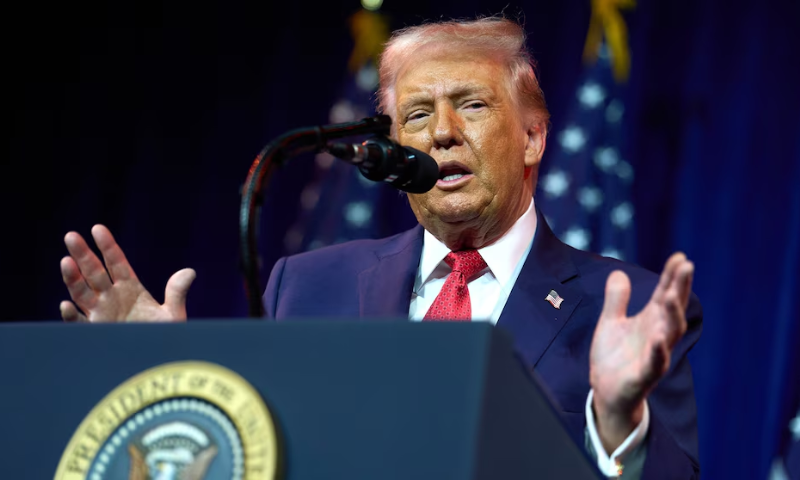
Washington, January 8, 2026: US President Donald Trump has said the United States could oversee Venezuela and control its oil revenues for an extended period, signalling a long-term role following Washington’s recent military intervention in the country.
In a wide-ranging, two-hour interview with The New York Times published on Thursday, Trump said it was too early to define how long US oversight would last. When asked whether it could be months or a year, he replied: “I would say much longer.”
Trump said the United States intended to rebuild Venezuela “in a very profitable way” after US forces seized President Nicolas Maduro in a night raid on January 3. He added that Washington would utilise Venezuela’s vast oil resources to stabilise global prices while providing financial support to the country.
“We’re going to be using oil, and we’re going to be taking oil. We’re getting oil prices down, and we’re going to be giving money to Venezuela, which they desperately need,” Trump said.
The US president said Washington was “getting along very well” with the government of interim President Delcy Rodríguez, a longtime Maduro ally who previously served as vice president. He declined to say whether he had personally spoken with Rodríguez but noted that Secretary of State Marco Rubio was in frequent contact with her. “We are in constant communication with her and the administration,” Trump said.
Trump also declined to explain why power was not handed to Venezuela’s opposition, which Washington had previously recognised as the legitimate winner of the 2024 election.
On Tuesday, Trump unveiled a plan to refine and sell up to 50 million barrels of Venezuelan oil that had been stranded under US sanctions. He said the current Venezuelan authorities were cooperating with US demands. “They’re giving us everything that we feel is necessary,” he said.
The interview also suggested a de-escalation in tensions with neighbouring Colombia. Trump appeared to walk back earlier threats of military action against Bogotá and invited Colombian President Gustavo Petro to visit Washington.
The New York Times reported that its journalists were permitted to observe a phone call between Trump and Petro, with the understanding that the contents would remain off the record. Trump later described the conversation as positive, saying on social media that he appreciated Petro’s “call and tone” and looked forward to meeting him.
Petro, who had previously been sharply criticised by Trump, described the call as cordial. Earlier this week, Trump had threatened military action against Colombia, accusing Petro of involvement in drug trafficking.
According to the newspaper, the hour-long call “appeared to dissipate any immediate threat of US military action” against Colombia.
Trump’s use of force in Venezuela has sparked unease among some Republicans, particularly given his long-standing criticism of US military interventions abroad. The US Senate is due to consider a resolution on Thursday that would block further military action without congressional authorisation.
While Republicans hold 53 seats in the Senate, recent votes on similar measures have been close. Senator Rand Paul, a Republican co-sponsoring the resolution, said additional members of his party were now reconsidering their positions.
Senior US officials said on Wednesday that Washington may need to control Venezuela’s oil sales and revenues indefinitely to revive the country’s energy sector and rebuild its economy. Venezuela holds the world’s largest proven oil reserves but has suffered economic collapse in recent years, forcing around eight million people to flee abroad.
Trump is scheduled to meet the heads of major oil companies at the White House on Friday to discuss boosting Venezuelan oil production. Representatives from Exxon Mobil, ConocoPhillips and Chevron—companies with longstanding experience in Venezuela—are expected to attend, according to a source familiar with the plans. The companies declined to comment.
Washington and Venezuela’s opposition have long blamed corruption, mismanagement and repression by the ruling Socialist Party for the country’s decline, while Maduro has repeatedly accused US sanctions of crippling the economy.