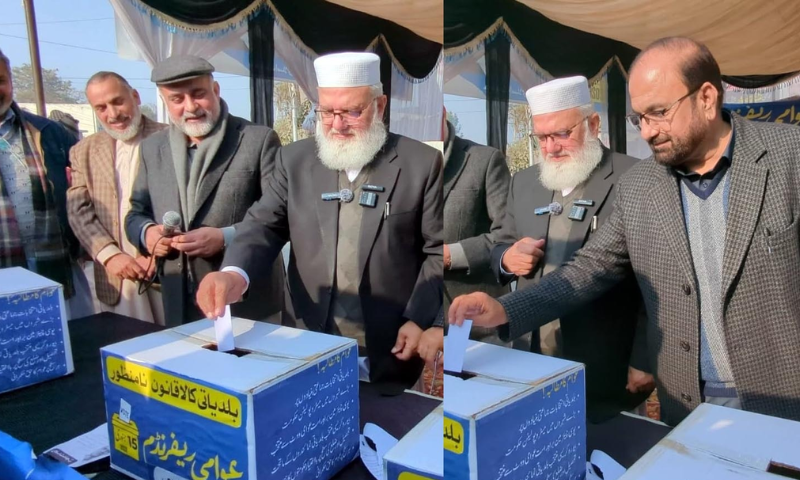
Islamabad, January 15, 2026: A four-day public referendum against the Punjab Local Government Act has commenced across all districts of Punjab, drawing active participation from citizens of diverse backgrounds and viewpoints. The initiative, organized by Jamaat-e-Islami (JI), has reportedly witnessed widespread public engagement and enthusiasm throughout the province.
JI workers have established referendum booths and camps at the union council level, as well as in prominent public spaces including markets, bus stands, railway stations, mosques, streets, and major intersections. Ballot boxes are also being carried door-to-door to ensure maximum participation, enabling citizens to express their opinions on the controversial local government law.
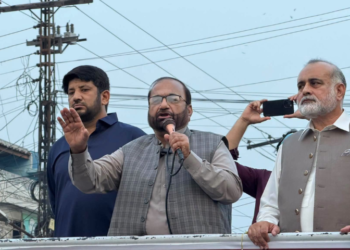
As part of the campaign, Naib Ameer Jamaat-e-Islami Pakistan Liaquat Baloch and Ameer Jamaat-e-Islami Punjab Dr. Tariq Saleem addressed a public gathering at Kachhari Chowk, Gujrat, while Secretary General JI Punjab Iqbal Khan inaugurated a referendum camp in Attock and visited multiple districts to oversee the process.
Speaking to participants, Liaquat Baloch criticized the Punjab Local Government Act as undemocratic and unconstitutional. He said, “Previously, the Senate and National Assembly became centers of horse-trading. Now, through non-party-based local government elections, the ruling elite intends to extend this practice to the grassroots level.” He added that the law strips the public of decision-making authority by placing local government institutions under bureaucratic control. He reiterated JI’s commitment to resist the law and force the government to withdraw it, stating that transferring administrative, financial, and decision-making powers from elected representatives to the bureaucracy lacks constitutional justification.
Dr. Tariq Saleem and Iqbal Khan elaborated that the referendum seeks public opinion on key demands, including holding party-based local government elections, conducting direct elections for Union Council Chairmen and Vice Chairmen, granting full financial, political, and administrative autonomy to local governments, and ensuring that district bureaucracy is accountable to elected representatives.
They emphasized that the referendum aims to gauge the views of millions of citizens across Punjab on the Act, which they described as a direct attack on democratic and constitutional rights. They asserted that public issues cannot be effectively addressed unless local governments are provided complete autonomy.
The leaders demanded immediate amendments to the Local Government Act, restoration of direct elections for mayors and chairmen, and full authority for elected representatives to manage development funds. They also called for constitutional protection of local government institutions to ensure empowered, transparent, and effective governance at the grassroots level, enabling tangible relief for citizens and a genuine transfer of power to local communities.