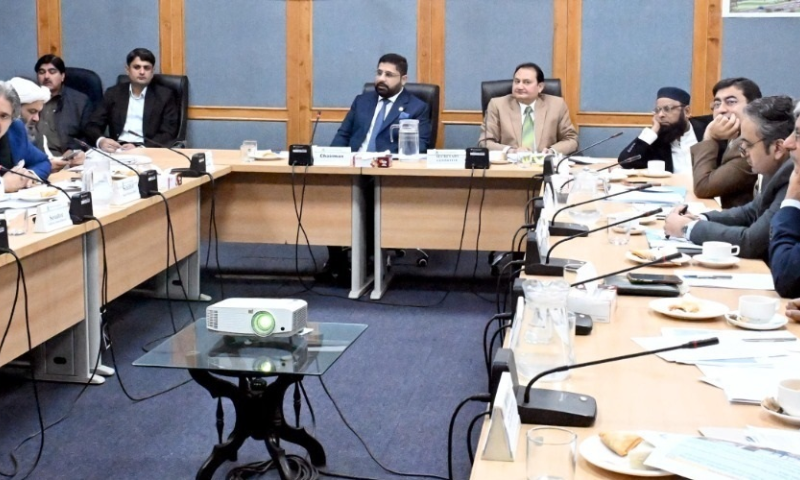
Islamabad, February 2, 2026: The Senate Standing Committee on Kashmir Affairs, Gilgit-Baltistan, and States and Frontier Regions (SAFRON) held a detailed meeting on Monday at the Old PIPS Hall, Parliament Lodges, Islamabad, to review key governance, humanitarian, environmental, and security-related issues concerning Azad Jammu and Kashmir (AJK), Gilgit-Baltistan (GB), and the repatriation of Afghan refugees.
The meeting was chaired by Senator Asad Qasim and attended by Senators Nadeem Ahmed Bhutto, Faisal Saleem Rehman, Nasir Mehmood, and Atta-ul-Haq.
The Committee was briefed on the implementation status of recommendations from its previous meeting in Skardu (October 21–22, 2025). Members conducted a detailed review of the post-flood situation in Gilgit-Baltistan, raising concerns about the deteriorating condition of early warning systems. Authorities informed the Committee that a Rs 336 million project proposed by the Directorate General of Meteorology had been sent to the Ministry of Climate Change, but no response had been received so far.
Additional Chief Secretary Gilgit-Baltistan, Mushtaq Ahmed, reported that screens and dashboards had been installed in Deputy Commissioner offices, enabling real-time data monitoring. Currently, 115 early warning systems are operational across the region.
The Committee was briefed on forest conservation measures in GB, including the establishment of Forest Conservation Committees (FCCs) at the village level. Around 30 FCCs are active with Forest Department support, while 54 committees protect over 30,000 hectares in collaboration with the department. Assisted Natural Regeneration Committees operate under Forest Department supervision, recruiting guardians and actively preventing illegal logging, managing pastures, and monitoring forests. Senators requested data on plantations and policies regarding confiscated wood.
The Committee discussed recent unrest in AJK, including demands by the Awami Action Committee, which were observed as potentially challenging to national unity. However, deliberations could not proceed due to the non-participation of the Chief Secretary of AJK for the second consecutive meeting. The agenda was deferred, with the direction that the Chief Secretary ensure participation in the next session.
The Ministry of Interior and the Chief Commissionerate for Afghan Refugees briefed the Committee on the repatriation process. Following an SRO issued on July 31, 2025, Afghan refugees holding Proof of Registration (PoR) cards were declared illegal, with a one-month grace period until September 1, 2025, for voluntary return. Deportations subsequently commenced, coordinated by provincial governments with support from NADRA, UNHCR, and Afghan Commissionerates.
Voluntary Repatriation Centers were established at 11 NADRA Proof of Card Modification centers, providing de-registration from NADRA’s ANR database and transport to border points. In 2025, a total of 1,155,221 Afghan nationals were repatriated, including:
- 163,429 PoR card holders
- 74,943 Afghan Citizen Card holders
- 509,671 undocumented individuals
- 407,178 voluntary returnees
Currently, 54 Afghan refugee camps exist nationwide: 43 in Khyber Pakhtunkhwa, 10 in Balochistan, and one in Punjab. Senators requested detailed year-wise and district-wise data from 2005 to 2025 regarding Afghan nationals in Pakistan.
The Committee concluded the meeting with directions for enhanced coordination, accountability, and timely compliance with its recommendations, emphasizing the broader national interest in governance, security, environmental conservation, and refugee management.