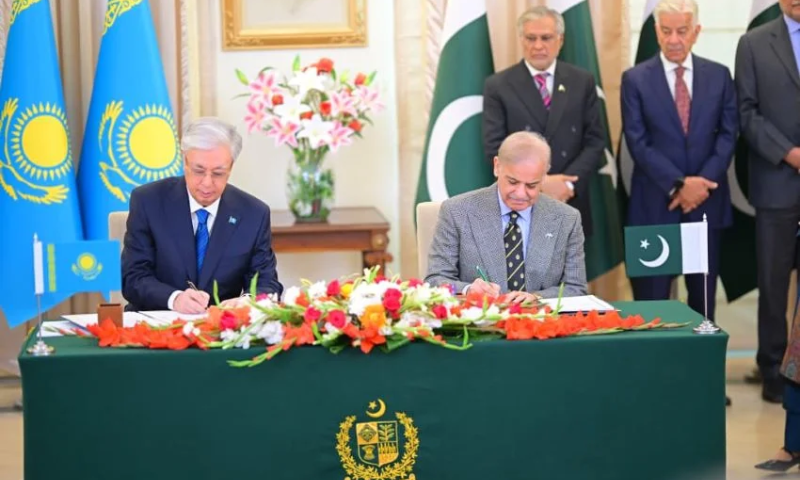
Islamabad, February 4, 2026: Pakistan and Kazakhstan on Wednesday signed a joint declaration establishing a strategic partnership, marking a historic milestone in bilateral relations between the two countries.
The declaration was signed by Kazakh President Kassym-Jomart Tokayev and Prime Minister Muhammad Shehbaz Sharif following high-level talks in Islamabad.
Addressing a joint press briefing, Prime Minister Shehbaz described the signing as a “historic moment” for the two brotherly nations and underscored their shared commitment to peace, progress, and prosperity. He noted that bilateral trade currently stands at $250 million and called for collective efforts to raise it to $1 billion within the next year, urging business communities from both countries to pursue joint ventures.
The prime minister said both sides had agreed to develop the Belarus–Russia–Kazakhstan–Uzbekistan–Afghanistan–Pakistan transport corridor to enhance regional connectivity. He added that Pakistan has offered Kazakhstan full access to its transit infrastructure and seaport facilities.
Highlighting the immense natural resources of both countries, Shehbaz Sharif said collaboration in the energy sector would be a win-win situation. He affirmed that Pakistan recognizes Kazakhstan as a strategic and highly valued partner in Central Asia and assured swift implementation of the 37 memorandums of understanding (MoUs) signed to strengthen cooperation in trade, economy, and culture.
In his remarks, President Tokayev described Pakistan as a reliable and important partner in South Asia and beyond, calling it a brotherly country with a rich history, vibrant culture, and well-established international standing.
He said the peoples of both nations are united by centuries-old ties rooted in the legacy of the Great Silk Road, as well as deep cultural and spiritual affinity. “The two nations share common values, traditions, and joint aspirations for the future,” he added.
Describing the declaration as historic, the Kazakh president said it would open immense opportunities to expand engagement across the full spectrum of bilateral and multilateral cooperation by elevating relations to a new level.
Praising Prime Minister Shehbaz Sharif, the visiting president said he is widely recognized as a wise and visionary leader steering the country forward, adding that Pakistan’s regional and global standing continues to grow.
Referring to Pakistan’s role in the UN Security Council, Tokayev said its constructive and responsible steps have contributed meaningfully to strengthening peace and stability in the region.
The Kazakh leader also acknowledged Pakistan’s strong economic potential, developed industrial capacity, and extensive transit and transport capabilities, noting that its agricultural and medical products are widely represented in international markets.
He said the dynamic development of Pakistan’s defense industry is globally recognized and welcomed expanded cooperation in this sector. He added that collaboration between the two countries’ security and law enforcement agencies has been progressing steadily in recent years.
President Tokayev reiterated that both sides have agreed to enhance bilateral trade to $1 billion in the near future, with priority given to transport and logistics projects aimed at facilitating higher trade volumes. The two leaders also discussed the capabilities of Karachi and Gwadar ports and agreed to explore the possibility of resuming direct air connections.
The president said discussions also focused on implementing energy projects and reviewing prospects for the Turkmenistan-Afghanistan-Pakistan-India (TAPI) gas pipeline.
Earlier, the two sides signed 37 MoUs and agreements to promote cooperation across diverse fields, including petroleum, mining and geosciences, maritime affairs, customs, railways, agriculture, artificial intelligence and digital development, health, education, science and technology, news exchange and broadcasting, professional development, climate change and environmental protection, economy, culture, humanitarian collaboration, crime prevention, and sports.
Additionally, a treaty on extradition and a transit trade agreement were signed, further reinforcing the framework for long-term partnership between the two nations.