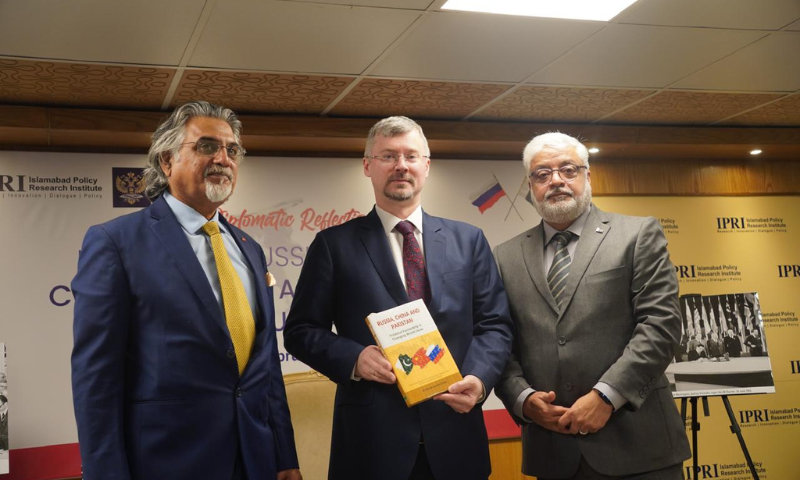
Islamabad, February 9, 2026: Russian Ambassador to Pakistan Albert P. Khorev underscored the strengthening partnership between Russia and Pakistan while outlining the legacy of Russian diplomacy at a seminar titled “Legacy of Russian Diplomacy: Current State and Prospects of Russia-Pakistan Relations” held at the Institute of Policy Research (IPRI).
Addressing the gathering ahead of Russia’s Diplomats’ Day, observed annually on February 10, Ambassador Khorev traced the origins of Russian diplomacy back to 1549, when the country established its Ambassadorial Service. He highlighted key milestones in Russia’s diplomatic evolution, emphasizing the role of prominent statesmen in shaping the country’s foreign policy and global engagement.
Turning to bilateral ties, the ambassador noted that diplomatic relations between Russia and Pakistan were established in 1948 and have steadily expanded despite challenges during the Cold War. He recalled Soviet assistance in developing Pakistan’s energy infrastructure, including metallurgical and thermal power projects.
Khorev stated that cooperation gained fresh momentum in the 2000s as Russia pursued a multi-vector foreign policy and increased engagement with countries in the Global South. “Today, we can confidently say that the friendship between Russia and Pakistan is growing stronger every year,” he said, citing a dynamic political dialogue and regular high-level contacts, including two leadership meetings last year in Beijing and Ashgabat.
He also highlighted robust interparliamentary exchanges, noting recent visits by parliamentary leaders and Russian participation in the Inter-Parliamentary Speakers’ Conference in Islamabad. The two countries maintain consultative mechanisms on bilateral and regional issues, strategic stability, counterterrorism, and emerging security challenges, he added.
The ambassador stressed that Moscow and Islamabad coordinate closely at international forums such as the United Nations and the Shanghai Cooperation Organization, sharing commitments to a multipolar world order, equitable trade, cultural preservation, and the fight against terrorism, extremism, and discrimination.
On economic cooperation, Khorev identified several promising projects, including the revival of Karachi Steel Mills, potential railway connectivity via the North-South International Transport Corridor, joint pharmaceutical production, hydropower development, and oil and gas exploration. He said both sides are also exploring alternative payment mechanisms and pilot barter arrangements to ensure uninterrupted trade amid anti-Russian sanctions.
The envoy pointed to opportunities for Pakistan’s engagement with BRICS, its New Development Bank, and the Eurasian Economic Union, describing them as avenues for expanded economic collaboration.
Highlighting people-to-people contacts, Khorev noted that Russia tripled scholarships for Pakistani students last year to 152 and continues to promote educational and cultural exchanges through Russian language centers and initiatives such as the “Russian Teacher Abroad” program.
He added that the Russian Embassy remains committed to advancing comprehensive bilateral relations, referencing recent events including the 10th Intergovernmental Commission meeting, a cultural performance at the Pakistan National Council of the Arts, and the installation of a monument to cosmonaut Yuri Gagarin in Islamabad.
“We will continue working to realize the full potential of Russia-Pakistan relations,” the ambassador concluded.