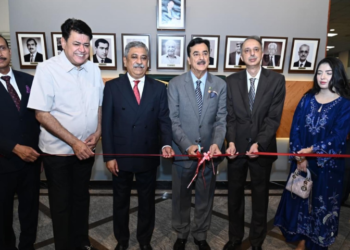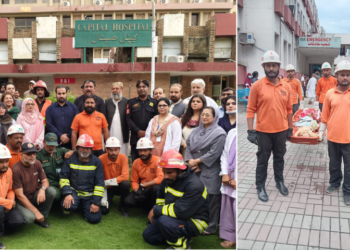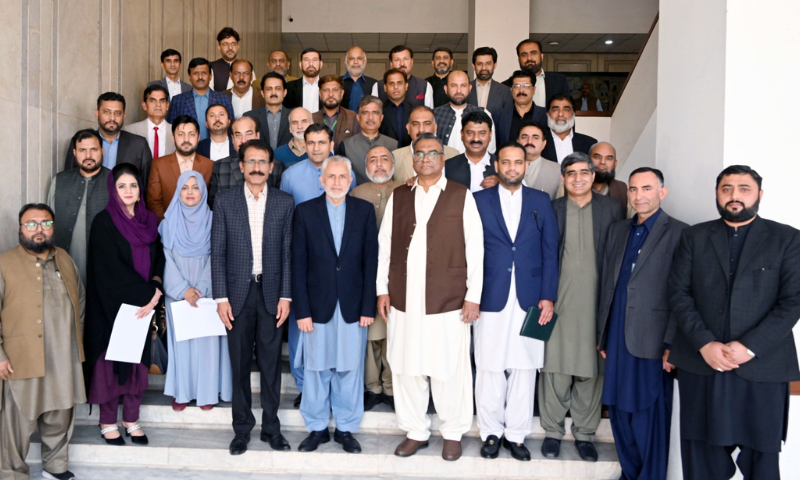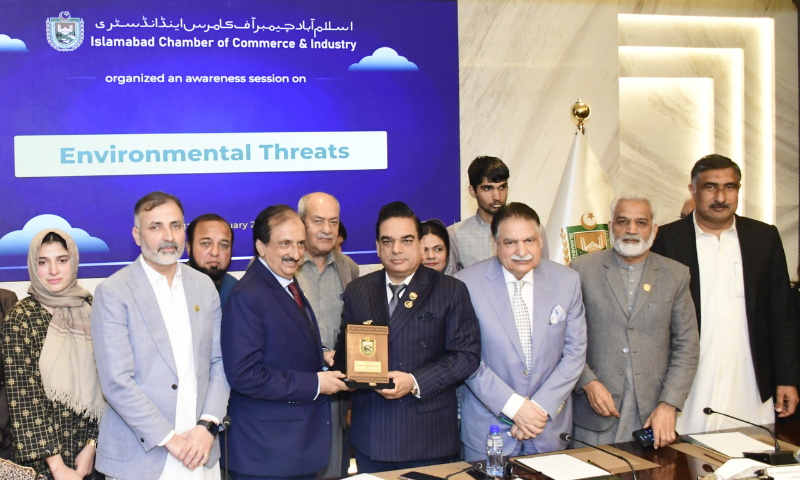
Islamabad, February 13, 2026: Chairman of the Pakistan Green Task Force, Dr. Jamal Nasir, warned that climate change and unchecked population growth have not been addressed with the seriousness they demand, resulting in severe environmental and economic consequences for Pakistan. He delivered these remarks while addressing an awareness session on “Environmental Threats” at the Islamabad Chamber of Commerce and Industry (ICCI) as the Chief Guest.
Dr. Nasir highlighted alarming global deforestation rates, noting that the world loses forest cover equivalent to a football field every few seconds. He observed that Pakistan’s forest cover stands at less than 5 percent—far below internationally recommended levels—making the country highly vulnerable to climate-induced disasters. He added that environmental pollution is causing an estimated annual economic loss of around 38 million USD to the national economy.
Stressing the urgency of collective action, he called for immediate and sustained measures to address environmental degradation and appreciated the private sector and NGOs for their proactive role in awareness and environmental protection initiatives.
In his welcome address, ICCI President underscored that climate change is no longer a distant threat but a present-day reality affecting supply chains, increasing energy costs, reducing agricultural productivity, and undermining business stability. He emphasized that sustainable development principles must be embedded in industrial and commercial operations to ensure long-term economic resilience.
Reaffirming ICCI’s commitment, the President announced initiatives promoting green business practices, renewable energy adoption, energy efficiency measures, and participation in plantation campaigns. He assured continued collaboration with government institutions and development partners to sensitize stakeholders and encourage environmentally responsible practices.
Former ICCI President Mian Akram Farid noted that although Pakistan contributes less than 1 percent to global greenhouse gas emissions, it is among the countries most severely affected by climate change. He called on major global polluters to fulfill their responsibilities and provide financial and technical support to vulnerable nations like Pakistan.
Ms. Rakshanda Tasneem, Chief Organizer of the Rizing Pakistan Movement, described environmental degradation as a serious and escalating challenge, emphasizing that civil society must work hand in hand with government and private sectors to effectively address climate risks.
Other participants, including ICCI Former Senior Vice President Khalid Chaudhry, President Public Affairs Ms. Hasna Khattak, Dr. Sanaullah, Ali Cheema, Ejaz Rehman, Mubashir Ahmed, Javaid Asim, Abdul Mateen Hashmi, Azeem Kakar, and Saba Hameed, lauded ICCI’s leadership in organizing the session and reaffirmed support for future environmental initiatives.
ICCI Vice President Irfan Chaudhry highlighted the Chamber’s Corporate Social Responsibility (CSR) programs and pledged continued cooperation in promoting sustainable development. Executive Member Zulqurnain Abbasi and senior member Israr Mishwani also attended the session.