Tashkent/Washington, February 18, 2026: At the invitation of U.S. President Donald Trump, President of Uzbekistan Shavkat Mirziyoyev will pay a working visit to Washington, D.C. from February 17–19 to participate in the inaugural meeting of the Peace Council.
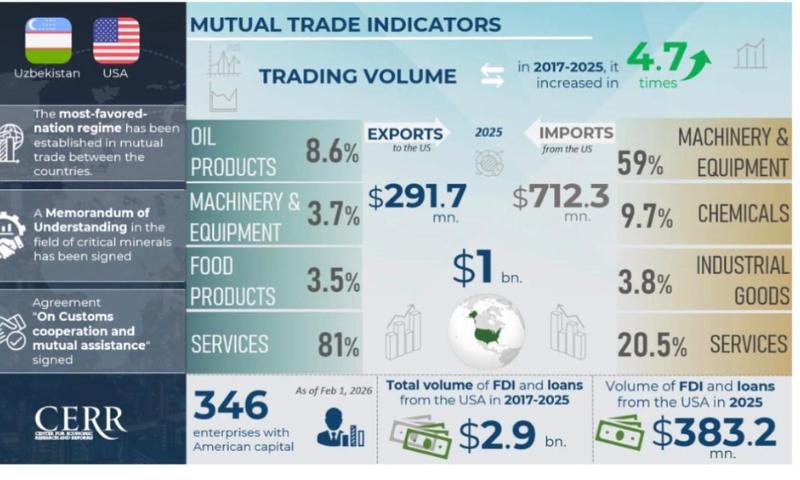
Ahead of the visit, the Center for Economic Research and Reforms (CERR) released an infographic outlining key indicators of trade, economic, and investment cooperation between Uzbekistan and the United States over the past nine years.
President Mirziyoyev has visited the United States multiple times to expand bilateral cooperation and participate in events organized by the United Nations
His first official visit to the U.S. took place on May 15–17, 2018, at the invitation of the American President. During that trip, negotiations were held at the White House, the U.S. Congress, and the Pentagon, culminating in agreements that marked a new stage in Uzbek-American relations.
In subsequent years, dialogue between the two countries progressed through bilateral engagements and regional platforms, including the C5+1 format.
From September 20–24, 2025, President Mirziyoyev visited New York to participate in the 80th session of the UN General Assembly. A key highlight of the visit was his meeting with President Trump, during which both leaders agreed to further strengthen the strategic partnership and expand practical cooperation.
During his stay, the Uzbek President also held a roundtable with representatives of the U.S. business community and met executives of leading multinational corporations, investment funds, and financial institutions. The visit included a ceremony for the exchange of signed trade contracts and investment agreements covering critical minerals, civil aviation, chemicals, energy, and other priority sectors.
To facilitate further expansion of bilateral ties in trade, investment, and tourism, Uzbekistan introduced a visa-free regime for U.S. citizens effective January 1, 2026, under a presidential decree issued on November 3, 2025.
The two countries operate under a Most Favored Nation trade regime. Between 2017 and 2025, bilateral trade turnover increased 4.7 times, rising from $215 million to $1 billion.
- Exports grew 9.1-fold, from $32.1 million to $291.7 million.
- Imports increased 3.9-fold, from $182.9 million to $712.3 million.
- The United States’ share in Uzbekistan’s foreign trade also expanded during this period:
- Total trade turnover: from 0.8% to 1.2%;
- Exports: from 0.3% to 0.9%;
- Imports: from 1.3% to 1.5%.
- Export and Import Structure
Services account for the largest share of Uzbekistan’s exports to the United States at 81%, including programming, financial, information, and transport services. Petroleum products, such as aviation kerosene, make up 8.6%, followed by machinery and equipment (3.7%), food products (3.5%), industrial goods (3.3%), and smaller shares of chemicals, manufactured articles, beverages, tobacco, and non-food raw materials.
On the import side, machinery and equipment dominate at 59%, including aircraft, automobiles and parts, computer units, engines, pumps, machine tools, and industrial installations. Services account for 20.5%, chemicals 9.7%, industrial goods 3.8%, food products 3.2%, and smaller shares of other manufactured goods and raw materials.
As of February 1, 2026, 346 enterprises with U.S. capital are operating in Uzbekistan, representing around 2% of all foreign-invested enterprises in the country. Of these, 146 are joint ventures and 200 are wholly foreign companies with U.S. participation.
Foreign direct investment and loans from the United States have grown nearly 64-fold over the past nine years — from $8.6 million in 2017 to $383.2 million in 2025. The cumulative volume of U.S. FDI and loans attracted during 2017–2025 exceeded $2.9 billion.
Investments have primarily been directed toward manufacturing industries — including metallurgy, automobile production, beverages, and textiles — as well as mining, construction, services (real estate and education), and agriculture.
The upcoming visit is expected to further consolidate the Uzbek-American strategic partnership and expand cooperation across trade, investment, and geopolitical engagement.
CERR Public relations and media sector