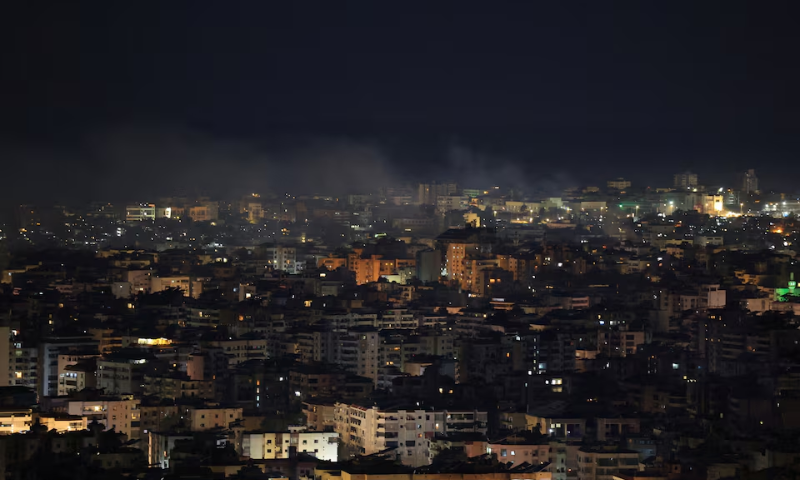
Beirut / Tel Aviv / Tehran/ Dubai, March 2, 2026: Israel on Monday intensified its military campaign against Iran and widened the conflict by launching heavy air strikes on Iran-backed Hezbollah positions in Beirut, while Tehran said it unleashed a fresh wave of missiles on Israel that had “opened the great gates of fire.”
The escalation followed Hezbollah’s announcement that it had fired missiles and drones at Israel in retaliation for the killing of Iran’s Supreme Leader Ali Khamenei, an assassination that has plunged Iran into political uncertainty and sent shockwaves across the region.
Lebanon’s state news agency NNA reported that at least 31 people were killed and 149 wounded in Israeli strikes on Hezbollah-controlled southern suburbs of Beirut. Israel said the attacks targeted Hezbollah command sites and senior militants.
At the same time, Israel pressed ahead with strikes deep inside Iran. Explosions were reported across Tehran, while state media said at least three people were killed in an attack on Sanandaj in Iran’s western Kurdistan province.
Shortly after 7:00 a.m. local time, air-raid sirens sounded across Israel, including in Tel Aviv and Jerusalem, warning of another Iranian missile barrage. Iranian state media said missiles were launched from central Iran toward “enemy locations.”
Iran’s Islamic Revolutionary Guards Corps said the strikes targeted Israel’s government complex in Tel Aviv, along with military and security facilities in Haifa and areas of East Jerusalem, warning that attacks would expand and that sirens in Israel “would never stop.”
Conflict spreads beyond Israel and Iran
The widening war reverberated across the Gulf. Kuwait said its air defences intercepted hostile drones, while the U.S. embassy urged residents to take cover. Witnesses reported a heavy security presence near the embassy, and video footage showed black smoke rising nearby.
Reuters witnesses also reported loud blasts in Dubai, Doha, and Samha, around 50 kilometres from Abu Dhabi.
In a further escalation, a drone strike hit Britain’s Royal Air Force base at Akrotiri in Cyprus overnight, causing limited damage but no casualties, officials said. It was the first attack on the base since 1986 and marked a significant expansion of the conflict’s geographic scope.
U.S. signals prolonged campaign
U.S. President Donald Trump said in interviews that the U.S.-Israeli assault on Iranian targets could continue for at least four weeks. A senior White House official later said the campaign would persist despite indications that potential new Iranian leadership might seek talks.
“Operation Epic Fury continues unabated,” the official said.
Israel’s military chief of staff Eyal Zamir warned that operations against Hezbollah could last days, requiring sustained defensive and offensive readiness. The Israeli military said it had established aerial superiority over Tehran and struck intelligence, security and military command centres across the capital.
A source briefed on the campaign said the strikes were far more intense than last year’s 12-day conflict between Israel and Iran, adding that more Israeli reservists would be called up within 48 hours.
Political fallout in Tehran and Washington
Iranian President Masoud Pezeshkian said a temporary leadership council had assumed the duties of supreme leader following Khamenei’s death. However, senior figures signalled defiance. In a post on X, Ali Larijani, a former adviser to Khamenei, said Iran would not negotiate with Trump, accusing the U.S. president of “delusional ambitions.”
The U.S. confirmed its first casualties of the campaign on Sunday, with three service members killed at a base in Kuwait. Trump paid tribute to them but warned more casualties were likely, even as he vowed to continue strikes until “all our objectives are achieved.”
The prospect of a prolonged war poses political risks for Trump ahead of U.S. midterm elections, with a Reuters/Ipsos poll showing only about one in four Americans support the operation.
Markets, shipping and air travel hit
Iran’s Revolutionary Guards said they had struck U.S. and UK oil tankers in the Gulf and the Strait of Hormuz and attacked bases in Kuwait and Bahrain. Shipping data showed hundreds of vessels dropping anchor as traders braced for sharp oil price spikes.
Air travel across the Middle East was severely disrupted, with major airports closed, including Dubai’s international airport, the world’s busiest for international passengers. Asian airline stocks fell sharply on Monday.
Uncertain future
Analysts said the death of Khamenei and other senior Iranian leaders represents a major blow but does not necessarily signal the collapse of Iran’s clerical system or the dominance of the Revolutionary Guards.
As missiles and drones continue to crisscross the region, diplomats and investors alike are bracing for further escalation, with no clear end in sight to a conflict that has now engulfed much of the Middle East.