Karachi, March 2, 2026: The Pakistan Stock Exchange (PSX) plunged into historic territory on Monday, with the benchmark KSE-100 Index recording its steepest-ever single-day fall amid escalating tensions between the United States and Iran.
The KSE-100 Index settled at 151,972.99 points, down 16,089.17 points, or 9.57%, from Friday’s close of 168,062.16 — marking the largest one-day decline in the exchange’s history.
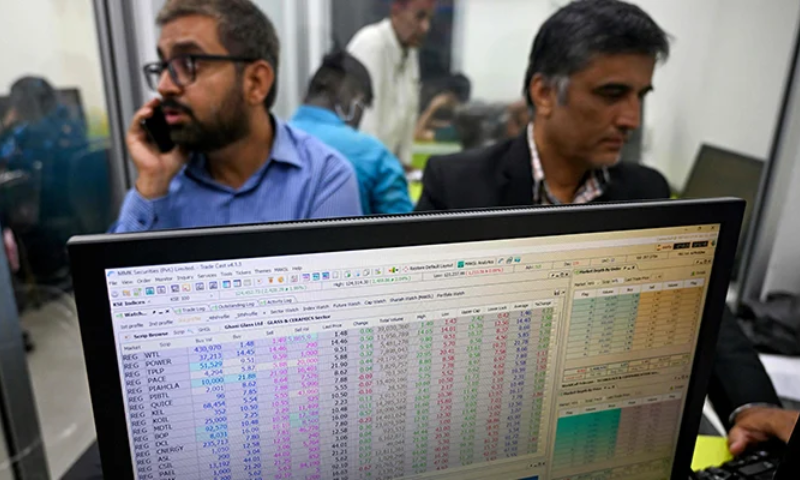
The index had plunged over 15,000 points at the start of trading, triggering an automatic trading halt under the exchange’s risk-management rules. Trading was suspended for about 45 minutes before resuming at 10:27am.
During the session, the benchmark touched an intraday high of 159,328.59 (down 7.23%) and a low of 151,747.96 (down 9.71%).
Market participants described the sell-off as panic-driven.
“Due to panic selling, PSX fell 9%. Leveraged positions coupled with Iran and Afghanistan developments added fuel to the fire,” said Mohammed Sohail, CEO of Topline Securities.
Independent analyst AAH Soomro termed the situation “panic mode,” adding that volatility could persist for several days. “Keep an eye on oil. Below $80 should settle the market by Friday,” he noted.
The sell-off comes as U.S. and Israeli military strikes on Iran show no sign of easing, while Tehran has responded with missile attacks across the region following the killing of Supreme Leader Ali Khamenei.
Global oil markets reacted sharply. Brent crude briefly spiked nearly 14%, while West Texas Intermediate surged close to 12% at the start of trade. Analysts attributed the jump to fears surrounding the effective shutdown of the Strait of Hormuz, through which roughly 20% of global seaborne oil passes.
Topline Research noted that crude prices rose 6–7% during Monday’s session and have climbed around 15% over the past seven sessions amid extreme volatility.
For Pakistan, the economic implications are significant. The country imports an estimated $15–16 billion worth of petroleum products annually, including crude oil, LNG and LPG. According to Topline estimates, every 10% rise in oil prices could add $1.5–1.6 billion to the import bill.
The brokerage further warned that a 10% increase in crude prices could raise inflation projections by 40–50 basis points, with indirect effects likely to ripple through the economy in coming weeks.
Other oil-linked imports — including edible oil ($4 billion), coal ($1 billion) and rubber products — could compound pressure on the external account.
Analysts also flagged potential pressure on the Pakistani rupee if higher import costs coincide with instability in the Middle East, which accounts for more than half of Pakistan’s remittances.
However, Topline described the State Bank of Pakistan foreign exchange reserves as “comfortable,” citing proactive interventions and improved buffers.
The turmoil was not confined to Pakistan. In the Gulf, the United Arab Emirates and Kuwait temporarily closed their stock markets citing “exceptional circumstances.”
In Europe, EUROSTOXX 50 futures fell 1.4% while DAX futures slid 1.3%. On Wall Street, S&P 500 and Nasdaq futures both dropped 0.6%, reflecting broader global nervousness.
Despite the sharp correction, Topline argued that valuations have returned to relatively attractive levels. The market is now trading at below 6.5x FY2027 price-to-earnings ratio, compared to a historic average of 6.9x.
The KSE-100 has fallen about 19% from its recent peak of 189,000 points reached on January 23, 2026, underscoring the scale of the correction.
While analysts caution that volatility is likely to persist as the geopolitical situation evolves, some suggest selective entry points could emerge if oil prices stabilise and tensions ease.
For now, however, investors remain firmly in risk-off mode as regional conflict and oil market uncertainty continue to dominate sentiment.