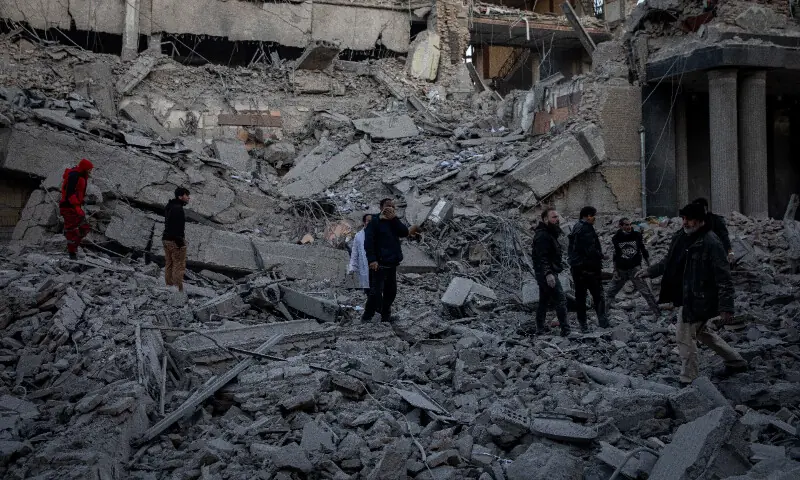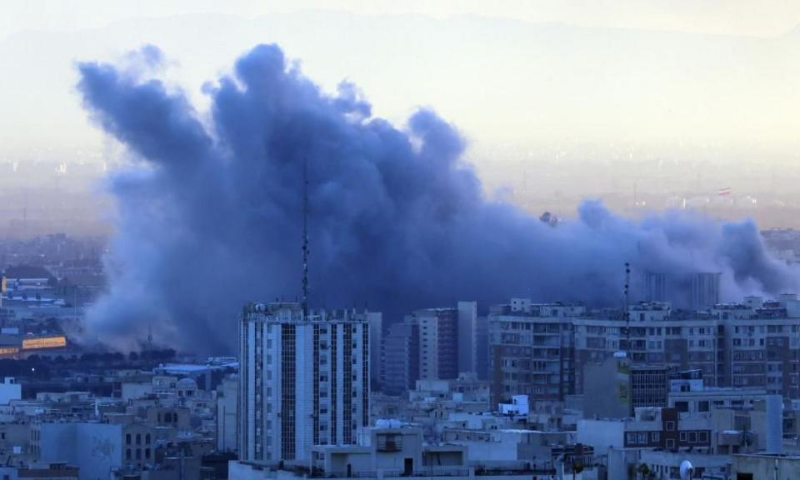
Tehran/Washington/Tel Aviv, March 4, 2026: The United States and Israel pressed ahead with round-the-clock military operations against Iran on Wednesday, marking the fifth consecutive day of an escalating regional war that has sent shockwaves through global energy markets and raised fears of wider instability across the Middle East.
Iranian state media reported that the death toll from US-Israeli strikes had risen to 1,045, although independent verification remains difficult amid ongoing bombardment. The offensive began with a wave of coordinated airstrikes that killed Iran’s Supreme Leader, Ali Khamenei, in what analysts describe as the first assassination of a sitting head of state by airstrike in modern history.
Leadership vacuum and succession battle
As explosions continued to rock Tehran, large crowds were expected to gather at the Imam Khomeini Prayer Hall for mourning ceremonies. Iran’s powerful Assembly of Experts, the constitutional body tasked with appointing the Supreme Leader, said it would announce a successor “at the closest opportunity.”
Among those widely seen as frontrunners is Mojtaba Khamenei, the late leader’s influential son, who is believed to command significant support within Iran’s security establishment. Iranian sources said he was not in Tehran during the strike that killed his father and other senior figures.
Assembly member Ahmad Khatami told state television that candidates had already been identified but declined to name them, citing wartime conditions.
Israel, however, issued a stark warning. Defence Minister Israel Katz said any successor who continued Iran’s hostility toward Israel and the United States would be considered a legitimate target.
Expanding military campaign
Admiral Brad Cooper, head of US Central Command, described the campaign as “ahead of the game plan,” revealing that 50,000 troops, 200 aircraft and two aircraft carriers were engaged in sustained strikes “from seabed to space and cyberspace.”
According to US officials, nearly 2,000 Iranian targets have been hit, including missile batteries, naval vessels and command centres. Iran’s navy has reportedly lost 17 vessels, and its air defence systems have been severely degraded.
Israel said its air force shot down an Iranian Yak-130 aircraft over Tehran using an F-35 fighter jet, marking what could be the first time the advanced stealth jet has downed a manned aircraft in combat.
Iran responded with waves of missile and drone attacks targeting Israeli cities and US-linked sites in the Gulf. Drones struck near the US consulate in Dubai and targeted the Al-Udeid base in Qatar. Tehran also claimed “complete control” over the Strait of Hormuz, through which roughly one-fifth of the world’s seaborne oil passes.
US President Donald Trump said the US Navy was prepared to escort tankers through the strategic waterway if necessary, although shipping analysts questioned the feasibility of sustained escorts amid missile threats.
Energy shock and market turmoil
The conflict has triggered sharp volatility in global markets. Brent crude climbed to $83.76 per barrel for a third consecutive day, while Asian equities suffered heavy losses, including a record-breaking crash in Seoul amid fears of prolonged energy disruptions.
European markets stabilized slightly after earlier losses, but traders worldwide scrambled to adjust to the prospect of sustained high oil prices. Even traditional safe-haven gold briefly fell before rebounding to $5,155 an ounce.
Qatar temporarily shut liquefied natural gas production, and Iraq scaled back oil output. Scores of vessels remain halted in the Gulf as insurers reassess risks.
Lebanon front and regional fallout
The conflict has also spread to Lebanon, where the Iran-backed Hezbollah movement launched rockets and drones toward Israel in retaliation for Khamenei’s killing. Israeli airstrikes targeted sites in southern and eastern Lebanon, including Baalbek and areas south of Beirut, killing dozens and displacing more than 30,000 people, according to local authorities and the United Nations.
Israel announced it was creating a buffer zone inside Lebanese territory, echoing tactics from previous conflicts.
No negotiations, says Tehran
Senior Iranian officials ruled out talks with Washington. Mohammad Mokhber, a top adviser to the late Supreme Leader, said Iran had “no trust in the Americans” and could continue the war indefinitely.
Similarly, Iranian security chief Ali Larijani dismissed reports of renewed negotiations, reiterating Tehran’s commitment to retaliation.
Despite early US hopes of quickly destabilizing Iran’s clerical leadership, the Islamic Republic has maintained retaliatory capabilities. Iranian Revolutionary Guards said more than 40 missiles had been launched in a new wave of strikes against US and Israeli targets.
Civilian toll and displacement
In Tehran, much of the population has fled or remains indoors amid sustained bombardment. Authorities have set up checkpoints across the capital, while air raid sirens sound regularly in Israeli cities as missile interceptors engage incoming projectiles.
The Iranian Red Crescent earlier reported 787 fatalities, though the updated figure cited by state media exceeds 1,000. In Israel, at least nine people were killed when a missile struck the town of Beit Shemesh earlier in the week. The US military confirmed six American service members had died since operations began.
As governments scramble to evacuate citizens from the region, the conflict shows no immediate sign of abating. With oil prices climbing and global powers on edge, the war between Iran and the US-Israeli alliance risks reshaping the geopolitical and economic landscape of the Middle East for years to come.