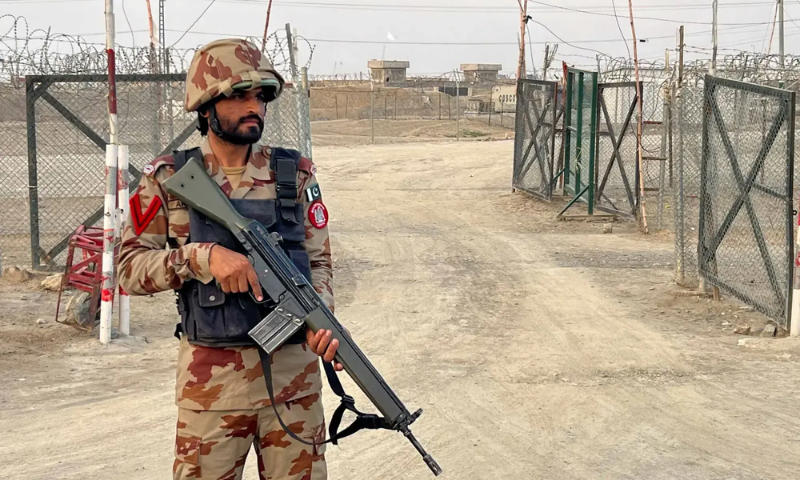
Peshawar, March 5, 2026: A senior Pakistani security official has said that the Afghan Taliban leadership is fully aware of Pakistan’s concerns and demands, stressing that the regime must take “verifiable steps” if it seeks a ceasefire or dialogue with Islamabad.
Briefing journalists from Khyber Pakhtunkhwa at the headquarters of the Inter-Services Public Relations (ISPR), the official said the decision now rests with the Afghan Taliban.
“If they want dialogue or a ceasefire, they must take verifiable steps,” the official said, adding that Pakistan does not wish to attack any country and that its primary objective remains national security.
Relations between Pakistan and the Afghan Taliban have sharply deteriorated in the four years since the group took power in Afghanistan. On February 22, Pakistan carried out strikes against terrorist camps and hideouts in the Afghan provinces of Nangarhar Province and Paktika Province. Following these strikes, the Afghan Taliban launched what Pakistani officials described as unprovoked attacks along the border.
The security official said the Pakistan-Afghanistan border remains the only international frontier that is effectively guarded by only one side.
“On the other side, terrorist elements are provided shelter in the border areas and facilitated,” he said.
He added that despite the ongoing military operation, Pakistan was exercising “utmost responsibility” by minimising collateral damage.
“Civilian population has not been targeted in any operation carried out by Pakistan,” he said, explaining that the strikes were limited to terrorist camps and military targets where militants were receiving weapons, resources and technical support.
The official said Pakistan had initially targeted camps of the banned Tehreek-i-Taliban Pakistan (TTP). However, he alleged that the Afghan Taliban subsequently launched attacks on Pakistani border posts established to prevent militant infiltration.
He also revealed that Pakistani forces had destroyed 36 militant posts inside Afghanistan that were allegedly being used to launch attacks against Pakistan.
Referring to earlier attempts at de-escalation following clashes in October, the official said three different countries had played a role in facilitating dialogue.
“These countries have accepted the evidence provided by Pakistan and have also convinced the Afghan Taliban that Pakistan’s concerns are absolutely valid,” he said, adding that no meaningful change had yet been observed in the Taliban’s behaviour.
He further warned of what he described as a “clear nexus between terrorism and crime in Afghanistan,” alleging that the Taliban were harbouring multiple militant organisations and acting as their “master proxy.”
Operations to dismantle militant networks and eliminate terrorists inside Pakistan are also continuing, he added.
However, the official emphasised that lasting success against militancy would require a unified national narrative against terrorism.
He pointed to the National Action Plan (NAP), saying it was designed not only to combat terrorism but also to curb extremism and crime within society.
“Vacuums in internal security systems and governance further strengthen terrorism,” he said.
The official maintained that Pakistan had no interventionist agenda in Afghanistan, stressing that the country’s political future was the right of the Afghan people.
“We have only one clear and single stance: Afghan soil must not be used for terrorism against Pakistan,” he said.
He added that operations would continue until Pakistan’s objectives were achieved, accusing the Afghan Taliban of protecting the banned TTP and other militant groups after Pakistan’s initial strikes.
Commenting on other developments, the official said Pakistan had targeted the Bagram Air Base in Afghanistan to destroy weapons and ammunition allegedly used against Pakistan.
He also said there was no need for a full-scale military operation in the Tirah region of Khyber Pakhtunkhwa, noting that security forces had already targeted militant bases responsible for attacks inside the country.
A day earlier, Pakistan’s Chief of Defence Forces and Chief of Army Staff Asim Munir said that lasting peace between Pakistan and Afghanistan could only be achieved if the Taliban regime “renounced their support for terrorism and terrorist organisations.”