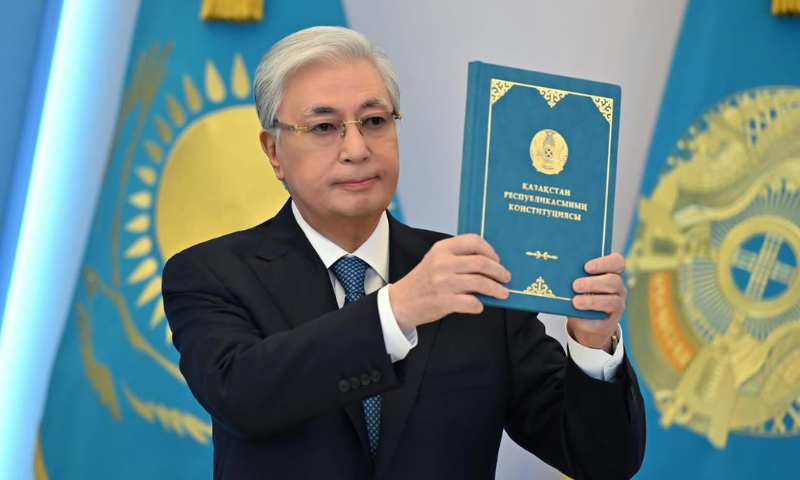
Almaty, March 31, 2026: President Kassym-Jomart Tokayev has hailed Kazakhstan’s newly approved constitution as a transformative step toward building a just, strong, and prosperous nation, following a landmark national referendum.
Describing the development as a pivotal moment in the country’s history, Tokayev said the constitutional reform reflects Kazakhstan’s commitment to political modernization and long-term national development. The referendum — the third consecutive nationwide vote — recorded a turnout of 73.12 percent, with 87.15 percent of voters supporting the new framework.
“This demonstrates the growing maturity of our political system and the readiness of our citizens to shape the country’s future,” the president noted.
The new constitution introduces significant changes to governance in Kazakhstan, reinforcing a model described by Tokayev as “Strong President, Influential Parliament, and Accountable Government.”
Among key reforms is the abolition of the presidential quota in parliament to enhance legislative independence. The transition to a single-chamber parliament, known as the Kurultai, aims to improve efficiency and accountability in lawmaking. Additionally, a consultative body — the Khalyk Kenesi (People’s Council) — will be established to broaden public participation in governance.
The reforms also introduce a vice president position and term limits for senior officials, signaling efforts to ensure leadership renewal and institutional stability.
A major feature of the new constitution is its strong emphasis on human rights. For the first time, the largest section of the document is dedicated to safeguarding fundamental freedoms, including privacy, personal data protection, and the inviolability of housing.
Judicial independence has also been strengthened to ensure fair access to legal defense, while any future constitutional amendments will require approval through a national referendum, keeping ultimate authority.
Tokayev stressed that the constitution is “about people, not just governance,” reflecting public aspirations for a fair and law-based society.
The constitution also lays out a strategic framework for economic growth, reinforcing property rights, protecting intellectual property, and establishing clear rules for business activity. It introduces special legal regimes for rapidly developing regions to support innovation and industrial expansion.
Kazakhstan already attracts nearly 70 percent of foreign direct investment in Central Asia, and the president said the reforms would further strengthen investor confidence and support the country’s transition toward a digital and innovation-driven economy.
Over three decades since independence, Kazakhstan has emerged as a top-50 global economy and a regional leader in digital governance, energy resources, and emerging technologies.
Tokayev described the new constitution as a forward-looking blueprint for future generations, particularly the youth, emphasizing investments in education, science, technology, culture, and environmental sustainability.
He announced that March 15 — the day of the referendum — will now be observed annually as Constitution Day in Kazakhstan.
“If the 1995 constitution was about independence and survival, then the 2026 constitution is about maturity, renewal, and confidence in the future,” Tokayev said, adding that the reforms mark the beginning of a new chapter focused on justice, economic openness, and responsible global engagement.