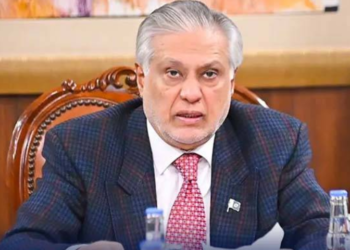
Washington, April 15, 2026: Saudi Arabia has pledged an additional $3 billion in financial support to Pakistan, with disbursement expected next week, while also extending its existing $5 billion deposit for a longer tenure. The announcement was made by Federal Finance Minister Muhammad Aurangzeb on Wednesday.
Speaking to journalists in Washington on the sidelines of the World Bank-IMF Spring Meetings 2026, the finance minister said the fresh Saudi assistance comes at a critical juncture for Pakistan’s external financing needs. He noted that the support would bolster foreign exchange reserves and strengthen the country’s external account.
The development follows reports that Pakistan has been in discussions with Saudi Arabia and China to secure additional financial support as it prepares to repay a roughly $3 billion loan to the United Arab Emirates. According to sources familiar with the matter, negotiations involve loans and investment exceeding $3.5 billion, though details remain confidential.
Pakistan was unable to reach an agreement with the UAE to roll over the debt for the first time in seven years. The repayment, due by the end of this month, is expected to exert pressure on the country’s foreign exchange reserves, currently estimated at around $16 billion—sufficient to cover approximately three months of imports.
Aurangzeb reaffirmed the government’s commitment to maintaining reserves in line with its obligations under the International Monetary Fund (IMF)-supported programme. He said Pakistan aims to raise reserves to around $18 billion—equivalent to roughly 3.3 months of import cover—by the end of the current fiscal year.
He further revealed that the existing $5 billion Saudi deposit would no longer be subject to annual rollover arrangements, providing greater financial stability through an extended tenure.
Highlighting recent achievements, the finance minister noted that Pakistan had successfully repaid its $1.4 billion Eurobond last week, describing the transaction as a “non-event” and reaffirming the government’s resolve to meet all external obligations under a disciplined financing plan.
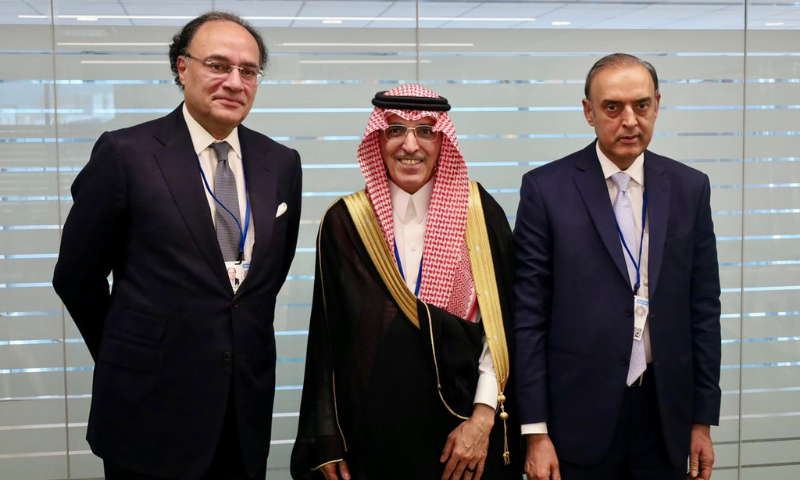
Aurangzeb also disclosed that he, along with the Governor of the State Bank of Pakistan and Pakistan’s ambassador to the United States, held a detailed meeting with Mohammed bin Abdullah Al-Jadaan in Washington. He added that he had previously met the Saudi minister in Islamabad but refrained from commenting due to the absence of formal communication at the time.
The minister expressed gratitude to the Saudi leadership, particularly Mohammed bin Salman, for their continued support and cooperation in finalising the financial package.
Aurangzeb also acknowledged the contributions of Pakistan’s leadership, including Shehbaz Sharif, Asim Munir, and Mohammad Ishaq Dar, as well as key economic officials in securing and operationalising the assistance.
He noted that Pakistan is witnessing growing confidence from international financial institutions, including the World Bank and the IMF, as well as institutional investors. He added that the country’s recent diplomatic role in facilitating dialogue between rival states has been widely appreciated, further strengthening investor sentiment.
The finance minister emphasized that Pakistan is advancing its broader external financing strategy, including the Global Medium-Term Note (GMTN) programme and plans for its inaugural Panda Bond issuance aimed at diversifying funding sources and enhancing access to international capital markets.
Concluding his remarks, Aurangzeb reaffirmed the government’s commitment to macroeconomic stability, continuity of reforms, timely debt servicing, and sustained engagement with bilateral and multilateral partners. He added that a detailed media briefing would be held at the conclusion of his visit.