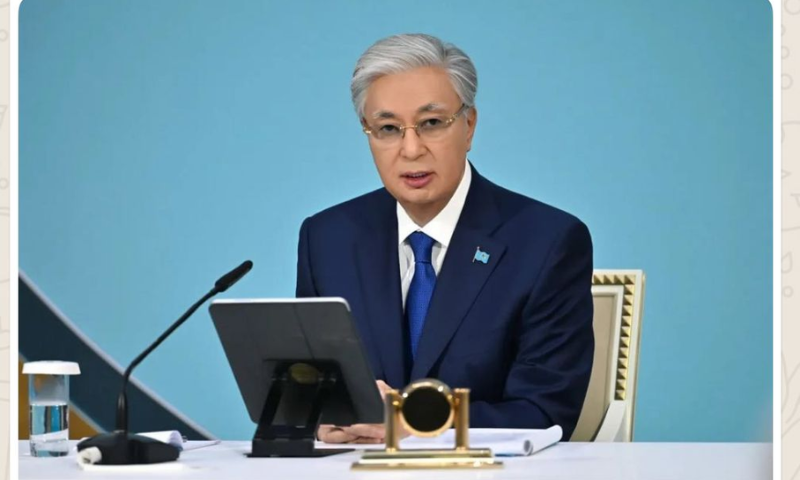
Astana, May 25,2026: An international symposium titled “The Golden Horde as a Model of Steppe Civilization: History, Archaeology, Culture, and Identity” was held in Astana on May 19 with the participation of President Kassym-Jomart Tokayev and more than 350 delegates from across the world.
The symposium brought together representatives of international organizations, historians, archaeologists, researchers, and scholars specializing in the history of the Great Steppe and the Golden Horde.
The discussions focused on the historical, political, economic, and cultural legacy of the Golden Horde and its contribution to the development of Eurasian civilization.
In his keynote remarks, President Tokayev emphasized the importance of objective and depoliticized historical scholarship, stressing that the Golden Horde should be viewed as a shared heritage of humanity rather than the exclusive legacy of any single nation.
He said the Golden Horde was one of the largest political entities of its time, connecting East and West across vast Eurasian territories and contributing significantly to state formation, governance, diplomacy, and civilizational development.
The Kazakh president noted that the history of the Great Steppe has often been narrowly portrayed through narratives of warfare, while its broader political, cultural, and intellectual achievements have been overlooked. He said modern interdisciplinary scholarship now provides opportunities for a more balanced and comprehensive understanding of the Golden Horde’s legacy.
President Tokayev underscored that historical assessments must remain objective, balanced, and politically neutral. He cautioned against attempts to monopolize historical interpretation or transform shared heritage into an exclusively national phenomenon, warning that such approaches undermine scholarly integrity and international trust.
Highlighting the governance model of the Golden Horde, Tokayev said the empire’s strength rested not only on territorial expansion but also on effective administrative systems, diplomacy, justice, meritocracy, and coexistence among diverse ethnic and religious communities.
He further pointed out that the Golden Horde controlled major Eurasian trade routes and transformed the steppe into a secure transit corridor linking East and West, while also developing advanced monetary and commercial systems.
The symposium, organized under the patronage of UNESCO, reflected growing international interest in the historical legacy of the Great Steppe and the Golden Horde.
President Tokayev reaffirmed Kazakhstan’s commitment to preserving and promoting the historical and intellectual heritage of the Ulus of Jochi through research, education, digital initiatives, publications, films, exhibitions, and international cultural engagement.
He also highlighted Kazakhstan’s modernization efforts, including investments in artificial intelligence, digital infrastructure, transport corridors, and data storage centres. The president announced that Kazakhstan would host an international AI Olympiad under UNESCO auspices involving participants from 100 countries.
The symposium also featured proposals for broader international academic cooperation, including the establishment of an international Centre for the Promotion of Steppe Civilization and expanded scholarly publishing projects on the Golden Horde.
President Tokayev described the traditions of steppe statehood as being rooted in openness, justice, intercultural dialogue, and coexistence, emphasizing that history should serve as a bridge between peoples rather than a source of division.
He reiterated that Kazakhstan views itself as a direct heir to the statehood traditions of the Golden Horde and the Great Steppe, adding that preserving historical continuity and cultural heritage remains essential for national renewal and future development.