Islamabad, June 4, 2026: Pakistan on Thursday categorically rejected reports alleging that Deputy Prime Minister and Foreign Minister Mohammad Ishaq Dar shared intelligence regarding Iran’s nuclear programme with US Secretary of State Marco Rubio, describing the claims as baseless and speculative.
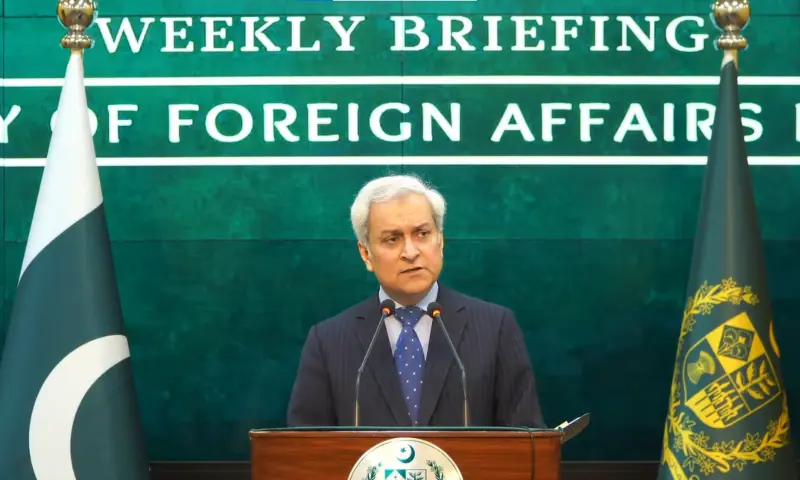
Addressing the weekly media briefing in Islamabad, Foreign Office Spokesperson Tahir Andrabi said Pakistan “categorically and unequivocally” rejected reports suggesting that Dar had conveyed intelligence about Iran’s nuclear intentions during his meeting with Rubio in Washington on May 29.
“Such claims are entirely baseless, speculative, and appear to be aimed at undermining ongoing diplomatic efforts and the broader process of dialogue and engagement,” Andrabi stated.
He clarified that discussions between Dar and Rubio focused on regional peace, stability and diplomatic solutions to ongoing challenges, stressing that “no intelligence was shared during the course of this dialogue.”
The clarification came after media reports and comments by former CIA analyst Larry Johnson claimed that Dar had conveyed sensitive information regarding Iran’s possible nuclear intentions, allegedly prompting the United States to influence Israeli military actions in Lebanon.
Rubio himself dismissed the reports during a congressional hearing on Wednesday, saying he was unaware of any such message and would have known if it had been delivered.
Pakistan welcomes US peace efforts
The Foreign Office welcomed continued US engagement in regional peace initiatives and acknowledged Washington’s role in facilitating efforts to sustain the ceasefire between Israel and Lebanon.
Andrabi urged media outlets to avoid speculation and rely on verified information regarding sensitive diplomatic engagements.
Government Working for Release of Pakistani Seamen Held by Somali Pirates
The Foreign Office also provided an update on the plight of 10 Pakistani crew members aboard the oil tanker MT Honour 25, which was hijacked by Somali pirates in April.
The Palau-flagged vessel was seized approximately 30 nautical miles off Somalia’s Puntland coast with 17 crew members on board, including 10 Pakistanis.
“Unfortunately, the situation remains grave,” Andrabi said, adding that Pakistan remains actively engaged with the ship owner and Somali authorities to secure the hostages’ release.
He explained that the vessel’s cargo, coupled with its geographical location, makes any rescue operation extremely risky.
“The ship is carrying highly explosive cargo, making any law-enforcement action difficult and potentially dangerous for the hostages,” he said.
Pakistan has urged both the ship owner and Somali authorities to ensure adequate food, drinking water and essential supplies for the captives. Officials from Pakistan’s embassy in Djibouti have also visited Mogadishu to gather first-hand information and maintain communication channels with all stakeholders.
“This is a very difficult situation. Our hearts go out to the families of those being held captive,” Andrabi remarked.
Pakistan defends right to respond to terrorism from Afghanistan
Responding to questions regarding recent tensions with Afghanistan, the Foreign Office reiterated Pakistan’s right to defend itself against terrorist threats originating from Afghan territory.
Commenting on concerns expressed by EU foreign policy chief Kaja Kallas regarding recent cross-border hostilities, Andrabi said no responsible state could remain passive when its citizens and security personnel were repeatedly targeted.
“We reserve the right to take all necessary measures to safeguard the lives and property of our nationals, based on the principles of necessity and as a measure of last resort,” he said.
The spokesperson emphasized that Pakistan’s actions are guided by the principles of distinction and proportionality under international law and target only locations used for planning and launching terrorist attacks against Pakistan.
He also noted that Pakistan remained open to dialogue with Afghanistan but expected an unequivocal commitment from Kabul that Afghan territory would not be used for terrorism against Pakistan.
Pakistan, China strengthen counterterrorism coordination
The spokesperson confirmed that China’s Special Representative on Afghanistan, Yue Xiaoyong, recently visited Islamabad and held productive discussions on regional security.
According to Andrabi, Pakistan and China agreed to further strengthen coordination and synchronize counterterrorism efforts aimed at safeguarding regional peace and stability.
Pakistan condemns India’s Chenab-Beas water diversion plan
The Foreign Office also strongly criticized India’s reported plans to divert water from the Chenab River to the Beas River, describing the move as a serious violation of the Indus Waters Treaty and international law.
Indian media reports indicate that New Delhi intends to begin work on the proposed Chenab-Beas Link Tunnel Project in August, aimed at transferring approximately 1.9 million acre-feet of water annually from the Chenab basin into the Beas system.
Andrabi said the project represented an unlawful inter-basin diversion of water allocated to Pakistan under the treaty.
“Such an inter-basin diversion constitutes a grave violation not only of the Indus Waters Treaty but also of international treaty obligations and established principles of international water law,” he stated.
The spokesperson further expressed concern over India’s reported plans to conduct silt flushing operations at the Salal Dam in Indian-administered Kashmir, warning that such actions could provide water-control capabilities inconsistent with treaty provisions.
‘India seeking to weaponise water’
Pakistan accused India of pursuing policies aimed at using water as a coercive tool.
“These projects confirm that India seeks to weaponise water,” Andrabi said, warning that such actions could threaten Pakistan’s economic security, food security and the livelihoods of more than 250 million people.
He noted that India had neither formally notified Pakistan of the projects nor sought consultations as required under treaty mechanisms.
“Pakistan has exercised restraint and responsibility and remains committed to dialogue. However, any illegal action that endangers Pakistan’s water, food and economic security is unacceptable,” he stressed.
The Foreign Office urged the international community to call upon India to abandon projects designed to reduce, stop or divert water flows allocated to Pakistan and to ensure the full implementation of the Indus Waters Treaty.
Reaffirming Islamabad’s position, Andrabi declared that Pakistan “retains all options necessary” to safeguard its rights under the treaty and protect its vital national interests.