Islamabad, June 11, 2026: Pakistan on Thursday issued a strong warning against any attempt to block or significantly curtail water flows vital to its population, declaring that such an action could carry “far-reaching consequences” and may amount to an act of war under international law.
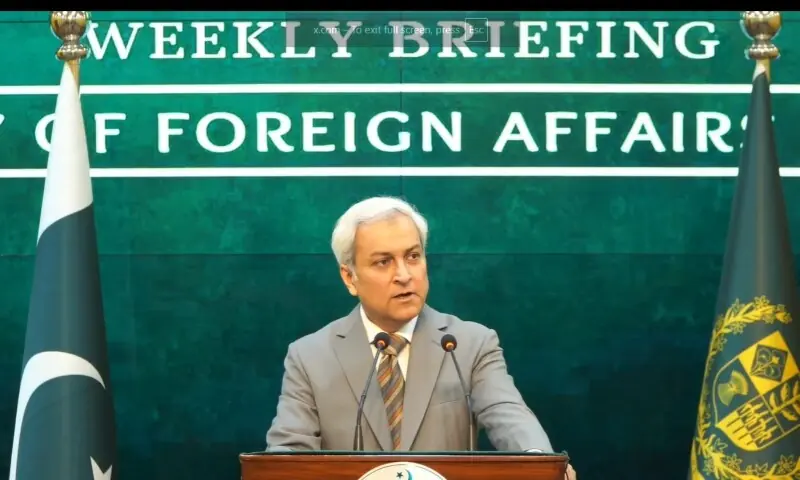
Addressing the weekly media briefing in Islamabad, Foreign Office spokesperson Tahir Andrabi responded to recent remarks by India’s Water Minister C.R. Patil, who had stated that India was working to ensure that “not a single drop of water” reaches Pakistan in the coming years.
“Any deliberate attempt to block water essential to Pakistan’s survival and development would constitute an extremely grave act with far-reaching consequences,” Andrabi said.
He stressed that Pakistan viewed water as a fundamental right rather than a political tool and rejected any effort to use it as an instrument of coercion.
“Any attempt to block or substantially curtail water that is vital to the livelihood, agriculture and well-being of over 250 million Pakistanis would be a deeply irresponsible act,” he said.
The spokesperson warned that such measures would violate established international obligations governing transboundary rivers as well as bilateral agreements between Pakistan and India.
“Pakistan firmly rejects any notion that water can be treated as a political tool, instrument of coercion or weapon,” he said.
Andrabi emphasized that any action threatening Pakistan’s water security would undermine regional peace and stability, adding that responsibility for any resulting escalation would rest with India.
He reiterated that Pakistan’s rights and interests regarding its water resources were non-negotiable and would be defended through all available diplomatic, political, legal and economic means consistent with international law and the United Nations Charter.
Referring to Article 51 of the UN Charter, which recognizes the inherent right of self-defence, Andrabi said Pakistan would take all necessary measures to safeguard its economy, national interests and the lives of its citizens.
He also called on India to act responsibly, honor its international commitments and avoid statements or actions that could further heighten tensions in South Asia.
Pakistan, he added, would continue closely monitoring developments in Indian-administered Jammu and Kashmir and other regions from where these water resources originate.
Pakistan concerned over India’s expanding nuclear arsenal
Responding to questions regarding a recent report by the Stockholm International Peace Research Institute (SIPRI), Andrabi said Pakistan was not surprised by findings indicating further expansion of India’s nuclear arsenal.
“The report broadly corroborates concerns that Pakistan has consistently raised regarding India’s continued vertical proliferation,” he stated.
The spokesperson suggested that publicly available assessments may not fully capture the actual scale of India’s strategic capabilities.
He pointed to developments including the canisterisation of missile systems, expansion of sea-based nuclear capabilities through submarines, and efforts to develop longer-range intercontinental ballistic missile systems.
“These developments enhance operational readiness, complicate crisis stability and carry implications that extend beyond South Asia,” Andrabi warned.
While reiterating that Pakistan does not seek an arms race and is not interested in matching warheads numerically, he said Islamabad remains mindful of the evolving regional security environment.
“Pakistan continues to work towards preserving strategic stability and deterring any possible aggression,” he said.
The spokesperson urged the international community, particularly suppliers of advanced technologies, to carefully assess the implications of emerging military capabilities being incorporated into India’s strategic posture.
He cautioned that further deployment and expansion of India’s nuclear arsenal could undermine strategic stability and pose risks to both regional and global security.
Release of Pakistani seafarers held by Somali pirates remains top priority
Andrabi also provided an update on efforts to secure the release of 11 Pakistani sailors being held hostage by pirates off the coast of Somalia.
The Pakistani crew members were among those aboard the MT Honour 25, which was hijacked on April 21 near southeastern Somalia.
Describing the issue as a “high priority” for the government, Andrabi acknowledged that securing the hostages’ release had proven difficult due to complex operational conditions on the ground.
“Sadly, despite our best efforts, we have not yet been able to secure their release,” he said.
However, he expressed optimism that ongoing diplomatic engagement could yield positive results.
Pakistan remains in contact with Somali authorities and the ship’s owners, who are engaged in negotiations aimed at securing the hostages’ safe release.
The spokesperson revealed that Deputy Prime Minister and Foreign Minister Senator Mohammad Ishaq Dar had personally discussed the matter with Somali Foreign Minister Abdisalam Abdi Ali, conveying Pakistan’s grave concern and urging immediate efforts to ensure the sailors’ safe return.
Dar also called for improvements in the living conditions of those being held captive.
According to Andrabi, Somali authorities have assured Pakistan of their continued cooperation and commitment to resolving the issue.
“Both leaders agreed to remain in close coordination until the matter is resolved,” he said.
The Foreign Office spokesperson further disclosed that the Somali ambassador had been summoned to the Ministry of Foreign Affairs, while Pakistan’s embassy in Djibouti had dispatched teams to Mogadishu to support ongoing efforts.
Inter-ministerial consultations are continuing, and another high-level meeting is scheduled at the Foreign Office next week.
Explaining the challenges involved, Andrabi noted that the hostages are being held in a semi-autonomous region where tribal dynamics significantly complicate negotiations.
“The pirates belong to one tribe, while the ship owners belong to another. This makes the situation operationally challenging,” he said.
He appealed to the families of the sailors to remain patient and assured them that the government was pursuing every possible avenue for their release.
Pakistan still hopeful of playing mediation role in Iran-US crisis
Commenting on the escalating tensions between the United States and Iran, Andrabi said Pakistan remained committed to diplomacy despite shrinking space for dialogue.
While acknowledging the challenges posed by renewed hostilities, he argued that fluctuations between conflict and diplomacy were a common feature of international crises.
“If a mediator or facilitator loses hope or becomes pessimistic, it does not augur well for the peace process,” he remarked.
Andrabi said Pakistan remained actively engaged with regional and international partners and pointed to recent diplomatic contacts, including Deputy Prime Minister Ishaq Dar’s conversation with Turkish Foreign Minister Hakan Fidan and Interior Minister Mohsin Naqvi’s recent visit to Tehran.
He reiterated Islamabad’s readiness to contribute positively toward de-escalation efforts and peaceful resolution of disputes.
“Let us not draw the curtains on Pakistan’s mediation role, and let us not lose hope,” he said.
Asked whether any official exchanges between Pakistan and Iran were expected in the near future, Andrabi said he had no specific information at present but did not rule out such visits.
“I do not have any specific information right now, but I certainly do not rule out such visits in the future,” he added.