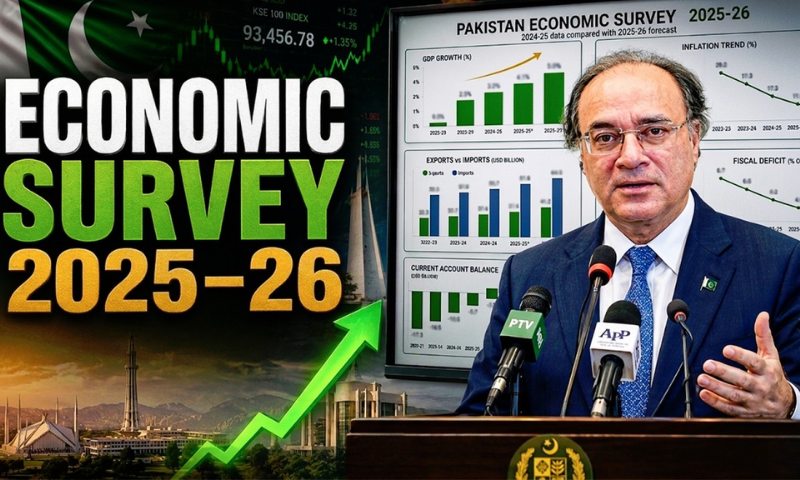
Islamabad, June 11, 2026: Pakistan’s economy expanded by 3.7 percent in fiscal year 2025-26, marking its strongest growth in four years despite floods, regional tensions and global economic uncertainty, according to the Pakistan Economic Survey (PES) 2025-26 unveiled by Finance Minister Muhammad Aurangzeb on Thursday.
The growth rate improved from 3.18 percent recorded in the previous fiscal year, although it remained below the government’s target of 4.2 percent.
Presenting the survey at a press conference in Islamabad, Aurangzeb described the outgoing fiscal year as a story of “resilience, discipline and recovery,” highlighting Pakistan’s ability to withstand a series of domestic and external shocks while maintaining macroeconomic stability.
“Pakistan faced uncertainty linked to global tariff developments, devastating floods in August and September 2025, and regional conflict earlier this year. These challenges tested our resilience, but we remained committed to moving from stabilisation toward sustainable growth,” the minister said.
Key economic indicators
According to the survey, Pakistan’s economy reached a historic size of Rs126.9 trillion, while per capita income increased to $1,901, up from $1,751 a year earlier.
Among the major indicators:
- GDP growth: 3.7%
- Agriculture growth: 2.89%
- Industrial growth: 3.51%
- Services sector growth: 4.09%
- Large-Scale Manufacturing (LSM): 6.1%
- Average CPI inflation (July-April): 6.2%
- Workers’ remittances: $30.3 billion
- Fiscal deficit: 0.7% of GDP
- Primary surplus: 3.2% of GDP
- Tax revenue growth: 11.3%
The survey noted that the economic recovery was supported by effective macroeconomic management, fiscal consolidation, exchange-rate stability, growth in manufacturing activity, resilience in agriculture despite climate shocks, and reforms implemented under the IMF’s Extended Fund Facility (EFF).
Strongest growth performance in four years
Aurangzeb said Pakistan’s economic growth trajectory has steadily improved after the contraction experienced in FY2023.
“GDP growth stood at minus 0.2 percent in FY2023, increased to 2.6 percent in FY2024, rose to 3.2 percent in FY2025, and has now reached 3.7 percent in FY2026,” he said.
He acknowledged that growth was initially projected to exceed 4 percent but was affected by geopolitical tensions and the ongoing conflict in the Middle East.
Nevertheless, he emphasized that Pakistan had recorded one of its strongest economic performances in recent years while global economic growth slowed from 3.7 percent to 3.1 percent.
Agriculture shows resilience despite floods
The agriculture sector posted 2.89 percent growth, compared with 1.53 percent last year, despite severe flooding during 2025.
The crop sub-sector expanded by 1.44 percent, while livestock continued to perform strongly and remained a major contributor to rural incomes and agricultural output.
The survey described the sector’s performance as evidence of resilience in the face of climate-related disruptions.
Industrial recovery driven by manufacturing and construction
Pakistan’s industrial sector grew by 3.51 percent, supported by a recovery in mining and quarrying activities, robust manufacturing performance, and increased construction activity.
The construction sector recorded growth of 5.73 percent, contributing positively to overall industrial output.
However, the electricity, gas and water supply sector contracted due to reduced subsidies, slower output growth and higher cost pressures.
Large-scale manufacturing rebounds
Large-Scale Manufacturing (LSM), considered a key indicator of industrial activity, registered 6.1 percent growth, the highest level in four years.
According to Aurangzeb, 16 out of 22 manufacturing sub-sectors recorded positive growth, demonstrating broad-based industrial recovery.
“It’s not one sector driving this turnaround. Growth is broad-based across industries,” he said.
The survey highlighted significant increases in industrial demand and production, including:
- Cement: 10% growth
- Fertiliser: 17% growth
- Petroleum products: 5% growth
- Automobiles: 31% growth
- Mobile phones: 9% growth
Overall manufacturing sector growth reached 6.6 percent.
Services sector leads economic expansion
The services sector, which accounts for nearly 58 percent of Pakistan’s GDP, recorded growth of 4.09 percent, also its highest level in four years.
Among the strongest-performing segments was communication and information services, which expanded by 7.52 percent, reflecting growing digitalisation and increased activity in Pakistan’s digital economy.
Fiscal consolidation improves public finances
The survey highlighted significant progress in fiscal management.
Pakistan’s fiscal deficit narrowed sharply to 0.7 percent of GDP (Rs856.4 billion) during July-March FY2026, compared with 2.6 percent of GDP (Rs2.97 trillion) during the same period last year.
Meanwhile, the primary surplus improved to 3.2 percent of GDP, described by officials as a historic achievement.
Aurangzeb attributed the improvement to stronger revenue collection and reduced debt servicing costs.
Tax revenues increased by 10.1 percent, while markup payments declined by 23 percent, creating additional fiscal space.
Inflation remains manageable despite external pressures
Average Consumer Price Index (CPI) inflation stood at 6.2 percent during July-April FY2026, compared with 4.7 percent during the corresponding period last year.
Inflation remained relatively stable during most of the fiscal year but accelerated from 7.3 percent in March to 10.9 percent in April, driven largely by higher global oil prices and supply disruptions linked to Middle East tensions.
The Sensitive Price Indicator (SPI) averaged 4.1 percent, compared with 4.8 percent a year earlier.
The survey warned that geopolitical uncertainties continue to pose inflationary risks and require vigilant policy responses.
Aurangzeb noted that inflation had fallen dramatically from levels exceeding 28 percent in previous years, allowing the policy rate to decline to 11.5 percent.
Poverty and inequality remain concerns
Despite economic improvement, the survey acknowledged persistent social challenges.
Pakistan’s national poverty headcount increased to 28.9 percent in 2024-25, while inequality also widened.
The report attributed these trends to the lingering effects of Covid-19, inflationary pressures, climate-related disasters and economic adjustment measures.
Current account remains in surplus
On the external front, Pakistan recorded a current account surplus of $72 million during July-March FY2026, compared with $1.7 billion in the same period last year.
Workers’ remittances remained a critical source of external support, increasing by 8.2 percent to $30.3 billion.
Aurangzeb stressed that remittances would continue to play a vital role in maintaining external stability alongside export growth.
“Exports and remittances are not an either-or discussion. Both are essential pillars of our external sector,” he said.
Exports face mixed trends
The survey showed that food exports declined significantly, led by:
- Rice exports: down $1.1 billion
- Sugar exports: down $403 million
Overall food exports fell by approximately $1.5 billion.
However, textile exports registered growth, while sports goods exports increased by 18 percent during July-May FY2026.
The finance minister noted that footballs for the upcoming FIFA World Cup were being manufactured in Pakistan, underscoring the country’s strength in sports goods exports.
Pakistan’s IT exports surpassed $3.8 billion, with expectations of reaching $4.5 billion by year-end. Freelancer earnings approached $900 million.
Foreign exchange reserves reach multi-year high
Foreign exchange reserves strengthened significantly during FY2026.
According to the survey, total reserves stood at $20.6 billion as of April 17, including $15.1 billion held by the State Bank of Pakistan.
Aurangzeb said reserves currently stand at approximately $17 billion and are expected to rise to $18 billion by the end of June, providing roughly three months of import cover.
The trade deficit for the fiscal year was recorded at 8.5 percent.
Stock market and corporate sector show strong performance
Pakistan’s capital markets delivered robust returns during FY2026.
The benchmark KSE-100 Index gained 18.4 percent during July-March, supported by stronger corporate earnings, declining inflation, lower interest rates and successful IMF programme reviews.
Market capitalisation rose from Rs15.24 trillion to Rs16.53 trillion, reflecting an increase of 8.5 percent.
The survey also highlighted strong investor participation in sovereign Sukuk and corporate Islamic finance instruments.
Aurangzeb revealed that 39,000 new companies were registered during FY2026, bringing the total number of registered companies in Pakistan to 300,000.
He also noted growing investment activity by multinational firms in sectors including telecommunications, energy, information technology and digital services.
Public debt ratio continues to decline
Pakistan’s total public debt stood at Rs83.3 trillion by the end of March 2026, including Rs57.6 trillion in domestic debt and Rs25.7 trillion in external debt.
External public debt was reported at $92.2 billion, with multilateral lenders accounting for the largest share.
The public debt-to-GDP ratio continued its downward trajectory, falling from 75 percent in 2023 to 70.7 percent in 2025 and 68.5 percent in FY2026.
“This confirms that we are moving in the right direction and strengthening debt sustainability,” Aurangzeb said.
Tax collection improves through digitalisation
Tax revenues increased by 11.3 percent to Rs10.17 trillion, supported by stronger federal and provincial collections.
Federal Board of Revenue (FBR) collections rose by 10.1 percent to Rs9.31 trillion, while provincial taxes increased by 25.8 percent.
Aurangzeb credited technology-driven reforms for the improvement.
Digital production monitoring introduced in the cement and sugar sectors generated an additional Rs60 billion in revenue, while AI-based audit selection contributed another Rs34 billion.
The minister further revealed that digital banking users had reached 133 million, surpassing the government’s target of 120 million, while the number of merchants using digital payment systems approached 1.7 million, moving closer to the target of two million.
Outlook
The Economic Survey 2025-26 presents a picture of an economy steadily recovering from past crises, with stronger growth, lower fiscal deficits, improving debt indicators and rising industrial activity. However, challenges remain in the form of poverty, inflationary risks, export diversification and vulnerability to climate and geopolitical shocks.
With the federal budget for FY2026-27 due to be presented shortly, the government is expected to focus on sustaining growth momentum while preserving macroeconomic stability and advancing structural reforms under the IMF-supported programme.