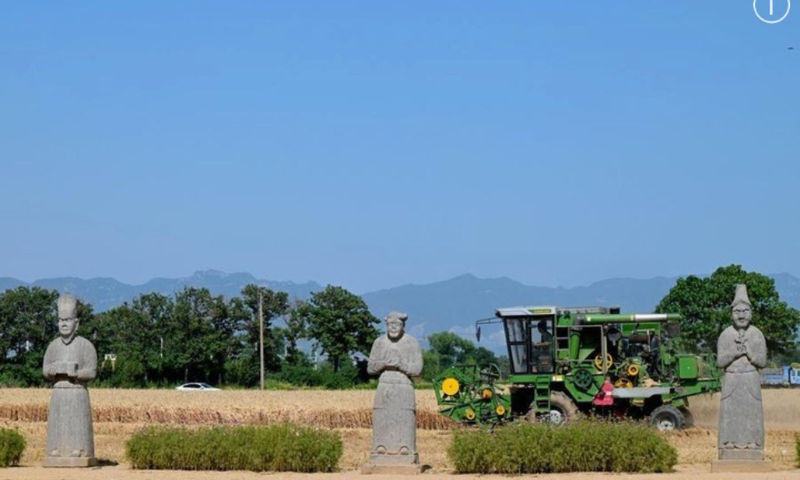
Beijing, June 14,2026: June marks harvest time in Baling Village of Gongyi, located in central China’s Henan Province. Golden wheat carpets the fields, where towering stone statues stand silently and harvesters rumble back and forth.
Carved during the Northern Song Dynasty (960-1127), these statues line the approach to imperial mausoleums near the village. Baling, which literally means Eight Mausoleums, is home to 1,027 surviving stone relics and the site is described as an “open-air museum of ancient sculpture.”
The setting is unusual. Rather than being displayed behind glass in a museum, the statues remain embedded in everyday rural life on fertile farmland shaped by the Yellow River.
“Here across these fields, the history feels tangible. No museum can offer such a unique experience,” said Liang, a tourist from China’s southwestern Sichuan Province.
However, the unusual landscape has also raised questions. Some wonder why the statues are left exposed to the elements rather than being enclosed for protection.
“For centuries, they have braved freezing winters and sweltering summers. Glass casings would block airflow and trap heat, much like a sauna, putting the relics at risk,” explained Zhu Xingli, head of Gongyi’s cultural relics administration.
Preserving the site, from Zhu’s perspective, means maintaining the relationship between the relics and the landscape that has surrounded them for generations.
For amateur photographer Liu Liheng, this coexistence is precisely what makes the site so compelling, as he tries to capture high-speed trains, ancient stone statues and golden wheat fields in a single frame. “It’s a conversation between China’s past and present.”
Baling reflects broader efforts by China to protect its vast cultural heritage pool while keeping it relevant in contemporary life.
The country launched its most recent nationwide cultural heritage survey in 2023. Scheduled to conclude this month, the effort has not only re-examined the roughly 767,000 sites recorded in the previous census but has also identified more than 130,000 additional heritage locations.
Beyond these outdoor stone carvings from the Song Dynasty, a vast number of other cultural relics are preserved in museums in China. The country now has more than 7,000 registered museums, which together hosted around 45,000 exhibitions and attracted 1.56 billion visits in 2025, according to official data.
Saturday marks Cultural and Natural Heritage Day of China. The National Cultural Heritage Administration noted that cultural authorities and institutions nationwide will host over 7,000 online and offline events to mark the occasion.
As the country’s conservation philosophy evolves, heritage protection is extending far beyond museum walls.
Beijing’s Central Axis, a 7.8-kilometer north-south corridor that links many of the capital’s historical landmarks, and one of China’s 60 World Heritage sites, has become a benchmark for balancing heritage conservation and urban growth.
In the Caochang neighborhood, near Tian’anmen Square, restoration projects have preserved historical buildings, including ancient guild halls. Vacant courtyard compounds there have been converted into boutique hotels while remaining integrated into the surrounding residential community.
“We retain the traditional architectural character while introducing modern amenities,” said Hao Dongxue, deputy general manager of Tianjie Group, which manages the restoration project. “These projects have also helped improve the wider neighborhood.”
For residents, the changes have preserved much of the area’s historic atmosphere. “These alleys still feel like traditional Beijing,” said Jiao Shuqin, who lives in one of the hutong neighborhoods there. “The gray brick walls, the old trees and the courtyards are all still here.”
From the stone guardians in wheat fields to restored neighborhoods in the capital, China’s approach to heritage conservation reflects a broader national strategy that seeks to balance preservation with development.
Heritage protection should focus on sustaining spiritual and cultural ties between humanity and heritage, rather than just preserving the past, to serve future generations, said Du Xiaofan, director of the Center for Land and Cultural Resources Research at Fudan University, located in Shanghai in east China.
Courtesy Xinhua